

[For Kids] Indoor Fun! Large-Group Recreational Activities and Games


Spending time with children, indoor fun time is important, isn’t it?
Even when the weather is bad or when you can’t go outside due to coordinating spaces with other classes, kids can refresh and have a fulfilling time if you enjoy doing recreations and games indoors.
Here, we’ve gathered ideas for indoor recreations and games that work well with large groups.
We’ve divided them into activities for preschoolers and for elementary school children, so you’re sure to find ideas that suit the kids who will be playing.
Please use this as a reference!
- Let's play with a big group! A collection of fun children's recreational activities
- Indoor games that different ages can enjoy! Ideas for fun everyone can get excited about together
- [Children’s Club] Easy and fun indoor games. Exciting party games
- [For Kids] Exciting Class-vs-Class Games: Team Competition Activities
- [Childcare] Play Right Now! Recommended No-Prep Games
- Recommended for upper elementary grades! Exciting indoor recreation and games
- Indoor Games for Small Groups: Exciting Recreational Activities
- No worries even in the rain! Fun recreational activities you can do in the gym
- Handkerchief and Towel Play! A Collection of Fun Play Ideas
- Get the party started at the preschool graduation! A collection of party game ideas
- [Elementary School Rec] Recommended Games and Performances for a Fun Party
- February: Liven up childcare! A collection of ideas for indoor play and physical activities
- Indoor games and recreational activities recommended for daycare and kindergarten
[For Kids] Indoor Fun! Large-Group Recreations and Games (41–50)
Cat and Mouse

If you’re looking for a game that lots of people can enjoy, we recommend this Cat and Mouse game.
The rules are very simple—think of it as similar to tag.
Each time the facilitator says “ne,” the cat team and the mouse team each take one step forward.
Once the two teams are at just the right distance, the facilitator calls out either “neko” (cat) or “nezumi” (mouse).
If they say “nezumi,” the cat team chases the mice, and the mouse team tries to reach their home base without being tagged by the cats.
It’s also fun to have the facilitator throw in unrelated words like “nezu-ko,” which slightly increases the difficulty and keeps everyone on their toes.

Hula hoop relay

This is a “hula hoop relay” where everyone lines up in a row, holds hands firmly with the people next to them, and passes a hula hoop from the first person to the last.
From start to finish, hands must remain clasped; you pass the hula hoop to the next person using only body movements, without using your hands.
If anyone lets go, the team is disqualified or must start over.
Try making it a team competition and race against the clock!

Don-janken

This is “Don-Janken,” a game where two teams compete.
The teams line up at opposite ends of a straight line and start moving along the line at the signal.
When a player meets someone from the opposing team, they press both hands together, say “Don!” and then play rock-paper-scissors.
The loser returns to the end of their team’s line, while the winner continues forward along the line.
The team that advances by winning rock-paper-scissors and reaches the opponent’s side first wins.
Tail tag game

When you get tired of regular tag, why not try a tail-grab game? In this version, players tuck a towel—used as a “tail”—into their waistband, and whoever snatches the opponent’s tail wins.
The roles of chaser and chased switch rapidly, so quick reflexes are key.
By the way, this tail-grab game can be played individually or as a team competition.
Choose the format that best fits the kids’ personalities and the size of the group.

cross-handed clap

Cross-hand clapping, where you clap in sync with the leader’s movements.
The leader alternates raising and lowering their left and right hands, and everyone claps when the hands cross.
It’s easy when done slowly, but it gets quite tricky as the tempo speeds up and feints are added.
Adjust the speed to match the children’s ages, and try throwing in a few playful feints to make it more challenging.
Newspaper War

This is a game called “Newspaper Battle,” where you crumple newspaper into balls and throw them to play.
First, make many balls by crumpling sheets of newspaper.
Split into two teams and throw the crumpled newspaper balls into the opponent’s territory.
The rule is to throw the balls one at a time—you must not kick them in with your feet or throw multiple balls at once.
The team that throws the most newspaper balls into the opponent’s side within the time limit wins.
Ball-passing race
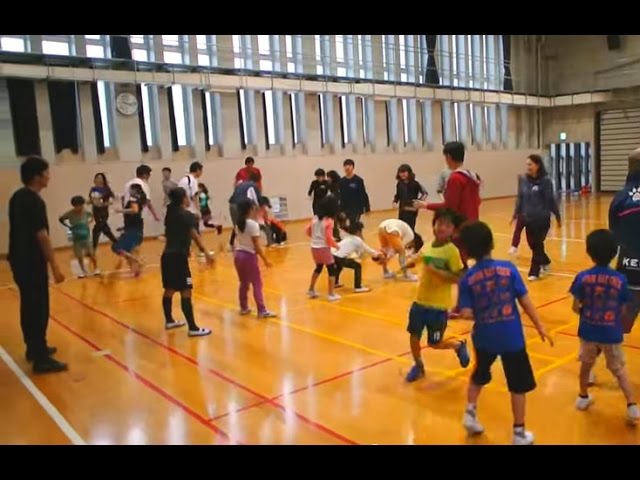
How about trying a game called the Ball Passing Relay, where you pass a ball down the line from the front to the back? It’s fun to simply pass it overhead, so for children around 3 years old, keep the rules simple.
For children around 4 and up, try adding a rule where players alternate passing the ball overhead and then through their legs, so it goes back using an up–down pattern.
After a player passes the ball backward, they run to the end of the line and join the back.
If you’re in a gym, you can go from one end to the other; in a smaller space, try turning around and going back several times to keep it interesting.