

March nursery rhymes & hand play songs! Spring songs you can enjoy with your kids

Are you looking for children’s songs and fingerplay rhymes to sing together with kids in March, as they get ready for graduation ceremonies and moving up to the next class?Songs that let you feel the changing seasons are perfect for creating memories unique to this time of year.Lyrics about springtime flowers and the gentle warmth of the season will naturally resonate with children.In this article, we’ll introduce nursery rhymes and fingerplay songs that are perfect for March.They’re all easy to use not only for activities in daycare and kindergarten, but also at home—so be sure to find your favorites!
- Nursery rhymes to sing in spring: a collection of classic songs you'll want to sing with your children
- [Spring Songs] Masterpieces for Mid-Spring to Listen to in March. Spring Tunes
- Children’s songs for Hinamatsuri: A collection of songs everyone can sing together for the Doll Festival
- [Spring Songs] Classic and Latest Hit Collections Perfect for a Bright, Gentle Spring
- [February Songs] Introducing children's songs, folk songs, nursery rhymes, and hand-play songs about Setsubun and winter!
- Nursery rhymes perfect for April: A collection of classic spring songs that capture the season
- [For Seniors] Spring Songs You'll Want to Hum: Feel the Season with Nostalgic Classics
- [Hand Play] Popular with kids! A collection of trendy hand-play songs and nostalgic traditional children’s songs
- [Songs to Listen to in March] Classic Spring Tracks and Moving Songs About Meetings and Partings
- [For Seniors] Classic spring songs to sing in April: A heartwarming moment with nostalgic children’s songs and kayōkyoku (Japanese popular songs)
- Collection of winter nursery rhymes, folk songs, and children's songs. Includes fun winter hand-play songs too.
- Recommended for preschool recitals! Choral songs that 3-year-olds can adorably sing
- A spring song with great lyrics. A lovely message that touches the heart.
March nursery rhymes & hand play songs! Spring songs to enjoy with children (21–30)
Cute Hide and SeekSakushi: Satou Hachirou/Sakkyoku: Nakata Yoshinao

Just imagining little chicks, sparrows, and puppies playing in the yard or on the roof is heartwarming, isn’t it? Even when they think they’re hiding, you can glimpse a bit of a yellow foot or a brown head—this nursery song depicts such charming scenes.
With lyrics by Hachiro Sato and music by Yoshinao Nakata, its rhythmic flow captivates children and doesn’t let go.
After it was broadcast on an NHK radio program in January 1951, it spread across the country in no time.
Its contributions through record production and more were recognized with the Minister of Education Award at the 1952 Art Encouragement Prizes, showing just how big the response was at the time.
It’s also a staple as a hand-play song where you move your body along with the lyrics.
On a warm spring day, try singing it with your child, as if you’re playing hide-and-seek.
Song of a Little BirdKato Ichika / Kinjo Narumi

A charming song that everyone can enjoy by mimicking the chirps that herald the arrival of spring.
It depicts little birds calling for their mothers and fathers with song, and their endearing presence warms the heart.
If you shape a beak with your hands and move them to the rhythm, you can play as if you’ve become a little bird yourself.
This children’s song is performed by Ichika Kato and Narumi Kinjo, popular on the educational YouTube channel, and is included on albums such as “BonBon Academy: Songs of Spring,” to be released in April 2025.
Long cherished at BonBon Academy, operated by Kodansha, this song is perfect for March, when children graduate from preschool or move up a grade, and for parents and kids heading out on a springtime stroll.
Humming it under the warm sunshine will make children’s smiles shine even brighter.
Close It, Open Itsakushisha fushou

In dazzlingly fresh May greenery, don’t you feel like getting active and playing with the kids? That’s when the perfect choice is that familiar hand-play song with the motions of opening and closing your hands.
Simple yet irresistibly engaging for children, its melody is actually said to have its roots in an opera by the French thinker Jean-Jacques Rousseau.
In Japan, it became widely loved in its current form as a play song after being included in the May 1947 elementary school textbook First-Grade Music.
Its easy-to-remember rhythm and movements are also great for interacting with very young children who can’t speak yet.
How about trying it outdoors on a picnic, sitting face-to-face and playing together as parent and child?
FlowerSato Hitomi

This song paints an elegant and beautiful Japanese scene—like watching a gently flowing river and rows of cherry trees in full bloom under the soft spring sunlight.
Released in November 1900 (Meiji 33) by Rentaro Taki as part of the song collection “Shiki” (Four Seasons), it has been cherished by many across generations.
Hitomi Sato, together with her puppet companions, presents it with gentle piano and vocals so that even difficult words are easy for children to understand.
If you sing while imagining the lovely imagery in the lyrics—such as the spring riverside and the hazy moon at dusk—your heart will feel warm and cozy.
It’s a perfect tune for parents and children to hum together during March’s Hinamatsuri, the preschool graduation season, or while strolling along the riverside for cherry-blossom viewing.
Be sure to sing it with your child as you feel the arrival of spring.
When spring comesFukuda Sho

This is a delightful children’s song that invites kids to move their bodies as if they’ve become the flowers and creatures discovered in spring, all under the warm sunshine.
Centered on the theme of springtime nature, it’s widely loved in early childhood settings as an expressive play activity where children enjoy gestures that match the lyrics.
Released in May 2017 and included in the CD book “Chotto Dake Taisou ~Hoick CD Book~,” the piece was created by Sho Fukuda, a former nursery teacher and children’s song writer.
Its major appeal lies in not only following set movements, but also incorporating children’s ideas—changing the lyrics or choosing poses freely.
It’s perfect for introducing a class activity to explore spring together, or for parents and children to play before a walk—an ideal song for savoring the arrival of spring with the whole body while expanding the imagination.
The flower smiled.Sakushi: Hotomi Kōgo / Sakkyoku: Yuyama Akira

This is a very cute song.
Just singing it might make you feel energized.
Since similar lyrics are repeated, your child will remember it quickly after hearing it once.
Try singing this song while looking for flowers that bloom in spring.

Mysterious PocketSakushi: Mado Michio / Sakkyoku: Watanabe Shigeru
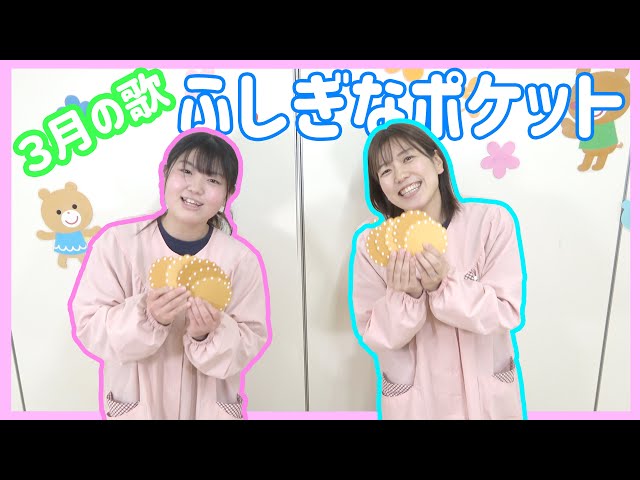
This work depicts the kind of innocent daydreams unique to children, where sweet treats multiply in a pocket as if by magic.
The song, created by poet Michio Mado and composer Shigeru Watanabe, was published in a magazine in September 1954 and remains enduringly popular today.
The fun of the number increasing with each playful “pop” or clap has also made it a staple as a hand game song.
It has been passed down in various forms, including being featured on anime-related albums such as “Selfish Fairy Mirmo! Fairy Concert: Let’s All Sing Children’s Songs Festival.” If you sing it during a field trip under the warm spring sunshine, or at snack time in March, you’re sure to see a lot more smiles from the children.