

[For Seniors] Fun and Engaging Recreational Activities in Nursing Homes

In this article, we introduce lively recreational activities for seniors to enjoy at day service centers and other care facilities!
Facilities offer many different types of activities every day.
We’ve gathered a wide variety—from ones that are great for lively group fun to those enjoyable for individuals or small groups—so please use this as a reference when you’re wondering, “What should we do today?”
Many activities can be enjoyed while seated, so everyone can participate and have fun together.
It can also be interesting to change the rules or add your own twists depending on the facility!
- [For Seniors] Simple Recreational Activities You Can Enjoy While Seated
- [For Seniors] Simple Tabletop Games: Fun and Engaging Recreational Activities
- [For Seniors] Easy and fun seated activities you can do in your room
- [For Seniors] Introducing Recreational Activities Anyone Can Enjoy at Geriatric Health Facilities!
- [For Seniors] Exciting Team-Based Recreational Activities
- Entertainment and Performances That Delight at Day Services for the Elderly
- [For Seniors] Recreational activities and games that let you have fun while strengthening your legs
- For Seniors: Fun and Lively Exercise Recreation
- [November Health Topic] Indoor Recreation Ideas for Older Adults
- For Seniors: Fun Entertainment That Excites at Nursing Homes
- [For Seniors] Today’s Recommended Activity: Fun and Engaging
- [Easy to Start!] Simple Recreational Activities to Enjoy in Nursing Homes
- [For Seniors] Fun Brain Training! Lively Whiteboard Activities
[For Seniors] Fun, Lively Recreational Activities in Nursing Homes (101–110)
Red pajamas, blue pajamas, yellow pajamas.
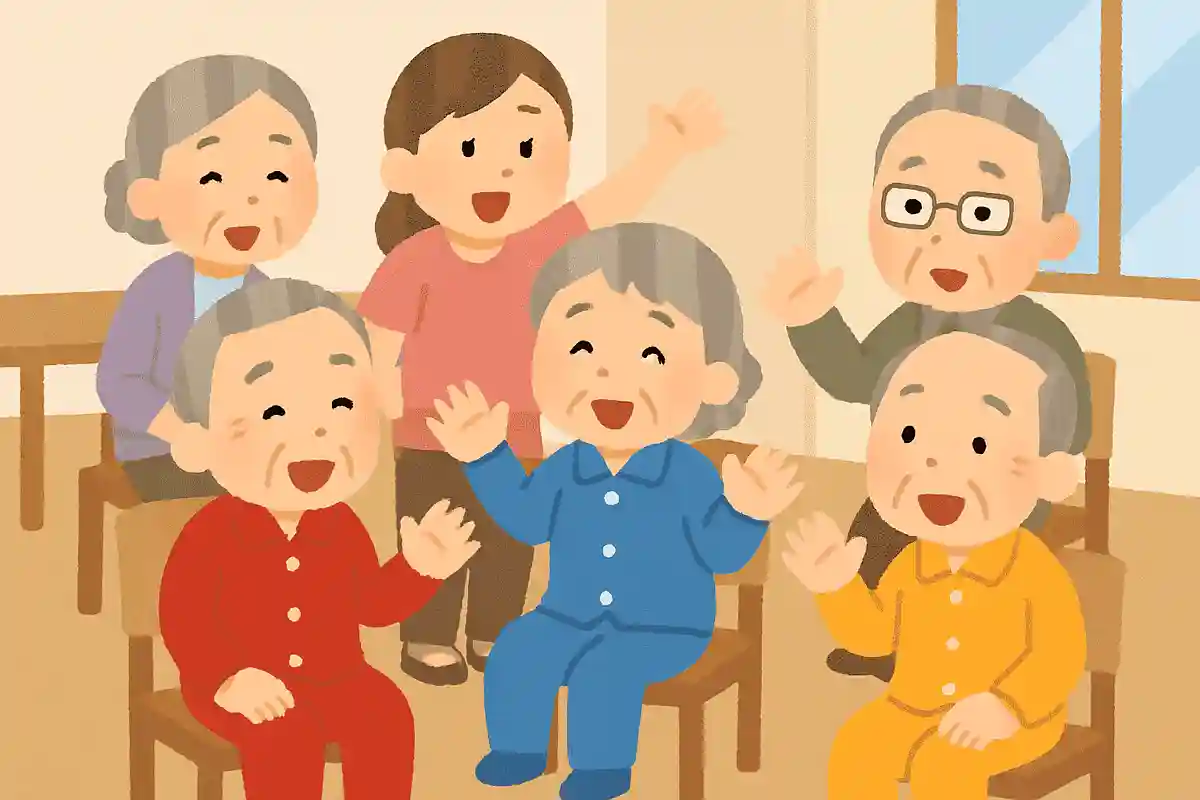
Arranging red, blue, and yellow at the start of words is also a classic pattern in tongue twisters.
“Aka” (red) and “ao” (blue) are sounds that require opening the mouth wide, so if you attach them to phrases with fine movements, the difficulty of the tongue twister increases.
Sounds like “pa” and “ma” are hard to pronounce without first closing the lips, so be mindful of that.
By carefully pronouncing each sound one by one at first, you’ll understand how to move your lips.
If you move your mouth deliberately and gradually increase your speed, your mouth movements will become smoother and you’ll likely strengthen those muscles as well.

The customer next door is a customer who often eats persimmons.
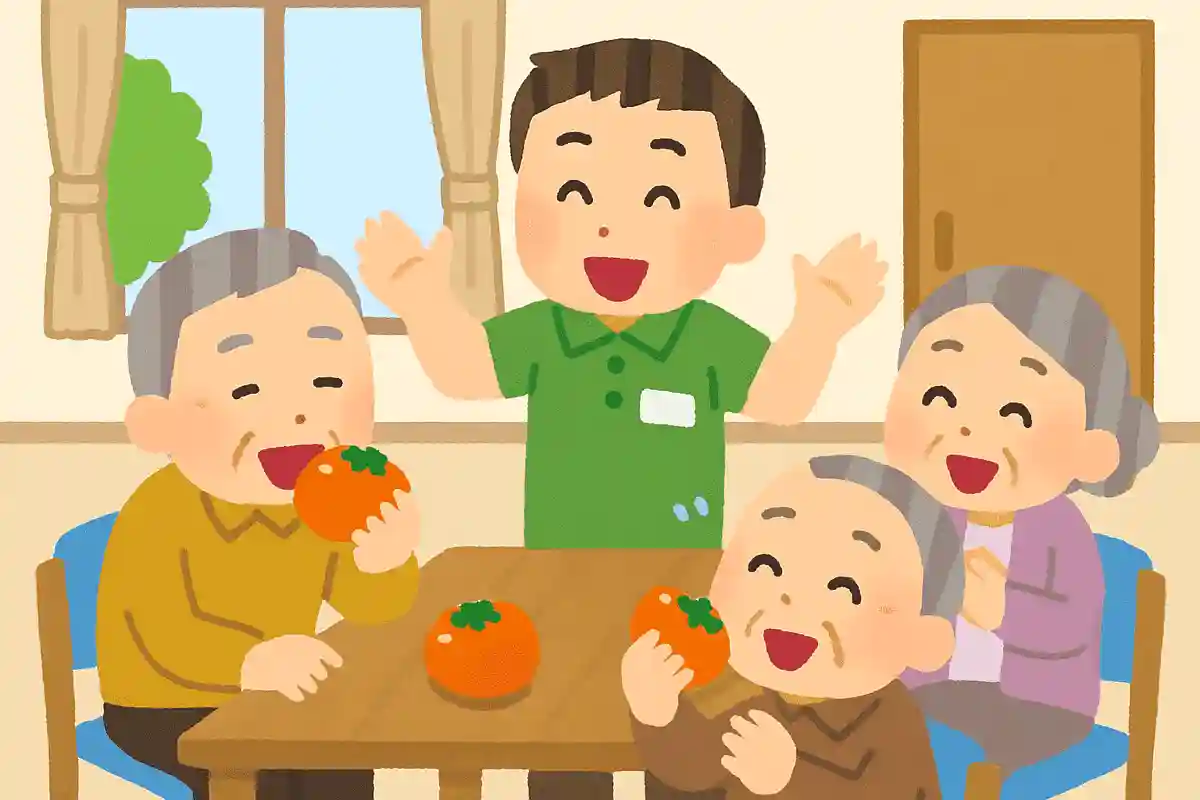
It’s one of the classic tongue twisters in Japan, and it evokes a rakugo-like world.
The key here is probably the pronunciation of “kyaku” and “kaki.” If you try pronouncing it syllable by syllable, you’ll realize that not only the movements of the lips and tongue matter, but the opening and closing of the teeth as well.
Another point to focus on is how you use your breath while moving your lips and teeth during pronunciation.
Overall, it’s a phrase that really engages the muscles around the mouth, making it a perfect tongue twister for training.
365-Step March Exercise

This is about moving your body energetically to the rhythm of Kiyoko Suizenji’s song “365-Step March.” By matching the powerful yet steady tempo characteristic of a march, you can put real strength into the exercises.
The routine mainly involves moving the upper body while seated in a chair, and by keeping proper posture in mind, it can lead to a full-body workout.
Incorporating steps and hand claps, and even singing along as you go, will make it more enjoyable to move—highly recommended.
Three-letter shiritori

What’s the very first game you remember learning as a child? Tag, rock-paper-scissors, and of course some might say shiritori.
Let’s spice things up with a twist—not just regular shiritori, but “three-letter shiritori.” Writing answers on a whiteboard takes a bit more time, but seeing each person’s handwriting and simple doodles can spark all kinds of conversation.
Plus, using your hands makes it a nice brain workout.
If you have a whiteboard, you can also enjoy illustrated shiritori just as it is.
AIUEO Puzzle

“Though the blossoms are fragrant, they soon will fall—who in this world can claim to be unchanging? Ui no…” Yes, that’s the famous Iroha poem.
Isn’t it almost a miracle that such a beautiful poem could be composed using each of the 50 kana exactly once, with no repetition? Records say it was created around the 10th century, but the author is unknown.
Still, they must have been remarkably brilliant.
Let’s spend some fun time with a similar game, the “50-syllable elimination game.” Write the 50 kana on a whiteboard and make as many words as you can.
Each time you use a hiragana character, erase it.
The goal is to use all 50 characters.
I’ve heard that few people manage to complete it, so join forces and aim for the goal together!
[For Seniors] Lively Recreational Activities to Enjoy at Nursing Homes (111–120)
Shoo Away Game

Let’s play a fun game using balls made from crumpled paper.
It’s called the “Shoo-It-Away Game.” Crumple up sheets of paper or newspaper into balls and place them in a horizontal line in the center of the table.
Before you start, put a strip of tape across the middle of the table to mark the center line.
This tape divides the table into your side and your opponent’s side.
When the game begins, use your hands to push the paper balls into your opponent’s territory on the opposite side.
The rules are simple, but it sounds like it could get exciting.
If you make the paper balls pink, they’ll look like cherry blossoms—perfect for an April game.
It also encourages conversation among participants and can help promote communication among older adults.

Arunashi quiz

As a whiteboard activity and brain training, we recommend the “Yes/No Quiz.” You list words under two columns, “Yes” and “No.” The words in the “Yes” column share a common trait, while the ones in the “No” column don’t fit that criterion.
Participants write out words and try to figure out what the common trait is.
You can either list many examples at once, or reveal one “Yes” and one “No” at a time so the hints gradually increase.
All you need is a whiteboard to play—no extra materials—so it’s an easy, accessible activity.
