




Have you ever wanted to sing Yutaka Ozaki’s songs at karaoke but hesitated because they seem high in key? In fact, the vocal range varies from song to song, and even well-known tracks like “Sotsugyo” can be sung comfortably once you get the hang of them.
In this article, we’ve selected songs by Yutaka Ozaki that are relatively lower in key or have easy-to-follow melodies, making them easier to sing.
Use this as a guide when choosing your next karaoke setlist!
- Karaoke Ranking of Popular Songs by Yutaka Ozaki [2026]
- For Men in Their 50s: No Worries If You’re Tone-Deaf! A Curated Selection of Easy-to-Sing Karaoke Songs
- [Even If You're Tone-Deaf, It's Okay!] Easy-to-Sing Karaoke Songs and Practice Tracks
- Karaoke songs recommended for men with low voices or who are good at singing in a low register
- Even karaoke beginners can relax! Easy-to-sing songs for men
- Karaoke songs where even men with low voices can aim for high scores
- Karaoke songs that are easy to sing and recommended for men of the Yutori generation
- [Karaoke] Kenshi Yonezu’s easy-to-sing songs: Vocal range you can handle without strain
- A collection of easy-to-sing Kobukuro songs: tracks that even those who aren’t confident singers can try
- Now karaoke isn’t scary! Easy-to-sing songs recommended for the Yutori generation
- Tsuyoshi Nagabuchi’s easy-to-sing songs: Recommended tracks for karaoke
- A must-see for Gen Z men! Easy-to-sing songs by male artists for karaoke
- [Enka] Songs That Are Easy to Sing Even for the Tone-Deaf [Male Singer Edition]
Singable songs by Yutaka Ozaki. Songs you want to belt out at karaoke (1–10)
Two HeartsOzaki Yutaka

This is a track from the final original album, “Proof Toward Radiant Heat,” released in May 1992.
It’s a gentle ballad that sings of the bond with a loved one and the strong connection between two people who accept each other as they are, featuring lyrics that seem to heal a lonely heart.
The song is accompanied by piano throughout, with Ozaki’s passionate vocals resounding.
When you sing it, don’t rush—stay calm and follow the lyrics word by word.
In the chorus where you need to belt, forcing it from your throat is dangerous, so try projecting your voice powerfully as if aiming into the distance.

Scrap AlleyOzaki Yutaka

It’s themed around a classmate who dropped out of school, and the title is said to be the name of the biker gang his friend was involved with.
“Scrap Alley” existed even before Ozaki’s debut and was one of his early signature songs, performed at the 1982 audition.
It’s a beloved classic for Ozaki fans, as it was the last song he performed at his final live concert in 1991.
The song itself moves along within a similar vocal range throughout, and as you can see in the videos, it feels like Ozaki himself is really enjoying singing it, using his whole body.
Using your body well also helps you relax, so I recommend it.
Try singing it while imitating him.
I’ll surely never forgetOzaki Yutaka

After his return, the work expresses Yutaka Ozaki’s mature view of love and his compassion for humanity, characterized by a dramatic sound featuring piano and strings.
It’s a track included on the album “Tanjou” (Birth), released in October 1990—a ballad themed around bittersweet love and parting, and memories of the past—singing of the feelings of etching memories with a loved one deeply into the heart.
It’s one of his masterpieces that enjoys enduring popularity among devoted fans.
The melody line is very simple, and if you follow the lyrics straightforwardly, it’s structured so that it’s not difficult to sing.
I think the vocal range is relatively moderate compared to Ozaki’s other songs.
If you accent the chorus sections when you sing, it will add good dynamics and contrast.
Donut ShopOzaki Yutaka

It starts with a mellow intro and is set in a donut shop in the city suburbs, giving the song a mature atmosphere that evokes loneliness and emptiness.
The track is on the longer side at 5 minutes 43 seconds, and there’s a spoken section in the latter half, so the key is whether you can sing confidently all the way through like Mr.
Ozaki without getting shy.
When you sing, if you pay close attention to the accents at the beginning of each phrase, it will add contrast, making it easier to sing and easier to listen to.
The range shouldn’t be that high, so if you lift your facial muscles, your throat will naturally open up and you should find it easier to project your voice.
Lost 1/2Ozaki Yutaka

It’s a positive song that powerfully voices the contradictions of society and the loss of innocence over a driving band sound.
The overall vocal range is D3–G4, and according to JOYSOUND karaoke info, the key is set slightly higher at +2; if you want to sing in the original key, please press “Original Key Transfer.” When singing, the range gradually rises and the energy builds from around the pre-chorus, so be careful not to overstrain your voice.
The melody line isn’t difficult and has a lot of repetition, so once you learn the first verse, you should be able to sing the full song right away.
Distant SkyOzaki Yutaka
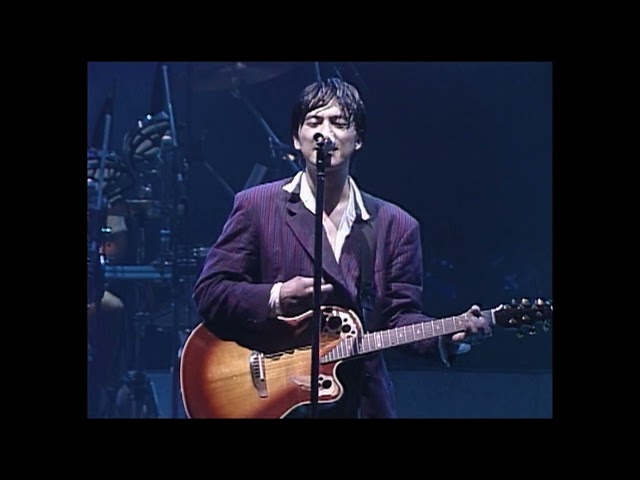
It’s striking how it’s arranged in an acoustic guitar singer-songwriter style, with the harmonica used to great effect.
It’s said that fragments of the lyrics were written during the 1986 stay in the U.S.
or during the subsequent detention, and the work blends the stifling atmosphere of that time with hope for the future.
“Tooi Sora” has relatively few lyrics, the chorus repeats phrases often, and the melody line is easy to remember.
If you sing the chorus with clear accents, it’s easier to project your voice and you’ll likely find it comfortable to sing.
Also, it might be good to sing it powerfully while moving with the groove.
COOKIEOzaki Yutaka

A staple of live shows characterized by vocals and a band sound full of energy that are so typical of Yutaka Ozaki, it was performed at the concert held at Yoyogi National Gymnasium (Olympic Pool No.
1) on October 25, 1991.
The song itself is on the longer side at 6 minutes 31 seconds, with a relaxed tempo that makes it easy to sing along with the rhythm.
The melody line is very simple, and the chorus really sticks in your head.
The rhythm is steady throughout, so you can keep the same groove from the start.
Try enjoying it while moving with the beat as you sing.