

[Piano] Piano Accompaniment Patterns | A selection of arrangements useful for adding accompaniment and for piano-vocal performance


When adding accompaniment to a melody or doing piano-vocal performances while reading a chord chart, the element that has the biggest impact on the final result is the accompaniment pattern! For beginners, it’s important to get used to simple approaches like root note + melody or chords + melody.
But once you can switch between chords smoothly, you’ll probably want to try arrangements that sound a bit more lush, right? In this article, we’ve picked out several recommended accompaniment patterns that will take your accompaniment and piano-vocal playing up a notch.
They’re not overly complex, yet they all deliver solid musical impact—perfect references for your piano accompaniment.
- How to play piano accompaniment using simple chords
- Tips for increasing your piano playing techniques
- For piano beginners: an easy-to-understand way to practice chord changes
- [Piano Accompaniment Score] A curated selection of recommended sheet music for popular sing-and-play songs!
- How can a beginner pianist learn to play chords easily?
- I want to sing and play the piano! How to use auto-accompaniment features and melody sheets with chord symbols
- A must-see for anyone who wants to try piano-and-vocal performances through code! From nostalgic oldies to the latest hits, all introduced at once.
- [Beginner] Recommended for adult piano beginners! Beautiful & stylish piano pieces
- [For Piano Beginners] Let's learn useful chords!
- It’s so cool if you can play these on the piano! A selection of irresistibly charming masterpieces.
- [Piano/vocal] Super cool! Recommended songs you can breeze through
- [Christmas Songs] Christmas songs you can play on the piano. A comprehensive introduction along with recommended sheet music!
- [For Piano Beginners] Play Right Now with Free Sheet Music! A Roundup of Recommended Practice Pieces
[Piano] Piano Accompaniment Patterns | A selection of arrangements useful for adding accompaniment and for singing while playing (11–20)
Four-on-the-floor

The “four-on-the-floor” pattern that can be used for root strumming and chordal accompaniment.
Four-on-the-floor means chopping the chords in time with the meter, and it’s called this because it’s mainly in quarter notes.
When you’re not yet comfortable with chords, you may be doing all you can just to hold a chord and play or sing the melody with a single sustained strum, but switching to four-on-the-floor creates a sense of pulse and helps stabilize the tempo, allowing you to perform the piece more smoothly.
It’s one of the simplest and most approachable accompaniment arrangements, so give it a try.

Octave tremolo

If you’ve gotten to the point where you can quickly identify the root note by reading the score, try turning the root into an octave tremolo to add range to your accompaniment pattern! A tremolo is a technique where two different notes are repeated in quick alternation.
In classical works, when tremolo is indicated, the number of repetitions isn’t specifically fixed; however, when incorporating it into accompaniment, it’s recommended to set it to quarter notes, eighth notes, or sixteenth notes so it’s easier to maintain a steady sense of pulse.
If you’re not fully confident in identifying all the chord tones but you do understand the root note, go ahead and give it a try!
Syncopation + chords

“Syncopation” refers to disrupting the natural pattern of strong and weak beats.
For example, in a meter that normally goes “strong-weak-strong-weak,” if you tie the weak second beat to the strong third beat, the emphasis shifts to the second beat, changing the feel to “strong-strong-resonance-weak.” Syncopation adds a nice accent to piano accompaniment, and when combined with chords it creates an even more impactful backing.
If you’re comfortable with chord playing and using both hands, give it a try.
A Part of Code + Melody
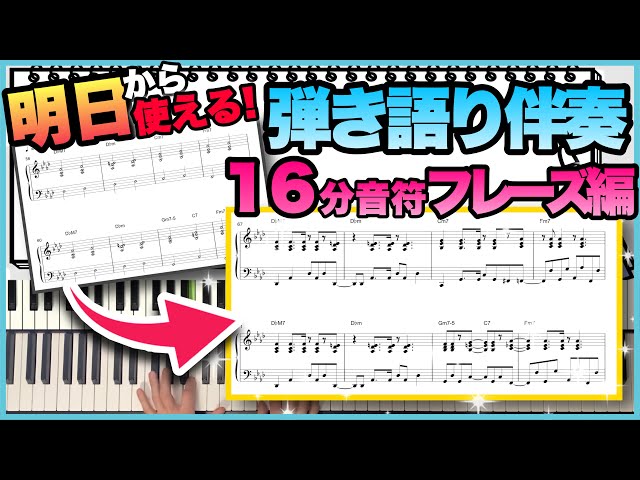
An accompaniment pattern that blends chords with fragments of the melody is perfect for a gentle, ballad-style sing-and-play performance.
Hold a chord with a strum-like sustain and sing, then trace parts of the melody on the piano to intertwine with your vocal, and you’ll get a polished sing-and-play rendition.
This accompaniment is a fairly advanced arrangement that can be a bit challenging unless you have a solid grasp of both the melody and the chords, but if you can add piano like an obbligato while singing your favorite ballad, it will be truly fulfilling.
Leap

The accompaniment pattern where you play the root note and then “leap” to a higher chord is recommended for those comfortable with two-hand playing.
It isn’t very difficult if the tempo is slow, but in up-tempo pieces, it’s hard to land accurately unless your hands are familiar with the distances.
Although it’s a simple broken-chord shape, you can’t focus only on the left hand in two-hand playing, so practice getting used to the leap widths first, then add the melody.
If you’re doing accompaniment with both hands while singing, it’s easier to incorporate this leaping pattern because you can divide the roles—left hand for the root note and right hand for the chord.
In conclusion
This time, we introduced relatively simple piano accompaniment patterns, from basic ones to more dynamic styles. By switching between them within a piece or mixing multiple patterns, you can greatly expand your arranging possibilities. Enjoy exploring how the accompaniment transforms the music, and have fun trying out different accompaniment styles!