

[Piano] Piano Accompaniment Patterns | A selection of arrangements useful for adding accompaniment and for piano-vocal performance
When adding accompaniment to a melody or doing piano-vocal performances while reading a chord chart, the element that has the biggest impact on the final result is the accompaniment pattern! For beginners, it’s important to get used to simple approaches like root note + melody or chords + melody.
But once you can switch between chords smoothly, you’ll probably want to try arrangements that sound a bit more lush, right? In this article, we’ve picked out several recommended accompaniment patterns that will take your accompaniment and piano-vocal playing up a notch.
They’re not overly complex, yet they all deliver solid musical impact—perfect references for your piano accompaniment.
Playlist
| [Piano] Piano Accompaniment Patterns | A selection of arrangements useful for adding accompaniment and for piano-vocal performance | |||
|---|---|---|---|
| show_chart | Title | Playlist | Review |
| 1east | Waltz Variations |  play_arrow play_arrow | In triple meter accompaniment, the classic pattern is a combination of bass and chords. |
| 2east | Alberti bass |  play_arrow play_arrow | Description and examples of using Alberti bass |
| 3east | Root note + perfect fifth |  play_arrow play_arrow | Add depth to the accompaniment by adding the fifth to the root note |
| 4east | Bossa nova style |  play_arrow play_arrow | Changing the accompaniment pattern to alter the flavor is an effective arrangement. |
| 5east | Off-beat backing |  play_arrow play_arrow | Craft accompaniment arrangements using offbeat jazz comping |
| 6east | root picking |  play_arrow play_arrow | Basics and Practice Methods for Root Playing for Beginner Pianists |
| 7east | Code Sonata |  play_arrow play_arrow | Chord playing is an accompaniment method that involves holding down chords. |
| 8east | Arpeggio (descending form) |  play_arrow play_arrow | Arpeggios are more stable in the ascending form. |
| 9east | Add rhythm to code performance |  play_arrow play_arrow | Add rhythm to the chord and arrange the accompaniment |
| 10east | Double stops + arpeggio |  play_arrow play_arrow | Double stop: sounding two notes simultaneously |
| 11east | 16-beat | play_arrow | A 16-beat is a fine-grained rhythm based on sixteenth notes. |
| 12east | Arpeggios (ascending + descending) | play_arrow | Rich piano accompaniment with an arpeggio mix |
| 13east | Arpeggio (ascending form) | play_arrow | Playing the chords in sequence creates rhythm in the accompaniment. |
| 14east | 8-beat | play_arrow | Add movement to the rhythm with eighth-note pulses |
| 15east | Four-on-the-floor |  play_arrow play_arrow | An arranging method that marks the chords in quarter notes |
| 16east | Octave tremolo |  play_arrow play_arrow | Incorporate the root note with tremolo into the accompaniment pattern |
| 17east | Syncopation + chords | play_arrow | Disrupt the strong-weak pattern with syncopation |
| 18east | A Part of Code + Melody | 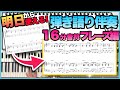 play_arrow play_arrow | Advanced accompaniment with chords and melody |
| 19east | Leap |  play_arrow play_arrow | The jump accompaniment suits two-handed playing; add the melody after practice. |