

![[Explained by a piano teacher] Let's play back number's Christmas song!](https://media.ragnet.co.jp/img/1200__jpg__https://www.ragnet.co.jp/files/2018/12/482046095e4fc304fe79c2b8d447f9df.webp)
[Explained by a piano teacher] Let's play back number's Christmas song!

Back when I was a student, there were hardly any piano schools that taught chords.
ClassicSo perhaps it was thought that you didn’t need to study code.
Code is, of course, helpful when playing rock or jazz, but in fact it also helps you gain a better understanding of classical music.
This time, I’d like to provide an explanation along with example tracks.
How do you use the three types of chords in actual songs?
These days there are many books for learning piano chords, but it seems many people still don’t know how to play them within the songs they actually want to perform.
There isn’t only one way to finger chords on the piano.
before / previously / formerly / earlier / in the pastAs I mentioned, there are ways to finger chords such as root position, first inversion, and second inversion.
It's just like how there are various ways to finger guitar chords.
The three types—root position, first inversion, and second inversion—are mainly used when playing chords with one hand, and in piano solo settings they’re often played in these shapes. However, when you’re playing in a band as a keyboardist or doing a sing-along and not playing the melody, it’s also common to voice the chords with both hands.
This is what’s known as an open chord (open voicing) shape.
In other words, if it says C, you can play any voicing that uses the notes C, E, and G.
In practice, you also need to consider things like the order to make it sound nice, though...
Even so, when beginners play an easy piano solo, they’ll often end up playing just the chords with the left hand. So first, learn the three types: root position, first inversion, and second inversion (there are four types if it’s a seventh chord).
You can’t use code just by memorizing it!
The position where you play the chords sounds best when it includes middle C on the piano, but it’s not an absolute rule.
Whether to use root position or first inversion depends on the sound, but first choose the one that’s easier to play in context (before and after).
Of course, just because the initial code was in the basic form doesn’t mean the next one will be as well, so it’s important to know how to change the code.
Please refer to the following article for how to make the change.
Related articles:For piano beginners: an easy-to-understand way to practice chord changes
Let's try playing back number's 'Christmas Song'!
back numberLet's think about the chords that appear in Christmas songs.
back number’s “Christmas Song” is a popular track every year during the Christmas season.
Many of you are probably thinking about doing a singing-with-guitar performance for Christmas, aren't you?
Everyone has their own way of holding down the strings, but I think about positions that make chord changes easier.
Below is the chord progression that appears in back number’s “Christmas Song.”
Here, E is in first inversion, B and C#m are in second inversion, and F# is in first inversion, but try figuring out positions you can fret in nearby positions on your own.
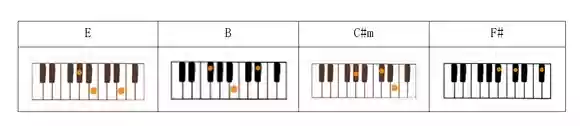
I’ve published the MIDI videos, so please use these practice MIDI video examples for reference: a “piano solo” where you hold the chords with your left hand, and a “singing with accompaniment” style where you hold the chords with your right hand.
Christmas Song (for Piano Solo Practice)
Christmas Song (for solo vocal-and-guitar practice)
Christmas song (E) chord keyboard diagram
Chord changes of Motohiro Hata’s “Himawari no Yakusoku”
I'll explain one more song.
Motohiro Hata“Himawari no Yakusoku” has long been a popular song, and in this chord progression as well, we try to keep the movement as minimal as possible.
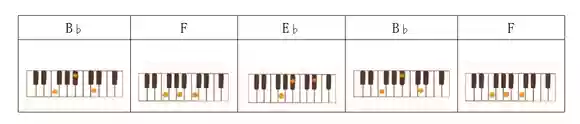
Here, B♭ is in second inversion, F is in root position, and E♭ is in first inversion.
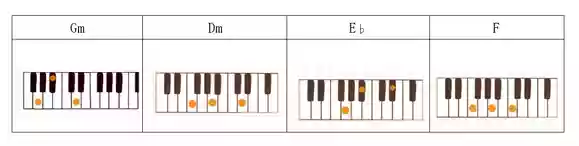
G minor is in root position, D minor is in second inversion, E-flat is in first inversion, and F is in root position.
Even if the same chord appears again elsewhere in the same song, it doesn’t necessarily have to be fingered exactly the same way, so you should be careful. That said, for beginners, deciding on a fingering to use consistently within a single song isn’t a bad idea for learning.
How do you finger four-note chords like 〇m7 or 〇7?
As you play through a piece, you may come across notations like ○m7, ○7, or ○dim7.
In this case, it consists of four notes, but at first it’s fine to play C7 as C and B♭7 as B♭ instead.
If possible, it would be good to be able to interpret the V in that key as a V7.
The Christmas song is in the key of E, so B7 is the V7; 'Himawari no Yakusoku' is in B-flat, so F7 is the V7.
In the key of C, the V7 is G7.
For more details about things like V7, see the previous article.
Related articles:How can a beginner pianist learn to play chords easily?
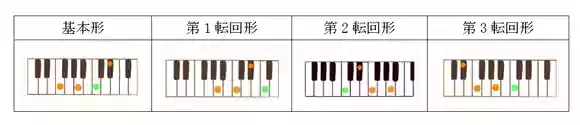
For F7, you would finger it as shown below, but for four-note voicings, it’s common to leave out the third (shown in yellow-green in the diagram) when you play it.
With a lead sheet (melody with chord symbols), once you can play the left hand, the next step is the right hand (the melody). However, to play with both hands, fingering is crucial above all.
If you're only using one hand, it's fine to play with just your index finger.
Since you only have five fingers, plan ahead before practicing: decide where to 'pass through,' where to 'spread,' and where to 'jump (shift).'
This is an article about past finger usage.
Related articles:Basic fingerings for piano beginners
You can download the chord chart used for “Himawari no Yakusoku” from the site below.
Himawari no Yakusoku – Chord Chart B♭
Himawari no Yakusoku - Chord Chart C
This is a practice video of “Himawari no Yakusoku” (piano MIDI).
Promise of the Sunflower (B♭)
Himawari no Yakusoku (C)
There are some parts that are not fixed in a specific code format, but please use this as a reference.
In conclusion
At the beginning, I mentioned using just triads for now, but in jazz the 7th is essential. For example, with C7 (“C–E–G–B♭”), what you actually play might be something like “root (C) and 7 (B♭),” or “3–(13)–7–9: E–A–B♭–D,” or “7–(9)–3–13: B♭–D–E–A.” In other words, you voice tensions while including the 3rd and 7th. So if you want to play jazz, I recommend practicing these kinds of voicings from the start.