

[Ultra-Advanced] Even challenging for advanced players! A curated selection of highly difficult piano pieces


The piano is an instrument that allows a single performer to play an enormous number of notes while skillfully using delicate motor skills in the fingertips and arms, interpreting the composer’s intent along with the notated instructions, and expressing the pianist’s own sensibilities.
There are many pieces that call for beautiful, nuanced expression, as well as passionate works where the keys are struck almost like a percussion instrument.
This time, we’ve selected and will introduce pieces from among the vast piano repertoire that are said to be difficult even for advanced players and professionals.
We’ve picked everything from famous works generally regarded as challenging to lesser-known pieces that may not dazzle in performance but are extraordinarily difficult.
Be sure to check them out!
- It’s so cool if you can play these on the piano! A selection of irresistibly charming masterpieces.
- [Masterpiece Classics] A special showcase of gem-like masterpieces so beautiful they’ll move you to tears
- Recommended for advanced players: Classical masterpieces to challenge at a piano recital
- For Advanced Players: Showstopping Classics to Play at a Piano Recital
- Rachmaninoff’s masterpieces. Recommended pieces by Rachmaninoff.
- Cool classical masterpieces. Recommended classical music.
- Piano Masterpieces: Surprisingly Easy Despite Sounding Difficult!? A Curated Selection Perfect for Recitals
- Classical piano masterpieces: legendary performances from around the world you should hear at least once
- Timelessly beautiful classical masterpieces. Recommended classical music.
- Beginner to Intermediate: Chopin pieces with relatively low difficulty. Recommended works by Chopin.
- François Couperin Popular Songs Ranking [2026]
- [Obituary] Hôko (Hiroko) Nakamura Passes Away: A Collection of Quotes from the International Pianist
- A masterpiece by Franz Liszt. Popular classical music.
[Ultra-Advanced] Even challenging for advanced players! A curated selection of highly difficult piano pieces (21–30)
Gaspard de la nuit, No. 3: ScarboMaurice Ravel

The masterpiece Gaspard de la nuit by the great French composer Maurice Ravel is an exquisitely beautiful work based on three poems.
I believe its difficulty lies above all in expression.
Of course, it is also technically demanding; in particular, the third piece, Scarbo, requires a level of virtuosity that Ravel himself said surpassed Balakirev’s Islamey.
But beyond that, simply playing the notes does not make it true music—you must perform it with a firm understanding of the work’s deeper intent.
It is therefore a piece of exceptionally high difficulty if you aim to sustain a high level of expressiveness while playing.
It also readily reflects the individual characteristics of each performer, so I encourage you to compare multiple interpretations.

Study No. 7 for Player PianoConlon Nancarrow

This Etude No.
7 for Player Piano is a work composed by Conlon Nancarrow, a contemporary music composer from Mexico.
It’s extremely obscure, so many of you may be hearing it for the first time.
Initially, performances were limited to a rapid-fire delivery that gradually increased in speed, but over time it was arranged into even more difficult renditions.
The most challenging aspect of this piece is undoubtedly its rhythm.
The rhythmic subdivisions are so intricate that it is said to be impossible for a human to perform—hence the use of a player piano.
[Ultra-Advanced] Even challenging for advanced players! A curated selection of highly difficult piano pieces (31–40)
Etudes-Tableaux, Op. 39Sergei Rachmaninov

One of the works the Russian composer Sergei Rachmaninoff undertook just before leaving his homeland is a set of nine piano pieces.
Composed between 1916 and 1917, they were conceived not as conventional études but as “pictures in sound” that depict scenes and narratives.
There are two sets, Op.
33 and Op.
39, and the Op.
39 set presented here is said to be more demanding both technically and musically.
Each piece contains its own distinctive mood and technical challenges, with Nos.
1, 3, 5, 6, and 9 often cited as especially difficult.
Beyond their difficulty as études, their allure lies in how, true to the idea of “sound pictures,” they evoke imagery reminiscent of paintings.
60 Grand Etudes No. 24 “Bravura (Heroically)”Jean-Amédée Méreaux
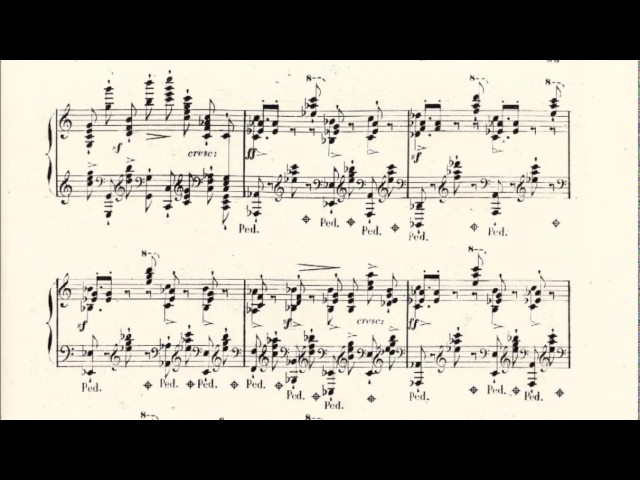
This work pursues the pinnacle of dazzling, powerful piano performance.
It is a piece from the album “60 Grand Studies,” renowned as a large-scale composition that demands heroic playing.
Published in 1855, the piece unfolds at an Allegro maestoso tempo and requires advanced technique from the performer, including passages where both hands cross simultaneously, rapid scales, and wide leaps.
It was adopted as teaching material at the Paris Conservatory, and its artistic value was highly praised by the music critic Antoine Marmontel, who stated that it holds importance on par with Clementi’s “Gradus ad Parnassum.” Highly recommended for pianists with strong technical skills or those seeking a new challenge in piano performance.
Etude Op. 25 No. 6Frederic Chopin

Frédéric Chopin, the great French composer who created numerous beautiful masterpieces.
He is also known as a composer of many highly demanding works, and among them, the Etude Op.
25 No.
6 ranks among the most difficult.
The main challenges of this piece are undoubtedly the right hand trills in thirds and the chromatic scales in thirds.
Thirds are already difficult as they are, but in this piece you must also play a dramatic melody with the left hand.
Although the difficulty level is considerable, practicing it is recommended, as it strengthens finger independence—a fundamental technique essential for playing any piece.
12 Etudes in All Minor Keys, Op. 39: No. 3 “Diabolical Scherzo”Charles Valentin Alkan

Charles-Valentin Alkan, a composer who epitomizes French Romanticism.
Among his works, one of the most notoriously difficult pieces is Études in All the Minor Keys, Op.
39, No.
3 “Scherzo diabolico.” Semitonal relationships derived from the Neapolitan sixth appear throughout the piece, and in places it demands rapid arpeggios, requiring a very high level of technical skill.
It truly merits the description “diabolically difficult.” Be sure to check it out.
Etude Op.10-2 in A minorFrederic Chopin

Among Frédéric Chopin’s works, the masterpiece Twelve Études is said to boast one of the highest levels of difficulty.
This time, I would like to introduce Étude Op.
10 No.
2 from that set.
Although its performative impact is not especially large, it is known for being extremely difficult.
The key point of this piece is, above all, the opening section: because the 1st and 2nd fingers must hold chords, the remaining 3rd–5th fingers have to play the other parts.
For these reasons, it is known as a high-difficulty piece that demands innate hand size and supple fingers.