


Even when we simply say “piano performance,” there are many different ways to play.
This time, I’d like to introduce what you need to grasp the key fundamentals that will serve as a basis for further application.
- [Piano/vocal] Super cool! Recommended songs you can breeze through
- [Piano] Piano Accompaniment Patterns | A selection of arrangements useful for adding accompaniment and for piano-vocal performance
- Mastering quintuplets on the piano
- [For Piano Beginners] 7 Tips to Move Your Fingers the Way You Want
- Basic fingerings for piano beginners
- Three key points beginners should know for singing while playing an instrument
- How can you play the piano with ease? Let’s think about “relaxation” — the fingertips edition
- How can a beginner pianist learn to play chords easily?
- [Must-See for Beginners] How to Start Learning Piano on Your Own: A Clear, Step-by-Step Guide!
- A must-see for piano beginners! Recommended training videos that are great for basic practice
- Things to check before practicing the piano
- For piano beginners: an easy-to-understand way to practice chord changes
- 5 Tips to Avoid Getting Nervous at a Piano Recital
Pitfalls when self-studying the piano
Learning to play the piano on your own is quite difficult, but if your goal is just to be able to play a single piece, you might manage with just books and audio materials.
It just means “only for that song!”
To become able to play the piano, once you can play one piece, you must be able to apply the techniques you used there to any other piece.
In short, it’s important to increase the number of techniques you can use at any time.
There are plenty of pieces you can play even if your fingers don’t move quickly.
Let's gradually increase the skills (items) you can use, even if they're simple.
Plan for fingering
Now, when it comes to playing the piano with both hands, the first thing to consider is the piano solo format. As I mentioned before, let’s start with the form where the left hand plays the root and the right hand plays the melody.
When playing a melody, planning your fingering is crucial.
Being able to decide your own fingering is the first step to learning piano on your own.
If you don’t plan out the fingering during one-hand practice, you’ll end up only being able to play while looking at your right hand. Then, when you practice with both hands, it suddenly becomes much harder, and you’ll be forced to give up at that point.
If you have to look at your hands every time you shift positions, you won’t be able to read the score or pay attention to your left hand.
This is also important when practicing the left hand, but first, let’s plan out the fingering.
It’s the same even when the left hand is only the bass.
Practice shifting positions such as finger-under, finger-over, and spreading so that you can do them without looking at your hands.
Position changeWe discussed this before, but first, practice while carefully watching the keys and your fingers so you can move to the positions you intend. Once you can do that, practice doing it with your eyes closed as well.
Regarding moving, let's make it so that you can freely move after checking the destination.
If you can do this, it means you’ve mastered the “technique” of shifting positions, and you’ll be able to use it whenever it appears in a piece.
When practicing a new piece, it’s also important to find where the position shifts are and mark them in advance.
Left-hand accompaniment: chord practice
What should I do about the accompaniment with the left hand?
The left hand is often played in chord shapes, but first, practice playing in solid blocks to grasp the chord image and how to move between chord positions. After that, work on patterns like arpeggios.
Even for your first two-handed practice, start with “blocks (white notes).”
Even if the left hand moves as in the score on the right, with the right hand playing the melody and the left hand playing chords, first practice it in “blocks.”
“Do-So-Mi-So,” “Si-So-Fa-So,” “Do-Mi-So,” “Si-Fa-So,” or “Do-So,” “Si-So” can be grouped as the chords C (Do-Mi-So) and G7 (So-Si-Re-Fa).
Even if the left hand moves as in the score on the right, where the right hand plays the melody and the left hand plays chords, start by practicing in “blocks.”

 Once you can play each hand separately, repeat practicing the left-hand blocks with the right-hand melody and the left hand alone. As you get used to it, stop using the block (long notes) approach and start shaping the left hand into each individual pattern.
Chopping, backing, and so on...
Even with the same chords, there are many different patterns you can create, but once you learn one accompaniment pattern, you should be able to use it whenever it appears in any song.
If you can do it, it means you’ve mastered the technique.
Of course, the same chord can not only be played broken up, but also “chopped” in various rhythms.
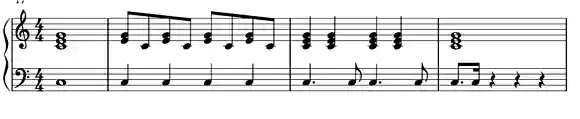
This is the same for left-hand bass as well; even with the same notes, you can create a variety of rhythms.
As for chord shapes, if you play blues or rock, you should also learn the root-and-fifth shape (for C, omit the E and play C–G).
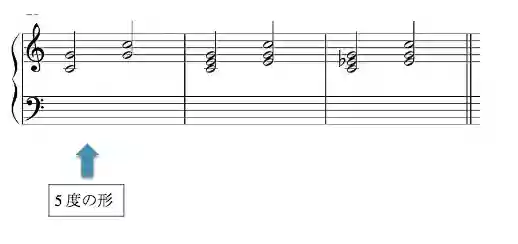
You’ll understand if you try playing the score below—it’s a form that’s common in hard rock.
Try playing it in this way, using fifths.
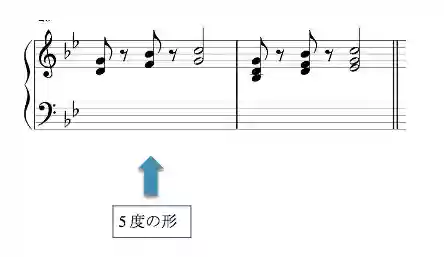
If you want to play jazz, make sure to learn the shapes for the root and the 7th as well.
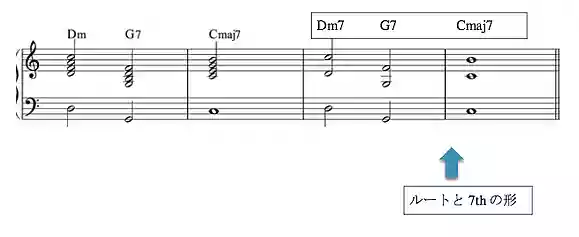 We sometimes play the shape above (root and 7th) with the left hand.
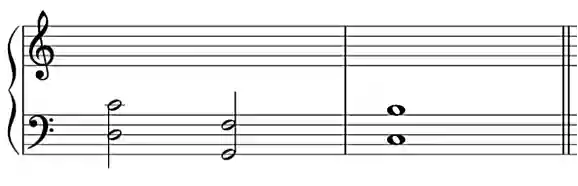
In jazz, it's also common to play the 3rd and 7th as shown below.
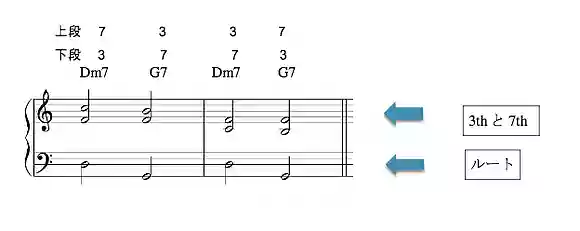
If there’s a bass, like in a trio, it’s not uncommon to play only the 3rd and 7th.
I'm adding tensions to the 3rd and 7th when I play.
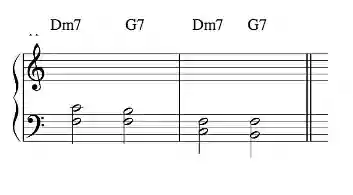
By the way, terms like G7 and 7th came up this time, and the “7” or “5” that appeared here indicate the intervals from the root note.
G7 is a chord built on G with the seventh—specifically, a minor seventh—added.
“7th” refers to the seventh scale degree (minor seventh or major seventh).
I'll talk more about pitch another time, but if you want to learn about it now, please see the “Chord Progressions” section of the music lessons for band beginners.
It explains the matter of pitch starting from the code (chord).