

Shizuka Kudo’s Most Popular Songs Ranking [2026]

We’ve put together a ranking of popular songs by Shizuka Kudo—former Onyanko Club member and now widely known as Takuya Kimura’s wife.
The four most prominent female idol singers of the late 1980s (Shizuka Kudo, Miho Nakayama, Yoko Minamino, and Yui Asaka) were known as the “Four Queens” of female idols.
- Kudo Shizuka’s Most Popular Karaoke Songs Ranking [2026]
- Shizuka Kudo’s famous and popular songs
- [Karaoke] A roundup of easy-to-sing songs by Shizuka Kudo
- Akina Nakamori’s Most Popular Karaoke Songs Ranking [2026]
- Seiko Matsuda Karaoke Popular Song Ranking [2026]
- Ranking of Beloved Hit Songs Among Women [2026]
- Kou Shibasaki’s Most Popular Songs Ranking [2026]
- Popular Japanese songs among women in their 50s: recommended classics and staple tracks
- [40s] Karaoke Popularity Ranking by Generation [2026]
- Miho Nakayama’s Most Popular Karaoke Songs Ranking [2026]
- Miho Nakayama Popular Songs Ranking [2026]
- Miyuki Nakajima’s Most Popular Karaoke Songs Ranking [2026]
- Masahiko Kondo’s Most Popular Songs Ranking [2026]
Shizuka Kudo’s Most Popular Songs Ranking [2026] (21–30)
It has to be you.Kudō Shizuka29rank/position

Released on October 6, 1993.
It’s a ballad, but with a bluesy feel unlike anything before.
Perhaps it’s similar to “Koe o Kikasete” from a year earlier.
It didn’t have the momentum from their breakout period, but it was a time when they were challenging themselves with various genres.
It peaked at No.
5 and sold 205,000 copies.
the opposite; reverse; contrary; the other sideKudō Shizuka30rank/position

Released on May 21, 1992.
The lyrics, true to her style, depict a coquettish woman, but the song itself lacked impact and inevitably came across as modest.
It peaked at No.
5 and sold 214,000 copies.
Around this time, her peak chart positions were no longer No.
1 or No.
2, as artists from the Being camp—such as B’z and WANDS—were already on the rise.
Shizuka Kudo Popular Songs Ranking [2026] (31–40)
Fly! Fly! Ruby ~Ruby Version~Kudō Shizuka31rank/position

A character song whose straightforward wish resonates in the heart! Shizuka Kudo, who also voices the character, delivers the pure desire to believe in oneself and soar into the open sky with a clear, luminous singing voice.
The song is an insert track that plays during a moving scene in the film “Go! Anpanman: Ruby no Negai,” released in July 2003, and is also included in the commemorative album “Go! Anpanman Movie & TV 25th Anniversary Works: Gather! Movie Songs.” When your child is about to take on a challenge, why not listen together as a family and cheer them on?
I want to break down and cry my eyes out.Kudō Shizuka32rank/position

Released on January 29, 1992.
A relaxed ballad.
Although there had been ballad-type songs before, most were mid-tempo, and there hadn’t been anything this laid-back released as a single.
It peaked at No.
4 and sold 282,000 copies.
It was performed at the 1992 Kōhaku Uta Gassen.
What you gave meKudō Shizuka33rank/position
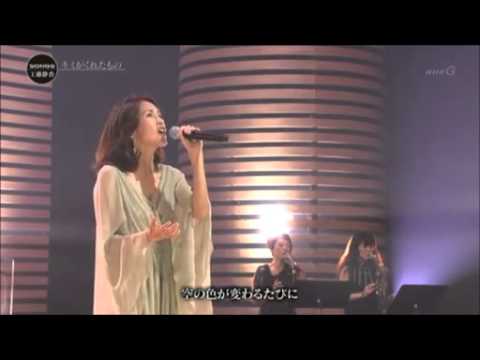
This single was released in October 2012 to commemorate Shizuka Kudo’s 25th anniversary as a solo singer, with lyrics and composition by Ayaka.
It was used as an ending theme for the TV anime FAIRY TAIL and reached No.
50 on the Oricon chart.
excellent; superior; gentle; kindKudō Shizuka34rank/position

Released on June 5, 1996.
It was the theme song for the film “Gokudō no Onna-tachi” (Yakuza Wives).
It peaked at No.
26 and sold 73,000 copies.
After the hit “Ice Rain” at the end of ’94, the following single “Moon Water” dropped out of the Oricon Top 10, and the next single “7” failed to reach 100,000 in total sales; she also missed the Kōhaku lineup in ’95.
This song didn’t perform well commercially either, but musically it’s a passionate piece very characteristic of her work and quite well-crafted.
I wish you would hold me.Kudō Shizuka35rank/position

Her third single overall, “Daite Kuretara Ii no ni,” is distinguished by its bluesy melody and ensemble.
It’s her first rock ballad as a solo single, and it exudes a sultriness that’s hard to believe came from someone still in her teens at the time.
The song is challenging, with high notes right from the opening and wide interval jumps, but the tempo is quite relaxed, so it’s easier to sing if you approach it calmly.
It’s a crowd-pleaser for karaoke—sing it with an awareness of the bouncing shuffle rhythm and expressive dynamics.
