

Tips for running faster in the sports day relay: from baton passes to running form!


When it comes to relays, it wouldn’t be an exaggeration to say they’re one of the most exciting marquee events at a sports day! While it’s common for people confident in their speed to take part, the fun—and the challenge—of a relay is that you can’t win on individual speed alone.
In addition to each runner’s pace, smooth baton passes are crucial for relay speed.
In this article, we’ll share tips for running faster in relays, touching on basic sprinting form as well as baton passing, which is the key to success in relays.
Practice is essential for improving your baton pass, but we’ll also introduce tips you can implement right away just by being mindful—so please use them as a reference!
- Dances that elementary school kids can do! Recommended tracks to liven up a school sports day
- [Sports Day] A roundup of exhilarating, fast-paced tracks perfect for relay race BGM!
- [Sports Day] Songs for footraces: tracks that make kids want to run [classics & J-pop]
- [Youth Songs] Songs that liven up sports days and athletic festivals. Music that adds color to the event.
- [Korean-Style Hair Arrangements] Perfect for Sports Day! Carefully Selected Recommended and Trendy Hairstyles
- [Ekiden Theme Song] Masterpieces that mirror the act of running—cheering anthems that give you courage
- Recommended exit songs for sports day: A collection of tracks that are perfect for a brisk, quick-march exit.
- [March, Foot Races, Dance] Energetic songs and the latest hits to liven up a sports day
- [Sports Day] A roundup of popular Japanese songs perfect for mass performances [Athletic Festival]
- From classics to fan favorites! A catalog of music and BGM to liven up your sports day
- [Dance Tracks] Perfect for School Sports Days! A Curated Selection of Fun, Popular Songs to Dance To [2026]
- [Sports Day Cheer Songs] A roundup of classic cheer anthems and recommended parody-song picks [2026]
- Pump Up the Sports Day! A Collection of Cool Flag Dance Song Ideas with Flags
Baton Pass (1–10)
Choose a baton pass method that suits you (us)

There are broadly two methods for passing the baton.
One is called the overhand pass, where the baton is exchanged at shoulder height.
The other is the underhand pass, where the exchange is made at waist height.
The overhand pass allows you to cover more distance because the arm is extended widely, but it has the drawback that the incoming runner has to extend an arm backward, making it harder to accelerate.
The underhand pass lets you receive the baton within your running form, making it easier to run, and once you get better at it, you’re less likely to drop the baton.
On the other hand, it doesn’t gain as much distance as the overhand pass and is more technically demanding.
Since each method has its pros and cons, there’s no single best recommendation; try both and choose the one that feels more natural to you.
Make full use of the takeover zone to accelerate in advance.
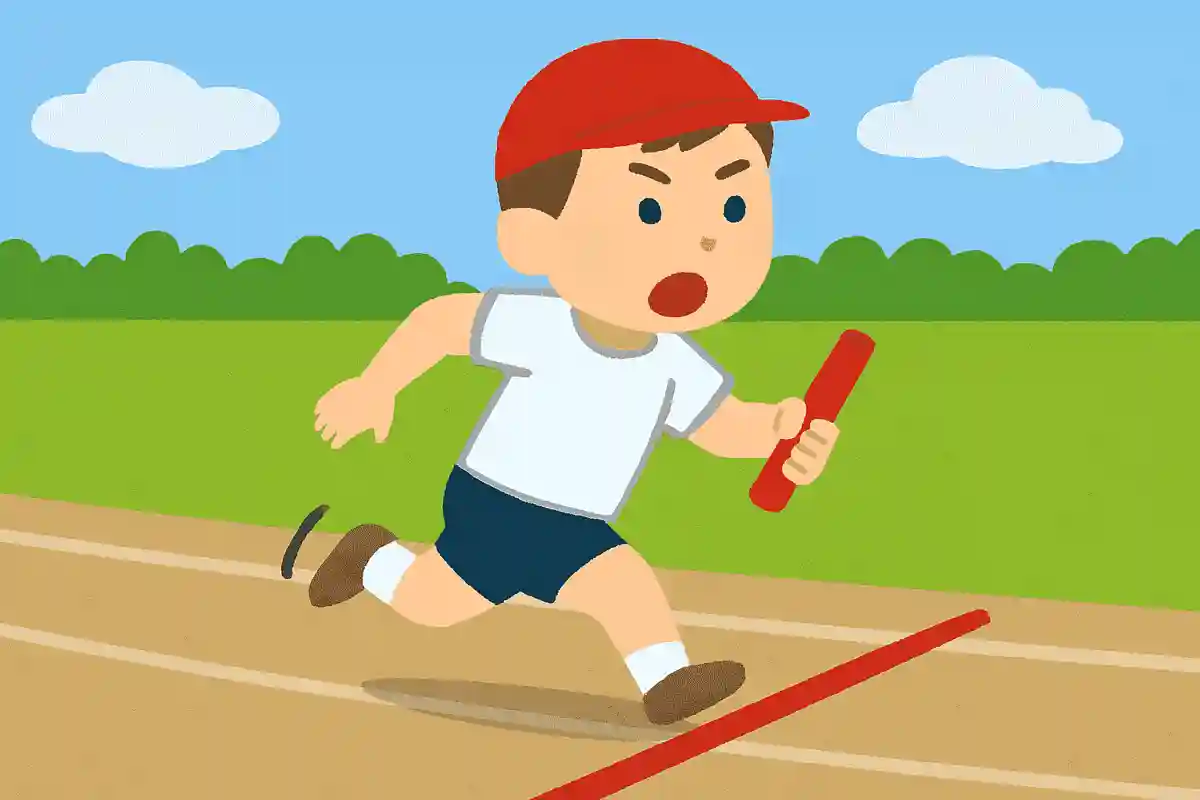
We first introduced two methods for passing the baton, and next are tips for the incoming runner.
The key is to use the entire takeover zone for the exchange and accelerate to the fullest.
If you run as though you’re breaking away without worrying about the outgoing runner handing you the baton, you’ll be able to accelerate smoothly.
It’s also important to make the exchange without looking back, which will be explained in the next section.
call out

For the next runner to receive the baton without looking back, it’s essential for the outgoing runner to call out.
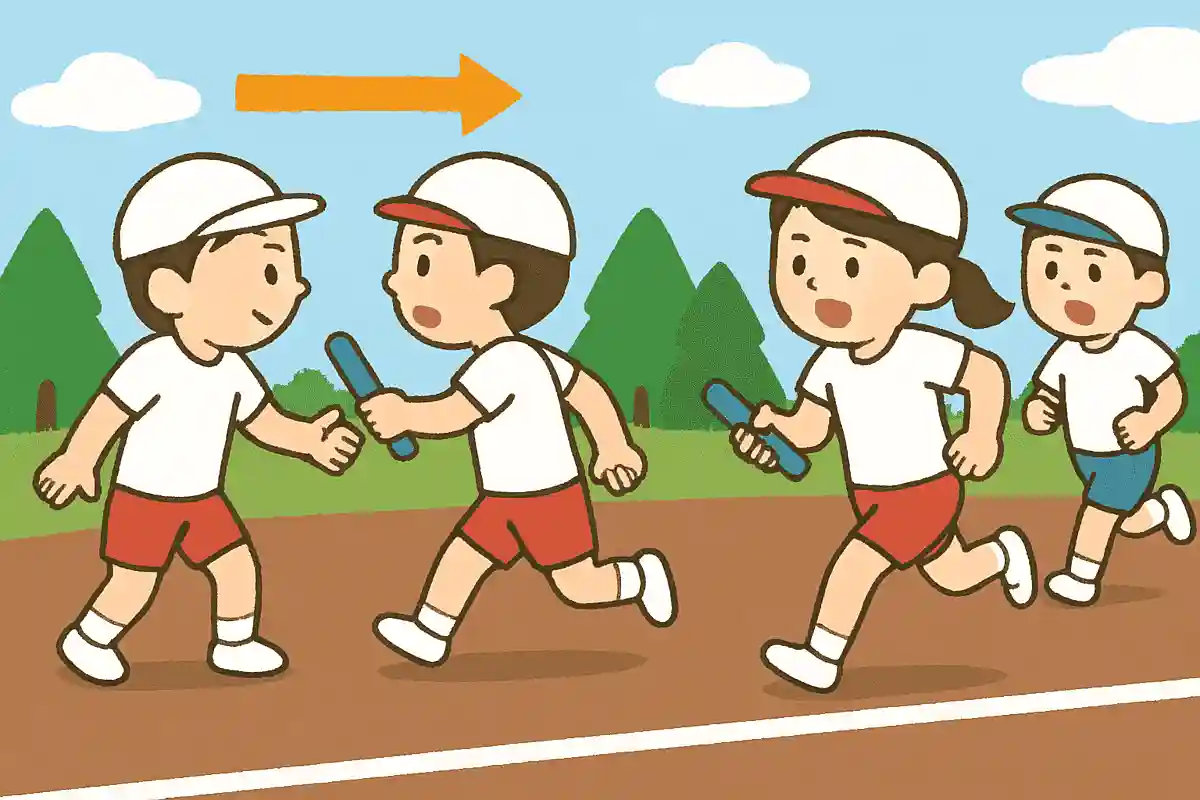
When the outgoing runner catches up to the incoming runner who is accelerating, they say “Hai!” (Ready!), and the next runner extends their hand backward in response to receive the baton.
It’s a simple action, but it’s no exaggeration to say that without the call, a smooth baton pass is nearly impossible—this is a fundamental element.
Don’t switch the baton

The final baton-pass tip is not to switch hands after receiving the baton.
As I’ve mentioned several times in this article, strong arm drive is crucial for running fast, and switching hands can hinder your arm swing.
To avoid that, the baton should be passed alternately: the first runner uses the right hand, the second the left, the third the right, and so on.
Practice this repeatedly as a team so you can execute smooth baton passes even during competition!
Other tips (1–10)
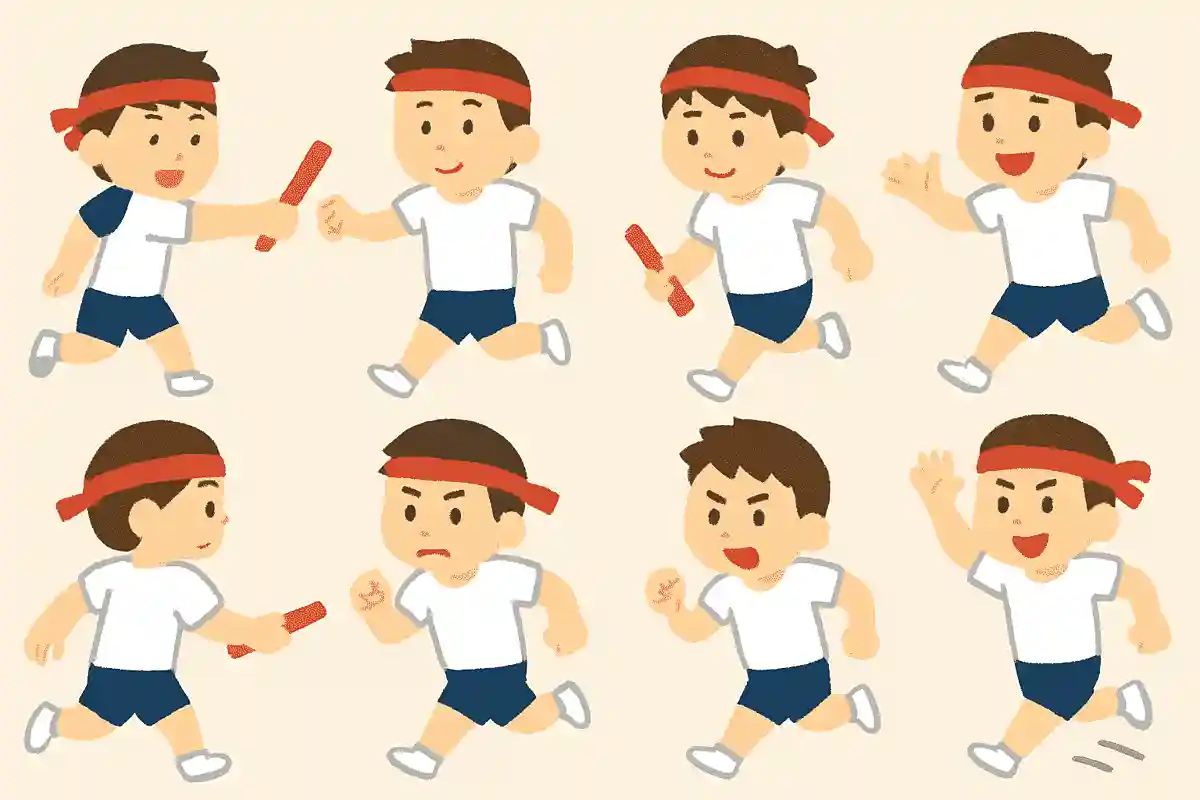
Up to now, I’ve introduced tips for running faster in relays, such as form, running technique, and baton passing.
Finally, I’ll share a few more relay tips that I couldn’t cover earlier.
Some will be effective just by keeping them in mind, and others can be used strategically, so please use them as a reference.
Keep the same pace until the end.
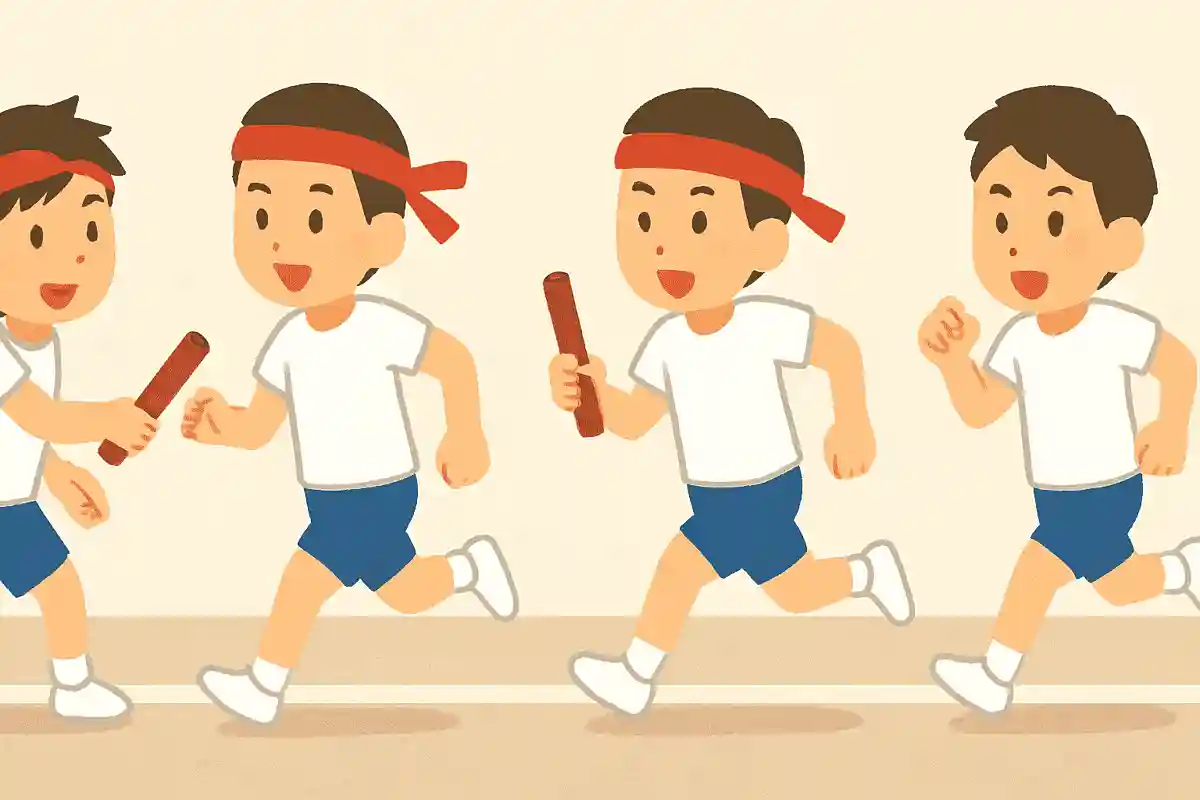
In a team relay, it’s easy to get carried away with the desire to win and go all out from the start, but it’s also important to focus on maintaining your pace through to the end.
You’ve probably seen scenes at past sports days where someone leans too far into their eagerness and their legs get tangled, or they run out of stamina in the latter half and slow down.
Staying calm and running without mistakes so you can pass the baton securely to the next runner is also crucial in a relay.
When running on the outside, gently move to the inside before the corner.
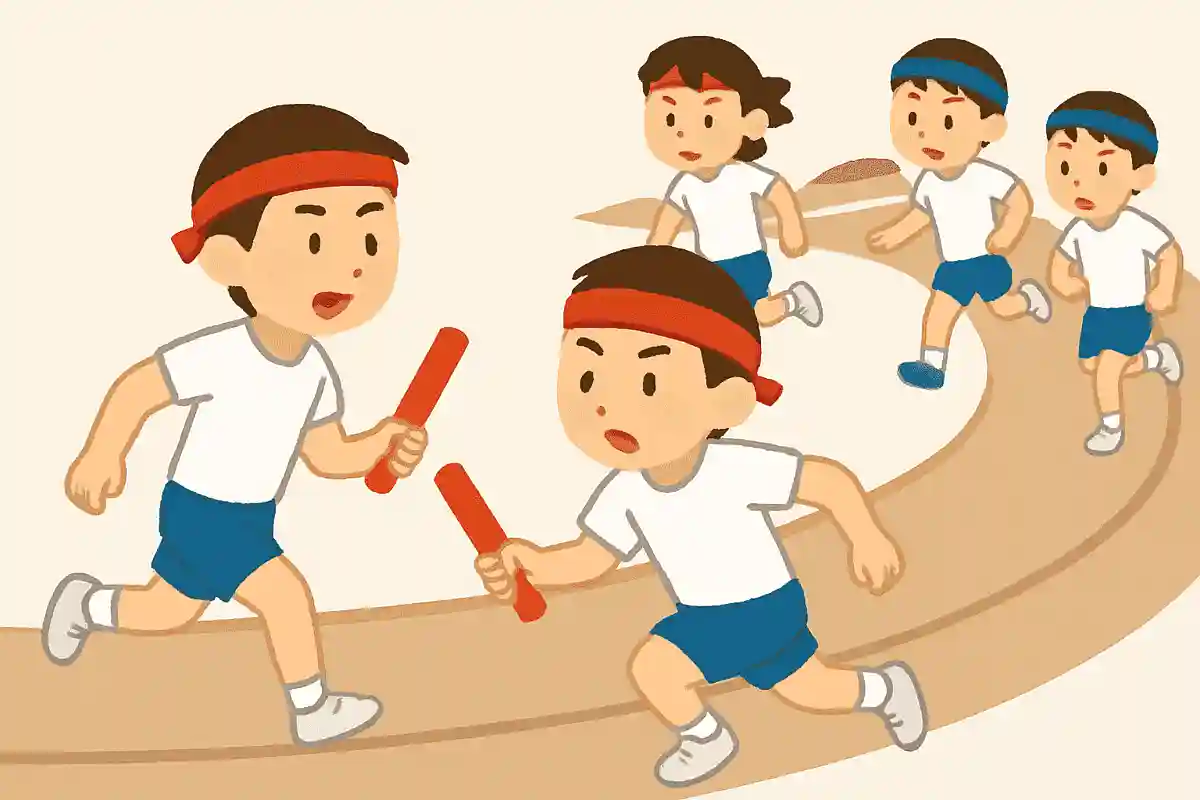
In a relay, since you run on a track, it’s advantageous to take the inside on the bends.
However, if you’re still some distance from the corner and running on the outside, suddenly switching to the inside line right before the turn can cause you to slow down or risk colliding with other runners.
Therefore, as the corner approaches, gradually moving toward the inside allows you to watch the other runners and smoothly take the inside line.
Overtake on the straights; don’t overtake in the corners.
Lastly, let’s talk strategy: where to make your pass.
As mentioned in the first half of the article, you often can’t build much speed in corners, and if you don’t have the inside lane, overtaking from the outside is tough.
So, if you’re not strong in corners, it’s better to give up on passing there and go all-in on the straights.
Conserve your energy through the corners without forcing it—just enough not to fall behind—and then make your move all at once once you hit the straight.
In conclusion
We’ve thoroughly introduced tips for running faster in a relay, focusing on a few key points. In addition to techniques that can change your form and running style just by being mindful individually, we also explained baton passing—the most crucial part of a relay. Use this article as a guide, practice with your team, and aim for victory in your relay!