

[Japanese School Anthems] A Hot Topic at Koshien! From Beautiful Anthems to Unique Ones, All Introduced at Once

A school anthem that resonates in everyone’s heart, alongside irreplaceable memories of youth.
Lyrics that convey nostalgia and pride, a majestic melody, and the exhilaration of singing together with friends.
Japan is home to countless school songs that leave you spellbound.
In this article, we’ve carefully selected especially captivating anthems from schools across the country—ones you’ll want to tell someone about right away! From beautifully moving pieces to quirky songs with a unique worldview, and even cool, contemporary numbers, we’ll introduce a wide range of standouts.
- [Songs of Saitama] A Wealth of Humor-Filled Classics! Local Anthems Packed with Love for Saitama
- Songs about schools: a collection of songs that depict school building scenery.
- [2026] Masterpieces Themed on Ibaraki: From Local Songs to Municipal Anthems
- Recommended entrance songs for high school students: moving masterpieces and popular hits.
- Memories come flooding back! Graduation songs recommended for the Yutori generation
- [Okayama Songs] A roundup of local anthems and classic hits brimming with hometown pride!
- [Songs of Aomori] A collection of local songs depicting the grandeur of nature and the warmth of its people.
- [Song of Osaka] A selection of passionate, warm-hearted Osaka tunes
- [High School Baseball Anthems] A curated selection of moving masterpieces that color the players’ drama!
- [Fight songs and marches included] Moving songs you want to hear at the Spring High School Baseball Tournament
- Koshien Songs & Theme Songs: Iconic Tracks and Fight Songs That Support High School Baseball Players
- [Frenzy] A Collection of Popular High School Baseball Cheering Songs
- Popular cheering songs for summer high school baseball and classic brass band tunes that hype up the crowd
[Japanese School Anthems] A Hot Topic at Koshien! A Comprehensive Introduction to Everything from Beautiful Anthems to Unique Ones (11–20)
Nihon University Yamagata High School Song

Its structure opens with a resounding English phrase that leaves a vivid impression on listeners.
It’s a work brimming with unconventional charm—so much so that the anecdote about lyricist Kotaro Jimbo choosing it with firm conviction feels entirely convincing.
The lyrics depict hometown scenes such as the majestic silhouette of Mount Zao and the flow of the Mogami River, and you can almost see the passionate students raising their voices together with their peers.
Because it’s performed at high school baseball tournaments and draws attention for its uniqueness each time, many of you may already be familiar with it.
Meitoku Gijuku High School Anthem

That school anthem from Kochi—the one that plays with every victory at Koshien and is surely familiar to many baseball fans.
From a campus surrounded by majestic nature, the lyrics conjure up refreshing scenes like clear skies and sparkling water.
The song carries a passionate message to young people: walk straight along the “path of truth.” It became widely known through its use at the National High School Baseball Championship.
When the team won its first title in the summer of 2002, the resounding melody etched itself into many people’s memories.
It’s a heartening piece whose dignified march rhythm powerfully propels those who single-mindedly strive toward their goals.
Uemiya High School Song

Uemiyā High School, established in Osaka City in 1890 with the Jōdo-shū (Pure Land) sect as its foundation, became coeducational in 2011 after having been a boys’ school.
The lyrics of the school song use words spoken by the school’s founder, Honen Shonin, about the Buddha’s compassion, and the song is titled “Tsukikage” (“Moonlight”).
It has also drawn attention as a school song with one of the shortest sets of lyrics.
Shigakukan High School Song

This is the school song of Shigakukan High School in Aichi Prefecture.
It’s a school with nationwide name recognition that competes at Koshien in high school baseball.
The school song, titled “Yume-Oibito” (Dream Chaser), feels refreshingly unlike a typical school anthem, in a good way that seems to reflect the times.
It’s the kind of song everyone wants to sing, and one that becomes a cheer song for anyone.
With a school song like that, you naturally want to sing it enthusiastically at school events.
Komatsugawa High School Song

This is a piece passed down at Tokyo Metropolitan Komatsugawa High School, notable for its majestic mixed four-part chorus.
Composed by Mareo Ishiketa, it was established in January 1951.
Its greatest appeal is, above all, the authentic harmony.
It’s said to be so difficult that even current students find it extremely hard to master.
Written in classical literary Japanese, the dignified lyrics weave in local scenery such as the Arakawa River and the clock tower, while expressing young people’s hopes for the future, drawing listeners into its grand worldview.
It’s a timeless masterpiece loved across generations—one that fans of classical, richly satisfying choral works should definitely experience.
Chiben Wakayama High School Song

Many of you have likely heard that solemn melody that symbolizes victory at Koshien.
It’s the school song of Chiben Wakayama High School, established in February 1982.
The lyrics were written by the principal at the time, and the music was composed by Yasuo Sueyoshi, renowned in the field of contemporary music.
Paying homage to the land’s history and nature, and to the school’s founding spirit of pursuing truth, the song is carried by a powerful melody.
When sung in unison with friends, it stirs a heartfelt elation, sharing pride and glory for the future.
It’s a masterpiece that conveys the radiant spirit of earnest youth and a strong will to strive toward one’s goals.
[Japanese School Songs] A Hot Topic at Koshien! A Comprehensive Showcase from Beautiful Anthems to Unique Ones (21–30)
Suwa Seiryo High School Song
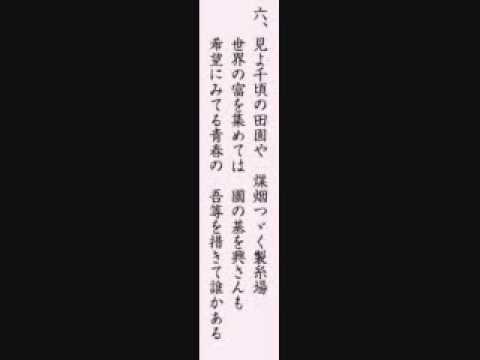
Famous as the longest school anthem in Japan, this work has been sung for generations at Suwa Seiryo High School in Nagano Prefecture.
Adopted as the school song in 1903, it is a grand two-part composition: the first half nobly celebrates the region’s beautiful nature, such as the Yatsugatake Mountains and Lake Suwa, while the second half elevates the lofty aspirations of youth.
You can almost picture friends raising their voices together to the beat of handclaps and taiko drums.
If you’d like to experience a sweeping epic intertwined with memories of youth, be sure to listen closely at least once.