

Recommended for elementary school students' independent research! Experiment and observation ideas using everyday materials


Recommended for elementary school students who haven’t decided on a summer vacation independent research project yet! Choosing a topic can be tough, but in this article we introduce exciting ideas that will make you feel thrilled just reading them—from factory tours at candy makers to gemstone polishing, and even a DIY telescope you can build with materials you have at home! You’ll also find plenty of ideas you’ll want to tell someone about, like a curious experiment to check your ear age and a project to make water that’s both hard and soft.
You’re sure to find tips for independent research that use familiar items and are fun to try!
- For 6th Graders: Unique and Fun Ideas for Independent Research Projects
- Elementary School Students: Simple One-Day Science Project and Craft Ideas
- Stand out with your junior high school independent research! A collection of fun experiment and craft ideas
- Recommended for elementary school students! Science fair topics & craft ideas
- For summer vacation homework! Simple and amazing crafts for elementary school students that you’ll want to make after seeing them
- Amazing discoveries with everyday materials! Fun summer vacation independent research ideas
- [For 4th Graders] Fun Independent Research Ideas You Can Do With Everyday Materials
- Third graders will be hooked! A collection of science project ideas using everyday materials
- [For First Graders] A Collection of Science Project Ideas Using Everyday Materials
- [For 2nd Graders] Make it with everyday materials! Irresistibly engaging ideas for independent research projects
- Make it with everyday materials! A collection of fun summer vacation craft ideas
- Recommended for middle school students! A collection of quick science project ideas you can do in a short time.
- Recommended Independent Research Projects for 5th Graders [Elementary School Students]
Recommended for elementary school science projects! Experiment and observation ideas using everyday materials (31–40)
Disposable Chopsticks Chomping Crocodile
@habii.jp Simple Crafts Series: Chopstick Chomping Crocodile. “Habi,” the official Child Development Support and After-School Day Service that supports the growth of children with developmental concerns. <Posts around 7 p.m. on Tue/Thu/Sat> The official account of Wellbe for Employment Support is here → @Wellbe Employment Support [Official]#NeurodevelopmentalDisordersParenting# developmental support (ryōiku)Habi
♬ All the Fun We Had Together – Official Sound Studio
Let me introduce the Chopstick Chomping Crocodile—its moving face is super fun! Get some chopsticks, rubber bands, and origami, and let’s make it.
First, split two pairs of chopsticks.
Align each pair lengthwise and secure them with rubber bands.
Once you have two secured sticks, attach them together top and bottom with rubber bands so they can open and close.
Finally, glue or tape a face and mouth to the tips of the chopsticks, and you’re done.
Give it a try for some chomp-chomp fun! Since the method is simple, it could also be fun to swap the crocodile for another animal.

For demon-slaying only! Bean-throwing rubber band gun
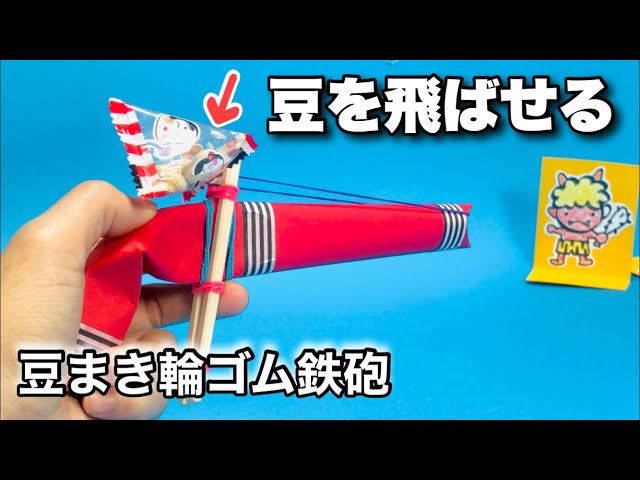
Oni-busting only! Here’s how to make a bean-throwing rubber band popper.
Prepare chopsticks, roasted soybeans (fukumame), construction paper, tape, scissors, and rubber bands.
Roll the construction paper into a tube, then secure the tube with rubber bands by clamping it between a pair of chopsticks folded in half.
The key is to wrap the rubber bands tightly so they don’t loosen.
Be careful not to cut your hand on the ends of the chopsticks.
When launching, dent the tip of the paper tube, hook on a rubber band, set it, and play.
When playing, don’t aim at people and make sure to play safely.
Experiment to make butter

Butter makes all sorts of foods delicious—spread on bread, melted over baked potatoes, and more.
Did you know it can actually be made with a very simple process? The main steps are to pour chilled heavy cream into a sterilized container and shake it vigorously for 15 minutes.
The liquid will separate and turn into solids—the solid part is unsalted butter.
Mix in salt, and you’ve got butter! Shaking for 15 minutes is surprisingly hard work, so it might be a good idea to do it while watching TV.
Let’s also summarize why butter forms in the first place.

repeating saline solution

Let’s try a summer break experiment using everyday items like cups and saltwater.
Make a hole in a plastic cup filled with saltwater at your preferred concentration.
Place the saltwater cup inside a larger cup filled with plain water.
You’ll notice something curious: the saltwater will flow out of the hole and then stop, and after a while it will start flowing out again and stop once more.
It could be fun to experiment by changing the salt concentration or the number of holes in the plastic cup.
Just watching this setup is interesting, but there’s also a proper explanation for what’s happening.
Try to think about that answer, too.

Piano de Independent Research

You can usually find at least one piano in schools, whether in the music room or the gym.
Many people also take piano lessons as an extracurricular activity, or have taken them in the past.
Since the piano is a familiar instrument even for high school students, why not use your summer vacation to put together a project about it? Try listing the questions you have about pianos—such as how many keys they have and how they were introduced to Japan.
As you work on your piano research project, you might be surprised by some unexpected facts.
It could be fun to get creative, too, like summarizing your findings on paper shaped like a piano.
Recommended for elementary school students’ independent research! Experiment and observation ideas using familiar materials (41–50)
An experiment to make natto

Many people are likely interested in experiments that use items that appear in our everyday meals.
This time, we’re introducing an experiment to make natto.
Natto, which has been eaten in Japan since ancient times, is said—according to various theories—to have existed as far back as the Yayoi period.
To turn soybeans into natto, you need natto bacteria (Bacillus subtilis var.
natto), and it’s said that straw naturally contains these bacteria.
Prepare steamed soybeans and boiled straw, then place the soybeans sandwiched between the straw.
Natto bacteria are heat-resistant, so boiling the straw is fine.
It’ll be exciting to see after the experiment whether the natto has successfully formed.
A study on easy ice cream you can make in one minute
@nonno.chan Summer vacation independent research, part two! Ice cream made in 1 minute using the power of chemistry. I’d be happy if you find it helpful!#Summer VacationIndependent Researchtranslation#HomemadeIceCream
♬ 3 minutes cooking style pop / cooking / sweets(957554) – ArcTracks
Have fun with it! Here’s an idea for a simple ice cream experiment you can make in just one minute.
Not many people have actually made ice cream themselves.
How about trying a fun and easy experiment where you can also enjoy delicious ice cream? All you need is milk, sugar, ice, salt, and resealable bags.
The steps are simple and easy to follow, so kids will likely jump right in! And since this is for learning, don’t forget to keep records of what you do!