

The Spirit of Japan: A Collection of Famous and Popular Shamisen Pieces

The shamisen is the quintessential traditional Japanese instrument.
Of course, it’s used to perform classic pieces, but it’s also a highly versatile instrument that shines in solo performances of intense songs and in collaborations with rock bands—traditional yet packed with showmanship.
In this article, we’ll introduce a wide range of songs that feature the shamisen.
We’ve included everything from older works to the latest tracks!
If you’re thinking about starting the shamisen, you might find this helpful—so be sure to read to the end!
- Masterpieces and popular songs by Wagakki Band
- Spirit of Wa: Masterpieces for the Koto — Japan’s Beautiful Melodies
- A Collection of Moving Shakuhachi Masterpieces | Beautiful Japanese Melodies That Stir the Heart
- [Japan] A collection of J-pop with a traditional Japanese (wa) vibe and Japanese-style taste
- From rock numbers to dance tunes! Cool songs of the Reiwa era
- [Songs of Aomori] A collection of local songs depicting the grandeur of nature and the warmth of its people.
- The soul’s cry woven into Japanese elegies: unraveling supreme masterpieces that resonate with the heart.
- [Hometown Songs] A curated selection of popular Japanese tracks that fill your heart with nostalgia
- [Song of Osaka] A selection of passionate, warm-hearted Osaka tunes
- [Classic and Contemporary Hits] Emotionally Stirring, Heart-Touching Songs
- [2013 Japanese Hit Songs] Masterpieces that Colored the Ama-chan Boom, Group Popularity, and the Band Scene
- [Local Songs] Recommended tracks packed with Japan’s nationwide classics and hometown pride
- [Resonates with the Soul] A Roundup of Sambomaster’s Most Popular Songs and Hidden Gems
[The Spirit of Japan] Shamisen Masterpieces and Popular Songs (21–30)
spring rainNAGANO Motose

Also known as “Uguisu-yado no Ume” (The Nightingale’s Plum), it features lyrics by Hanamori Shibata, a retainer of the Hizen Ogi domain, and became popular in Edo around the Kaei era (1848–1854).
It is unclear who set it to melody, but it is said to have been Okatsu, a courtesan of Maruyama.
As a celebrated hauta piece, it is still widely sung today.

Rapidtoukyou futari

An original piece by the Tsugaru shamisen duo Tōkyō futari, composed of Hibiki Sawada and Mokusho Iwata.
The bold, quintessentially Tsugaru shamisen timbre of the main line is striking, and above all, the choice to build the entire track using only Tsugaru shamisen—without adding other instruments—conveys a sense of respect for this traditional instrument.
While the shamisen imparts a distinctly Japanese atmosphere, the melody carried by the main line also strongly evokes a contemporary musical sensibility.
It’s a work that could serve as a gateway for a broad range of listeners to discover the Tsugaru shamisen.

It’s the cat, it’s the cat.Unknown

Known as “Occhokochoi-bushi” or “Neko ja Neko ja,” this is a popular folk song that spread from the Edo period into the Meiji era.
One verse depicts a wife, on the verge of being caught cheating, claiming that the man she’s hiding is actually a cat, while her husband responds by picking apart the lie in detail.
Although it’s a traditional popular song with roots in the Edo period, its content includes a humorous “pursuit of a lie,” so it is often performed with the light, playful feel of the shamisen.
It is also a lively piece frequently used as entrance music by rakugo storytellers.
Old PineKineie Tokushima Shibu
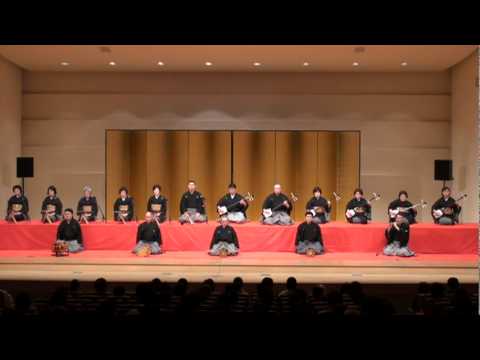
“Oimatsu” is a quintessential Nagauta piece, composed in the late Edo period by the fourth Kineya Rokuzaburō.
Because “old pine” symbolizes longevity, it has long been cherished as a celebratory work suitable for festive occasions.
It’s a single piece that distills the charm of Nagauta—expansive, elegant, and refined.
Jonkara ShinsetsuTakahashi Chikuzan

Takahashi Chikuzan is a legendary figure in the shamisen world who popularized the Tsugaru shamisen nationwide through his energetic postwar live performances and record releases.
Here he performs Tsugaru Jongara Bushi— the most famous piece in the Tsugaru shamisen repertoire and one of the Five Great Tsugaru Folk Songs that have been carefully passed down.
Don’t miss this dynamic work that leaves everyone in awe.
deep seaNiya-NIYA-

This is a piece by Tsugaru shamisen artist NIYA, who hails from Yagishiri Island in Haboro, Hokkaido.
The track is included on the mini-album VersuS.
You could say it’s a collaboration between the shamisen and contemporary rhythm instruments.
The rhythm makes a strong statement, but that powerful beat seems to further accentuate the fiercely strummed timbre of the Tsugaru shamisen.
It’s a work that offers a glimpse into NIYA’s pursuit of new possibilities for the Tsugaru shamisen, including collaborations with DJs and wind ensembles.
Nagauta: Echigo LionKagurazaka no ryōtei nite

This is a nagauta piece based on Kakubei Shishi, a traditional performing art from Minami Ward, Niigata City in Niigata Prefecture.
It is valued as a bearer of traditional culture, appearing as a Japanese dance number and even inspiring popular songs.
Centered on showcasing the sound of the shamisen, the piece is noted for its advanced shamisen techniques.
It is sometimes performed with hayashi accompaniment such as drums and flutes, but even in the basic nagauta format of just vocal and shamisen, it fully conveys its atmosphere as a work of traditional music.