

Recommended pieces for a wind band contest

A competition that wind band musicians across the country aspire to enter.
You spend an entire year practicing hard for that contest, don’t you?
At that competition, depending on the division, bands typically perform two pieces: a set piece and a free-choice piece.
While the set piece is chosen from several works announced each year, how do you decide on your free-choice piece?
Some bands compete with a piece they’ve performed for years and feel comfortable with, while others take on the challenge of a new work—but either way, it’s a tough decision.
In this article, we carefully select and introduce recommended pieces for your free-choice selection in competitions.
We’ll cover timeless classics and recent popular works, so please use this as a reference!
- Perfect for free selections and concert programs! Introducing famous and classic favorites in wind ensemble music.
- [History] A roundup of popular set pieces from the All-Japan Band Competition
- A classic brass band medley
- [Brass/Wind Band] Recommended for Beginners! A Collection of Classics and Popular Pieces Perfect for Practice
- [Wind Band] Guaranteed to hype up the school festival! Recommended pieces the brass band will want to play
- [March] A curated selection of classic marches and dazzling crowd-pleasers for concerts!
- A Collection of Pop Hits for Wind Band: From Classics to Popular Medleys
- [March] Carefully selected popular songs recommended for entrance and exit at sports days and athletic festivals!
- [Wind Ensemble] Wind band pieces that men like. Masterpieces of wind band music recommended for men.
- A Must-See for Middle and High Schoolers! Recommended Free-Choice Songs for Choir Competitions Catalog
- A collection of video game music I want to perform in a wind ensemble
- Practice pieces for beginner flutists. Recommended practice pieces.
- To you who are thinking about quitting the brass band club: You shouldn’t quit for reasons like these.
Recommended pieces for a wind band competition (1–10)
Symphony No. 2 “The Passion of Christ”Ferrer Ferran

This piece grandly portrays the arc from Christ’s birth to his crucifixion and execution, and ultimately to the emergence of new hope from his death.
Although its title is “The Passion of Christ,” it could just as well be called “The Life of Christ.” Each movement bears a subtitle: Movement I: “Birth – Massacre of the Innocents – Baptism,” Movement II: “The Three Temptations,” and Movement III: “Arrival at the Temple – The Last Supper – Arrest – Judgment – Crucifixion – Hope.” The entire work is constructed through concrete scene depictions; it is by no means abstract music, but rather crafted in a way that is as accessible as film music.

Festive OvertureDmitrii Dmitrievich Shostakovich

Among Shostakovich’s many works, this is a particularly popular masterpiece brimming with a sense of drive.
Composed in 1954 on commission from the Central Committee of the Soviet Communist Party for the celebration of the 37th anniversary of the October Revolution, it is said to have been written in just three days because the commission arrived only a few days before the concert.
The piece contains numerous melodies quoted from Shostakovich’s other works; for example, the opening fanfare is taken from the beginning of No.
7, “Birthday,” of the seven piano miniatures Children’s Notebook.
Concerto for Wind EnsembleKō Shōsui

“Maestoso” with powerful, celebratory fanfares.
“Pregando,” which contrasts two motifs: a magical, Oriental-sounding opening alto flute solo and an austere, Western-sounding horn solo.
The humorous “Scherzoso,” which uses rhythms from the traditional music of the Korean Peninsula.
“Affettuoso,” in which the woodwinds sing warmly and expansively.
“Festivo,” an integrated movement that weaves in music used in the other movements.
These five movements are intricately interrelated and inseparably bound together.
Recommended pieces for wind band competitions (11–20)
The Last Letter from MurdockTarumiya Masanori
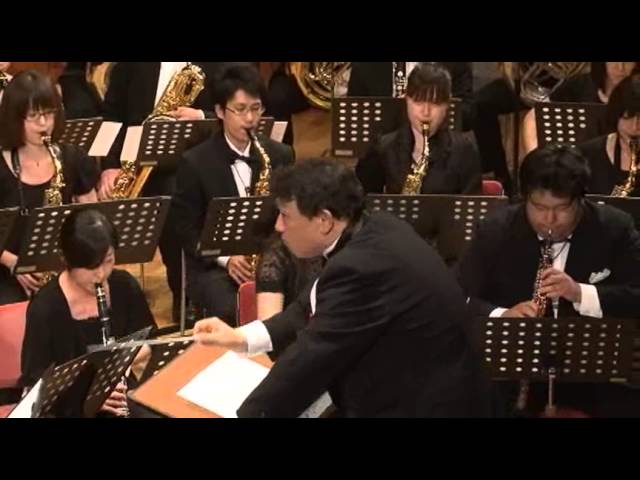
This song shines a spotlight on Murdoch, the First Officer of the luxury liner Titanic, built in the early 20th century.
Murdoch was one of the crew who bravely helped rescue passengers until the very last moments as the ship went down.
During the voyage, he made a habit of writing letters to his family, always sharing not only updates about himself but also words of care and concern for them.
Set to an Irish-style melody, the song portrays what might have been included in Murdoch’s “final letter”: the bustling scenes on deck filled with passengers, the beautiful views over the Atlantic, the mishaps that foreshadowed the disaster, and his heartfelt thoughts.
Magellan’s Challenge to the Unknown ContinentTarumiya Masanori

The theme of this piece is the Portuguese explorer Ferdinand Magellan, who was active during the Age of Discovery.
Although Magellan’s expedition achieved the first circumnavigation of the globe, Magellan himself died during the voyage.
The composition was created with the image of Magellan’s journey, imagining, “What if Magellan’s soul remained in this world and continued the circumnavigation…?” The piece depicts the figure of a tiny human challenging the great force of nature.
Alongside the various faces of the sea—its vastness, warmth, strength, ferocity, and terror—it also expresses Magellan’s pursuit of truth based on his own convictions.
From the opera ‘Turandot’Giacomo Puccini

Giacomo Puccini’s final opera.
Prince Calaf of the Tartar kingdom falls in love with the cruel princess Turandot, who poses riddles to her suitors and executes those who fail to answer.
He solves the riddles brilliantly, and in the end, Calaf’s love awakens love in Turandot—an inspiring story.
While preserving the original’s atmosphere—its exotic motifs, graceful melodies, tense harmonies, and sweeping grandeur—this arrangement also showcases the brilliance characteristic of wind band music.
It incorporates famous numbers such as “Is the moon not risen yet?” and “Nessun dorma.”
March ‘Memories Refrain’Itō Shion

A march notable for its dazzling modulations from the very beginning and the lively interplay unique to wind band instrumentation.
With refined tonal writing and beautiful harmonies, it incorporates contemporary elements to create an ambitious work.
While honoring tradition, it brings in a fresh breeze—showcasing the talent of the young composer, Shion Ito.
Published by the All-Japan Band Association in February 2025 and selected as the 2025 All Japan Band Competition Required Piece III, its appeal is spreading through performances by ensembles across the country.
This piece enables performers to rediscover the allure of their own instruments and offers a heart-stirring experience that captures the joy of ensemble playing.