

For Age 3: Have Fun Making with Your Child! A Collection of Easy Dinosaur Origami Ideas

Around age three, kids start to enjoy activities that use their fingers.
How about folding origami together with them and having some fun?
If they like animals, many children are also interested in dinosaurs.
So this time, we’re sharing some simple dinosaur origami ideas that are perfect to try with three-year-olds.
Along with famous dinosaurs, there are also some you might not hear about often—but if your child loves dinosaurs, they’ll surely know them!
Take a look at the folding steps together with your child and enjoy a fun time.
- Let's make it with origami! A collection of ways to fold “dinosaurs”
- Origami Butterfly Ideas That Are Easy for 3-Year-Olds
- Perfect for first-timers! A collection of origami that’s super popular with kids as young as three!
- Origami Penguins for Ages 3 and Up: A Parent-Child Folding Guide
- [For 3-year-olds] Easy snowman origami (how to make)
- [For 3-year-olds] A fun collection of easy origami fish to make!
- [Childcare] Recommended for 3-year-olds! Origami ideas with a winter theme
- [For 3-year-olds] Easy-to-make origami rabbit ideas collection
- [For Preschoolers] Fold with Fun! January Origami Ideas for Little Ones
- [Childcare] [Origami for 4-year-olds] Introducing origami for 4-year-old children!
- For older kindergarteners: Let’s make it! A collection of recommended origami ideas for February
- [For 3-year-olds] Let's make it with origami! A collection of easy mushroom folds
- [For 4-year-olds] Let's fold! A collection of simple rabbit origami ideas
[Age 3] Have Fun Making with Your Child! A Collection of Simple Dinosaur Origami Ideas (11–20)
A dinosaur that folds in five steps

Perfect for three-year-olds! Here’s a simple dinosaur you can fold in just five steps.
Prepare one sheet of origami paper.
First, fold the paper into a square and crease it, then fold it into a triangle and crease it.
After folding into a triangle, lift one layer and fold the first layer diagonally.
Offset the second layer slightly and fold it diagonally as well, then flip it over and fold the third layer in the opposite direction.
Draw the face and legs with a pen, and you’re done! It’s a very simple dinosaur to make, so be sure to try it with your child.

Archelon

Archelon is a type of sea turtle, and it’s estimated that the actual shell measured 4 meters in length and the animal weighed over 2 tons.
Archelon is known for its large shell.
By adding creases so the shell can be represented flat in origami, and adjusting the angles of parts like the legs while keeping the overall balance in mind, you can convey Archelon’s impressive presence.
Its flippers are shaped like oars, so when folding to bring out their form clearly, it’s recommended to use your fingertips or nails for the creases.

Velociraptor

Here’s how to fold a cool velociraptor using a single sheet of origami paper.
First, fold the paper into a square and a triangle to make crease lines.
Continue with the “squid” base folds, then fold the edges of the white section to align with the center crease.
Open it up and pull out the center corner along the crease.
Next, fold the two left edges vertically to meet the center and make creases.
Flip it over, align with the top center crease, fold the vertically creased section outward and down to make a crease, then tuck that part inside so it becomes vertical.
Fold the opposite side over while forming the legs.
Finally, fold over the tip of the tucked-in side to shape the face—and your velociraptor is complete!
Parent and child dinosaurs
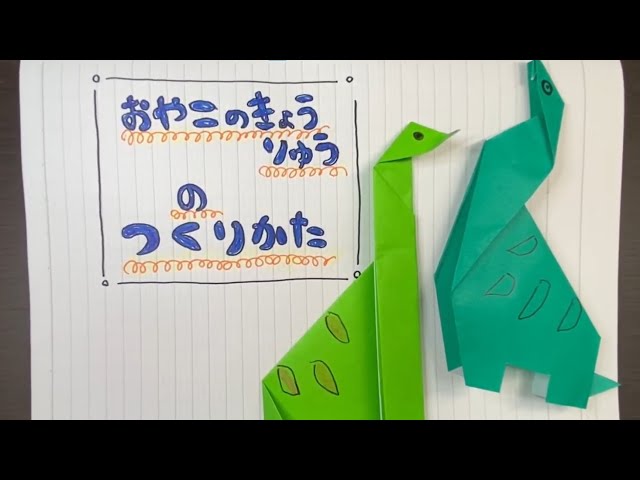
Here’s how to fold a parent-and-child dinosaur using two sheets of origami paper! First, fold into a triangle.
With the open side down, align the corner with the edge to make a right-angle crease.
Fold the bottom edge to the center line twice, rotate the paper 90 degrees, and fold so the tip forms a triangle.
Slightly fold the bottom corner to make the tail—your parent dinosaur is done.
Next is the baby dinosaur.
Start with the “octopus” base, then fold it in half inward.
Make a large diagonal squash fold at the tip, fold a small part back, and tuck the tip inside.
For the tail, use a step-fold (zigzag).
Snip the bottom slightly with scissors to make the legs.
The baby dinosaur is complete.
Finally, draw the face and patterns with a pen.
Quetzalcoatlus

Here’s how to fold a Quetzalcoatlus using a single sheet of origami paper.
First, fold the paper using the kite base, then fold the white section downward.
Bring both lowered corners to the center and crease, open them up, squash-fold them inside, and then fold the tips over to cover.
Repeat the same steps on the other side.
Pull out the inner corners, squash-fold them, then pull out the inside layers and make a cover fold.
Fold one outer layer vertically to form the legs, then tuck in one tip on a side to create the tail.
While folding the remaining tip over, shape the head, tuck in any excess, and adjust the form to finish your Quetzalcoatlus.
There are many fine steps, so try folding it together with children.
Stegosaurus

Let’s fold a stegosaurus with origami! We’ll use two sheets of origami paper.
First, turn one sheet over and fold it into a square to make a crease.
Fold it into a preliminary (kannon) base, open one side, and fold the other side up along the edge.
Turn it over and fold the left and right sides to the center crease.
Next, fold the front left and right corners to meet in the center and tuck them in.
Fold the top edge down to the center to crease, then fold in the top inner corners and open-squash them.
Turn it over, fold it in half horizontally, then fold the inner corners vertically so they stick out.
Take the second sheet and do a double “zabuton” fold.
Fold the four inner corners so they stick up slightly, then fold the piece in half so the front corner overlaps the top corner diagonally.
Finally, insert it into the first piece, and your stegosaurus is complete!
[Age 3] Have Fun Making with Your Child! Simple Dinosaur Origami Ideas (21–30)
Protoceratops

Around age three, some children start to admire “cool” things.
In this origami activity, we’ll make a dinosaur kids love: the Protoceratops.
Because it’s a three-dimensional dinosaur, pay attention to mountain and valley folds to create clear contours.
Sharply creasing the horn area will make it look even cooler.
Using glossy or larger origami paper will enhance the presence of the Protoceratops and improve the overall finish, so it’s highly recommended.