

[For 4th Graders] Fun Independent Research Ideas You Can Do With Everyday Materials


Many fourth graders are probably struggling to choose a summer break independent research topic that’s “fun but not too difficult.” In fact, you can create a project that makes your friends say “Wow!” using simple experiments and crafts with everyday materials.
Here, independent research pros introduce exciting ideas you can dive into, like a shiny coin experiment with 10-yen pieces, making kohakutou (amber sugar candy), and crafting hydrangeas.
Plus, everything from preparation to record-keeping is explained carefully, so you can take on the challenge with confidence.
Find a special independent research project that will become a lasting summer vacation memory!
- DIY science projects that elementary school boys will love: ideas you can make with everyday materials
- Simple and cute summer project crafts! A collection of ideas for girls that will make you want to create
- Recommended for elementary school students! Science fair topics & craft ideas
- Simple yet amazing crafts: craft ideas that elementary school students will want to make
- Recommended for elementary school students' independent research! Experiment and observation ideas using everyday materials
- [For Kids] Today’s Handmade Craft Ideas
- Simple but awesome! Craft ideas for upper-grade girls
- [Middle School Students] Easy One-Day Science Projects and Crafts Ideas
- Recommended Independent Research Projects for 5th Graders [Elementary School Students]
- Craft ideas using plastic bottle caps [for boys]
- Recommended for Elementary Students! A Collection of Fun Craft Ideas for 4th Graders
- Recommended for 4th graders! A collection of easy self-study ideas to try
- Amazing discoveries with everyday materials! Fun summer vacation independent research ideas
[4th Grade] Easy and Fun! Hands-on Science Project Ideas Using Everyday Materials (61–70)
Simple salt sand art
@watako.hoiku Also great for summer projects 🌻 | Salt Sand Art |Simple craftIndependent Researchtranslation
♬ เสียงต้นฉบับ – น้องมิแมวว♡ – ⋅˚₊‧ ୨ 𝒎𝒎𝒊𝒊 ୧ ‧₊˚ ⋅
This is about layering different colors of salt in a glass to create a picture-like, beautiful look.
Start by making colors that match what you want to create: mix paint into the salt to prepare it.
Once your colored salt is ready, simply layer it into the glass.
It’s best to pay attention to the boundaries between colors and avoid overmixing.
After filling the glass, press the layers to compact them—you can aim for more complex shapes this way.
Try various patterns to see what you can achieve.

Experimenting with resin?!
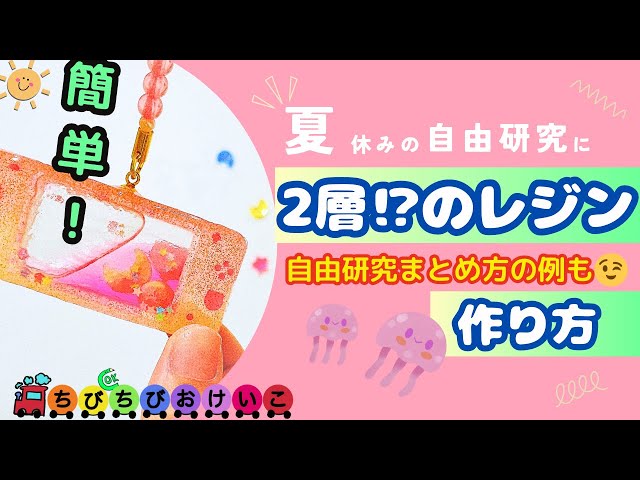
If you want to try your hand at making things with resin, why not purchase a resin craft kit? It comes with all the basic materials and tools, so you can start creating right away.
Deciding what shape to make and which parts to decorate with—and bringing your ideas to life—is a lot of fun.
While resin is often used for crafts, you can also do experiments, such as comparing how quickly different resin liquids cure! If it’s your first time, please work together with a parent or guardian.

Challenge in video production

It’s a great idea to incorporate video production into an independent research project, especially for today’s kids who are used to watching videos on YouTube and other platforms.
By switching roles—from watching to actually filming and creating their own videos—they can gain a deeper understanding of how videos are made.
It could be interesting to decide on a theme, such as who the video is for, what kind of video it should be, and how long it should be, and make that the focus of the project.
To keep it fun and engaging, it’s best to choose a topic they’re genuinely interested in.

Musical instruments made from empty cans

Let’s have fun making can instruments from empty cans.
Here, we introduce two instruments: an ocarina and another instrument that produces a scale alongside it.
Use an aluminum can for the ocarina and a steel can for the other instrument.
First, here’s how to make the ocarina.
Remove the pull-tab from the can, and tape a slightly thick straw to the mouth opening.
On the side of the can near the mouth opening, use a punch to make five holes spaced 2 centimeters apart.
Make one more hole at the top on the opposite side, and it’s done! For the other instrument, remove the can’s pull-tab and rub the bottom with something hard like a chopstick.
The pitch will change, so adjust it to the notes you want and line them up.
3 simple coasters

How about making coasters as a summer vacation craft? Here, we’ll introduce three methods.
The first is a coaster made by arranging tiles on top of paper clay.
The second is a coaster made by lining up beads and melting them in the microwave.
The third is a summery coaster that expresses a seasonal scene by placing shells, sequins, and stickers in resin.
They’re all easy to make, so give them a try.
You can buy most of the materials at 100-yen shops.
Simple kaleidoscope

Let’s make a kaleidoscope that shows rainbow colors.
Prepare three mirrors for a kaleidoscope and glue them together into a triangular prism with the mirror sides facing inward.
Place this inside a toilet paper tube, and seal one end with black construction paper that you’ve pierced with numerous holes using a pin.
Seal the other end with black construction paper that has a diffraction (rainbow) film attached at the center.
Finally, decorate the outside of the toilet paper tube with masking tape or similar, and you’re done! It’s very easy, so please give it a try.
It’s not a kaleidoscope with changing patterns, but the rainbow colors are truly beautiful.
I tried expressing sound with salt

Let’s observe how salt patterns change with sound! Tape a black plastic bag over a bowl, then poke a small hole to keep the air pressure inside the bowl stable.
Wipe the surface with a damp tissue to remove static electricity, and sprinkle salt on top.
Now you’re ready—try making different sounds near the bowl, such as low and high voices.
The salt will respond to the sound and move, creating various patterns.
It will be helpful to note which sounds produced which patterns and to take photos, making it easier to compile your report.