

Self-study that teachers will praise! Recommended independent science study ideas for 4th graders
Independent study in science can be a fun adventure for kids!
Here, we introduce self-directed science topics recommended for fourth graders that are sure to impress their teacher.
When you explore freely, learning becomes even more enjoyable.
Observe the nature around you, try simple experiments, and enjoy the thrill of discovering new things.
As your interest in nature and science grows, it’s also fun to share what you’ve learned with friends and family.
Please use this as a guide and let’s jump together into the exciting world of science!
- Recommended for 4th graders! A collection of easy self-study ideas to try
- Self-directed study that impresses your teacher! Recommended independent science study ideas for 6th graders
- Self-study that impresses your teacher! Recommended science self-study ideas for 5th graders
- Independent study that impresses your teacher! Science self-study ideas recommended for third graders
- [For 4th Graders] Fun Independent Research Ideas You Can Do With Everyday Materials
- Recommended for Elementary Students! A Collection of Fun Craft Ideas for 4th Graders
- Recommended for 5th graders! A collection of easy self-study ideas you can enjoy while learning
- Recommended for elementary school students' independent research! Experiment and observation ideas using everyday materials
- Recommended for 3rd graders! A collection of easy self-study ideas you can try
- Recommended for 6th graders! A collection of easy self-study ideas you can enjoy while learning
- Recommended for elementary school students! Science fair topics & craft ideas
- Recommended Independent Research Projects for 5th Graders [Elementary School Students]
- For 6th Graders: Unique and Fun Ideas for Independent Research Projects
Self-directed study that impresses your teacher! Recommended independent science study ideas for 4th graders (1–10)
Stargazing with a handmade telescope

How about doing astronomical observations with a telescope and turning that into your independent research project? You might think it sounds a bit boring, but here’s an idea: why not make the telescope yourself! It’s surprising, but you can build one using materials like a cylindrical empty snack box, black construction paper, reading glasses, a magnifying glass, and black vinyl tape—basically recycled items and supplies from a 100-yen shop.
Use your original telescope to observe the Moon and stars.
Hopefully, there will be a lunar eclipse or a meteor shower during summer vacation for an extra celestial show!

Let’s make kohakutou (amber sugar)

How about choosing kohakutou—beautiful and cute to look at, and delicious to eat—as the theme for your independent research project? It takes time, but you can summarize the changes over that period as your research findings.
Kohakutou is easy to make: dissolve sugar and agar in water, transfer the mixture to a container, add color with food coloring or shaved ice syrup, then once it sets, cut it and let it dry.
Depending on how much it dries, the texture will range from bouncy and soft to crisp.
You can record which number of drying days you found the most delicious and summarize your results.
plant dyeing

Kusaki-zome is a traditional technique for dyeing fabric using natural plants.
By using familiar leaves, roots, flowers, and more, you can create your own original colors, letting you enjoy learning both science and home economics at the same time.
Once you’ve prepared the fabric you want to dye and the plants to use as dye, wash the fabric thoroughly in lukewarm water.
Add protein to the fabric to perform a deep-dye (mordant) treatment, then soak the washed and dried fabric.
After carrying out a mordanting process that induces color changes through chemical reactions with metals, place the dye material in nonwoven fabric and submerge it in water.
Put the prepared fabric into the liquid, wait about 15 minutes, then rinse it well with water to finish.

Self-Study That Earns Your Teacher’s Praise! Recommended Science Self-Study Ideas for 4th Graders (11–20)
Which condiment makes a 10-yen coin the shiniest?

Many of you have probably seen videos or experiments about polishing 10-yen coins until they shine.
In this experiment, we soak 10-yen coins in various seasonings for five minutes to test which seasoning cleans them best.
Try any seasonings you have at home—soy sauce, oil, mentsuyu (noodle soup base), lemon juice, miso, and more.
Prepare some dulled 10-yen coins, soak each one in a different seasoning, then rinse them with water after five minutes.
Which seasoning will make the 10-yen coin the cleanest?
Comparing how salt and sugar dissolve in water

In connection with the way substances dissolve, which is studied in 5th-grade science, let’s compare how salt and sugar dissolve in water.
For the same amount of water, which dissolves more—salt or sugar? Also, as the water temperature increases, how does the amount that dissolves change for salt and for sugar? Summarize the results you obtain through experiments in a report.
In addition to salt and sugar, look for other substances that dissolve well in water, substances that dissolve better when the water temperature is raised, and substances whose solubility does not change much even when the water temperature is increased.

Let’s investigate how ice melts
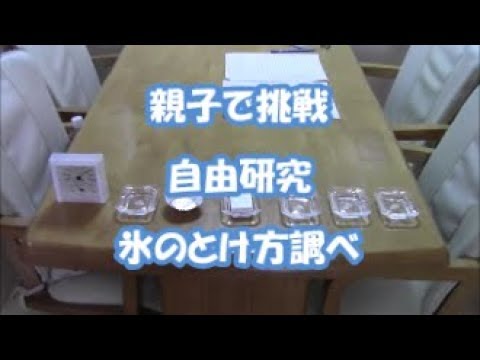
During the hot summer vacation, we often see ice—chilling drinks or eating shaved ice.
How about exploring ways to make ice last longer by researching how it melts? You can compare melting times under various conditions, such as placing aluminum foil or Styrofoam underneath, or mixing sugar, salt, or cola into the ice.
Since it’s hard to watch continuously, it’s a good idea to set a timer and check at intervals.
Let’s aim for a cooler summer with longer-lasting ice.

seaweed specimen

This is an idea to make specimens using seaweed, similar to the ones often made with flowers and plants.
When you think of seaweed specimens, you might imagine they’d get brittle and crack, or that it would be hard to remove the moisture since they’re from the water.
First, wash the seaweed thoroughly and carefully to remove the salt.
Then place it on a plastic base, arrange it into shape, and dry it thoroughly.
The trick is not to let it dry as-is, but to press it with cardboard or blotting paper, changing the paper frequently, and dry it while blowing air from the side.