

Surnames that start with “A”: from common to rare

How many surnames starting with “A” can you name?
Across the country, there are people with all kinds of surnames: not only common ones you’re likely to find among our acquaintances, but also the surnames of famous people and politicians, and even rare surnames held by only a few hundred people nationwide.
In this article, we’ll introduce a large number of surnames that start with “A.”
We’ll cover everything from familiar surnames to unusual ones, so please take a look.
We also hope you’ll find this useful as a source of hints for surname shiritori.
- Songs whose titles start with 'I'. Masterpieces that begin with 'I'.
- Inspiring quotes that resonate in your heart for a name on the back—words that will always give you strength.
- How many do you know? A roundup of words that start with 'pa'
- Food names starting with “ne,” categorized by character count
- Useful for shiritori! A list of food names that start with 'fu'
- Heisei-era graduation songs roundup: iconic youth anthems from the ’90s to the 2010s
- Can you find your destined partner? A roundup of psychology tests about names
- [Surprisingly hard to recall?] Food names starting with 'go' by character count
- Usable for Shiritori! A roundup of animals that start with “shi”
- Famous quotes everyone knows, including words from great figures and characters
- Nagoya dialect tongue twisters are exquisite! A fun collection where your tongue gets tied in knots with regional dialects
- How many can you read? Test your trivia skills with a brain-twisting ateji quiz!
- [Name Psychology Test] Will your destined person or next potential lover be revealed?!
Surnames starting with “A” (1–10)
Asada (浅田, Asada/Ashada) or Asada (麻田, Asada/Ashada)
The surname Asada is known from figures like the skater Mao Asada.
It is said to originate from Asada in Chikuma District, Shinano Province, which is now Nagano Prefecture.
Meanwhile, the surname Asada written with the characters for “hemp” (麻田) is an ancient name primarily associated with performing Shinto rituals and ceremonies; there were lineages such as Asada no Muraji and Asada no Sukune, and it is said to have branched from the Nakatomi clan.
From a word-chain perspective, since it ends with “da,” it can be a strong surname that’s hard to continue from.
Thinking about names that have lasted hundreds or even over a thousand years, it’s fascinating just to reflect on the history those names have traced.

Aida (e.g., Aida, Aida)

The surname Aida, known from figures like Mitsuo Aida, is said to be held by about 18,000 people nationwide.
It is believed to originate from Aida in Naka District, Hitachi Province, which is now part of Ibaraki Prefecture.
By prefecture, Tokyo appears to have the most people with this surname, though it is distributed across the country.
The wide distribution may be related to the fact that the surname has very old origins.
As a side note, it is also said that the reading “Sōda” (rather than “Aida”) is particularly common in central Shizuoka Prefecture.
As for specific areas, there are reportedly many people with this surname in Sanjo City, Niigata Prefecture as well.
Anzai (also spelled 安西, 安斉, etc.)
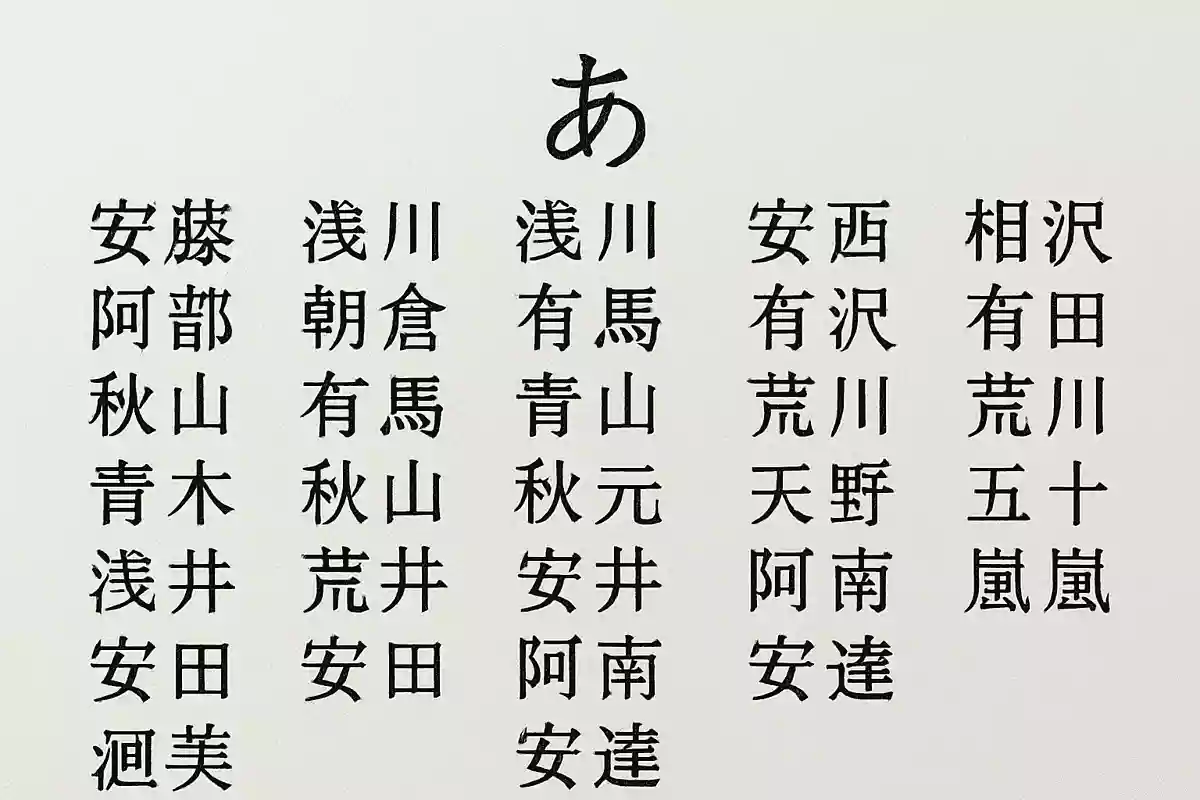
Although it varies depending on the kanji used, it is a surname that is widely distributed nationwide, mainly in Fukushima, Kanagawa, and Chiba Prefectures.
The place name in the western part of Awa District in Chiba Prefecture was called “Anzai,” and from there the name seems to have spread across the country while the kanji changed.
There are also place names spelled “安西” in Shizuoka and Mie Prefectures, so people with the surname “Anzai” likely trace their roots to different regions.
Because the character 斎 carries the meaning of enshrining deities or Buddhas, when this kanji is used it may also suggest something about the occupations of one’s ancestors.

Rare surnames (1–10)
Airoku (Goroku)
姓「合六」は「Airoku」または「Gōroku」と読み、主に佐賀県・福岡県、および兵庫県に分布しています。
It is said to have originated in the hamlet of Airoku (a smaller locality) within Nōsho, Higashi-Taku-machi, Taku City, Saga Prefecture.
With structures like Airoku Castle located at the center of the settlement, the names of buildings in the surrounding area clearly convey that this place is the birthplace of “Airoku.” The fact that there are multiple readings is also intriguing; exploring how these different pronunciations developed would be interesting.
Ainoya (Ainoya)
“Ainoya” is written as 相野谷.
Its origin is said to be in Ainoya Village, Toyoda District, Shimōsa Province, in present-day Ibaraki Prefecture.
For that reason, this surname is commonly found in Ibaraki.
There are currently about 600 people with the surname Aino’ya in Japan, around 270 of whom live in Ibaraki Prefecture—roughly half.
Furthermore, Bando City in Ibaraki stands out with about 200 people.
Incidentally, in Aino’ya, the character 野 represents vast natural fields, while 谷 denotes the land between the Yamato Mountains.

Akasofu (Akasofu)
Some of you may find this name familiar: I’d like to introduce the surname “Akasofu.” It is said to have originated in Etchū Province, which is present-day Toyama Prefecture.
Records indicate that this surname has long been known as the name of a distinguished family.
There are various theories about its etymology: some link it to the Heian-period poet Akazome Emon, while others suggest it derives from the Asobebe, a group in ancient Japan that conducted mourning and funeral rites.
If you’re curious, try looking into the historical background in more detail.
Ae (Ae)
This surname is said to have its roots in a place name located in today’s Harima Town, Kako District, Hyogo Prefecture.
It is mentioned as far back as the Nara period, and it is believed that the characters changed from the old place name “阿閇” to “阿江,” which then became widespread.
Pronouncing “阿閇” as “A-e” was characteristic of this area; in other regions, the same “阿閇” was read as “A-toji,” which led to the variant surname “阿閉” after the characters changed.
Because this surname is rare nationwide, it may be easier to identify which region it originates from.