

![[For Wind Bands] The Appeal of the Double Bass Part and Fundamental Exercises You Should Practice](https://media.ragnet.co.jp/img/1200__jpg__https://www.ragnet.co.jp/files/2016/09/6df700bd336e379bc351d0466a970752.webp)

“The double bass is fun! I love supporting everyone with those low notes!”
When I teach the double bass section in the concert band, I hear a lot of different voices.
I believe that throwing yourself into practice for the regular concert and competitions will become a great asset and a treasure in the future.
Competitions are about results, but it’s the process leading up to them that truly helps you grow.
One event ends, and you can finally take a breath.
Before the generational shift and moving up a grade, I’ve put together some thoughts on what to focus on during this period and how to approach practice when playing double bass in a concert band.
- Practice songs for beginner electric bass players
- [Brass/Wind Band] Recommended for Beginners! A Collection of Classics and Popular Pieces Perfect for Practice
- [Practice!] Practice Songs for Beginner Bassists During Spring Break
- Recommended pieces for a wind band contest
- [History] A roundup of popular set pieces from the All-Japan Band Competition
- Practice pieces for beginner trumpet players
- Perfect for free selections and concert programs! Introducing famous and classic favorites in wind ensemble music.
- Master one song over summer break! Recommended practice songs to level up your bass
- [Low End] A collection of Japanese songs with high-difficulty bass parts [Cool]
- Enrich your natural voice resonance: chest voice practice pieces and tips for improvement
- Practice pieces for beginner flutists. Recommended practice pieces.
- Wind Ensemble: Brass Band Pieces Popular with Girls. Masterpieces of Wind Music Recommended for Women.
- [Wind Band] Guaranteed to hype up the school festival! Recommended pieces the brass band will want to play
What is a contrabass?
First, please listen to the following performance.
Reinhold Glière (January 11, 1875 – June 23, 1956) was a composer who was active from the late Russian Empire to the early years of the Soviet Union.
The ballet music The Bronze Horseman by Glière (originally for orchestra) is performed by many ensembles, including at wind band competitions.
double bassorchestranot onlyJazzIt’s an instrument that plays an active role across a wide range of music scenes, regardless of genre, including pop.
Among them, following the orchestra, the next most prominent is the double bass as it appears in wind ensembles.
In the world of wind ensembles—especially in middle and high school band programs—the tuba, as the only string instrument,baritone saxophone、bass clarinetTogether with instruments like these, it handles the low-frequency range and serves as the unsung hero supporting the entire band.
The contrabass—also known as the double bass or string bass—has a unique name in the wind band world: “gen-basu” (string bass).
Japanese wind bands are of an exceptionally high level by global standards, but when it comes to the double bass in school wind bands, it’s still a work in progress. As the only string instrument, there are unique challenges—such as having no one nearby who can teach it and few opportunities for proper instruction.
Here, we shine a spotlight on the double bass in school wind bands and introduce what you should know to play the double bass in a wind band.
While being invited as an instructor to many workshops and teaching students, I have often heard comments like, “I had no seniors, so no one ever taught me,” and “I’ve tried various things through trial and error, but I don’t know what’s correct,” as well as concerns from teachers struggling to instruct string instruments outside their specialization.
If the teachers who provide instruction are struggling and the students who play instruments are also struggling, I’ve long been wondering whether a professionally trained double bassist could offer some kind of help.
I often hear people say, “I’m not good at it…,” but that’s absolutely not true.
It's not that you're 'bad'—you just don't know how to play it yet, and things aren't going well because you don't know the method.
It often happens that with just a little advice, someone becomes able to play.
Being able to do it with just that little bit of advice was because I already had the ability to do it.
I believe that treasuring those small moments of success—like “I did better than before” or “That went a bit more smoothly”—and steadily building up practice is the quickest path to improvement.
Let's review the basics!
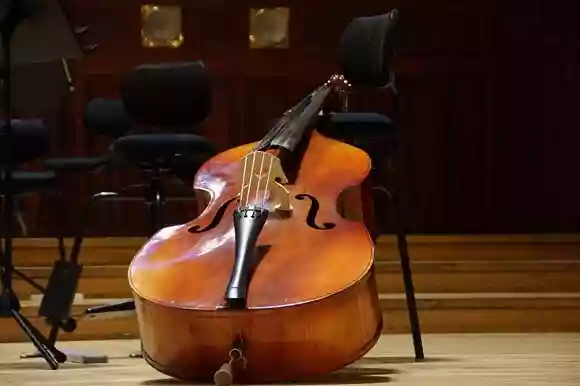
https://pixabay.com/
How is your work on basic practice going?
Whether you’ve been practicing every day, let it slide a bit, or only worked on it during basic ensemble sessions, let’s treat this as a fresh starting line and review the fundamentals—such as bowing and finger shape—to strengthen your foundation.
How to hold the instrument
Stand directly beside the instrument, step your left foot one step back, and place your right foot slightly forward.
Since the instrument and your body are facing straight ahead, turn your body slightly toward the instrument and tilt the instrument slightly toward yourself.
Stand with your feet about shoulder-width apart, and try making small adjustments by moving the instrument so that it can be supported around your hip bones.
Imagine the instrument leaning against you and being supported around your hip bone. Note: If you are short, you’ll find it easier to hold by tilting the instrument slightly.
How to hold a bow
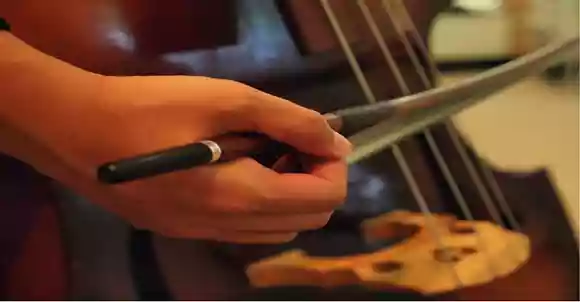
Make an OK sign with your right hand.
Place the frog inside the OK sign, hold the top with your index finger and thumb as if holding a pencil, and support the bottom with your pinky. The other two fingers should simply rest on the frog. Avoid gripping the bow tightly.
There are many ways to hold the double bass and many ways to hold the bow.
These are just examples, so try referring to the photos found in instruction manuals and similar resources.
Right-hand bowing practice
Bowing is the most important technique in playing string instruments.
First, let’s practice the right hand using open strings.
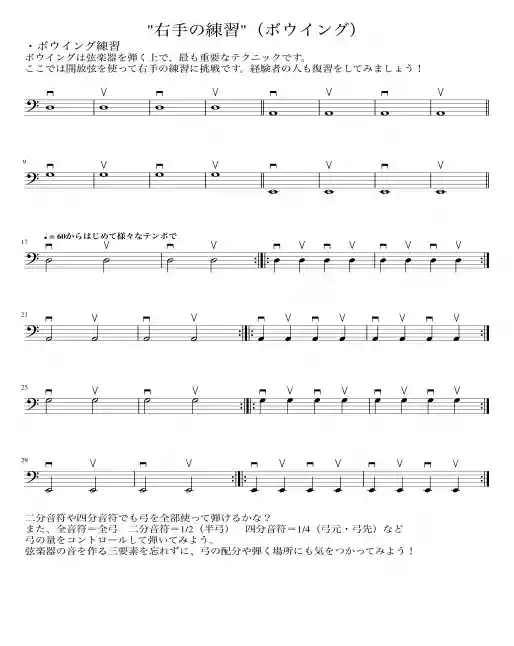
Tempo ♩=60. On each string (open string), play for four beats. Use the fingerboard seams as a guide to set your bow, moving from the frog to the tip (down-bow), and once you reach the tip, return to the frog (up-bow).
It’s best to work on producing a rich sound—more of a “boo” or “boon”—by pressing the bow firmly against the string, rather than a scratchy “gari-gari-gari” noise.
For beginners
- Is your way of holding the bow okay?
- Is the bow and string at a right angle?
- Isn’t the tip of the bow lowered?
First, we’ll check the setup before making any sound.
Alright! If you think it's okay, try playing the sound.
Make sure the speed is uniform from the base of the bow to the tip.
If the bow speed changes midway, the pitch will change.
At first, it can be helpful to approach it like a game, trying not to move the tuner’s needle from the straight (center) position.
Using the bow = Using the breath
As they say, bowing is like breathing; when playing with other instruments, be sure not to forget to take clear breaths.
It’s important to be mindful of it starting from basic practice.
Three important things for determining tone color and volume
- Where on the string to bow (from near the fingerboard to near the bridge)
- How much pressure to apply to the bow
- How much of the bow to use (bow speed)
After playing each string with a full bow, try playing them as half notes or quarter notes as well!
Since it’s difficult to check your own playing posture yourself, I also recommend practicing while watching your reflection in a hallway mirror or a classroom window.
It’s helpful to practice bowing by imagining you’re watching yourself play in a mirror and giving yourself advice; when you have section mates, face each other and practice bowing together.
The Story of the Left Hand
When pressing down the thick strings of the double bass, forming the correct shape with the left hand is very important for producing good intonation.
Whether during individual practice, basic ensemble time, or sectionals and full ensemble rehearsals, let’s make a conscious effort to maintain a stable left-hand position in every situation.
How to remember finger numbers
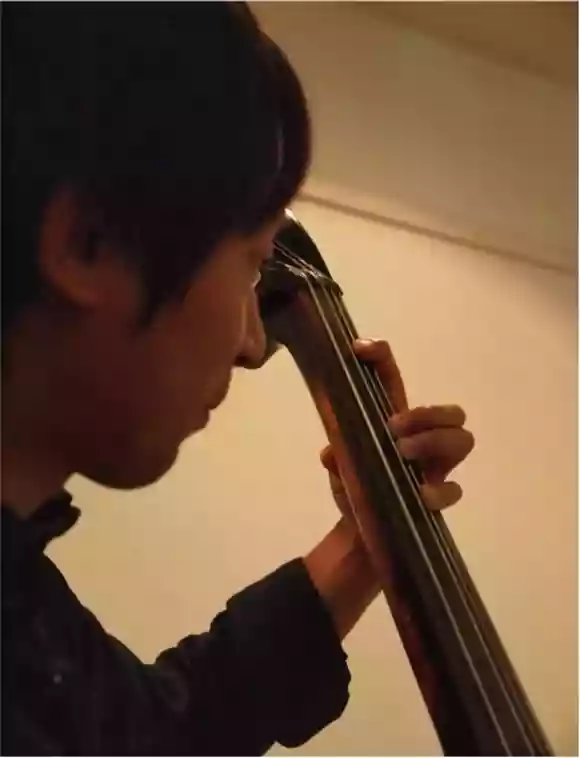
The finger numbers for double bass are
- Index finger…1
- Middle finger…2
- Ring finger... 3
- Pinky finger…4
It says so, but since the ring finger only supports the pinky, the fingers you actually use are 1, 2, and 4.
(From around the G an octave above the G on the G string, use the 3rd finger.)
As for how to remember those finger numbers,
- Finger 1 uses a single finger to press.
- Finger 2 is a finger pressed with two fingers.
- The fingers for 4 are the four fingers used to press down.
Try to remember it like that.
The intervals between 1 and 2, and between 2 and 4 are each a semitone, while the interval between 1 and 4 is a whole tone.
Because the double bass, unlike a guitar, has no frets, you can achieve accurate intonation by maintaining the shape and spacing of each finger—your left hand effectively serves as the frets.
At first, it can be difficult to maintain the shape of your left hand; the fingers that should stay pressed may lift off, or because of weak strength, other fingers may crowd toward the finger pressing the string.
Pressing thick strings is tough, but let’s practice scales slowly and get used to the feel of pressing the strings.
If your fingers or wrist hurt while pressing the strings, don’t push yourself—take a break.
You may also see playing styles where only one finger is used to press down the strings, or where the neck is gripped tightly while pressing.
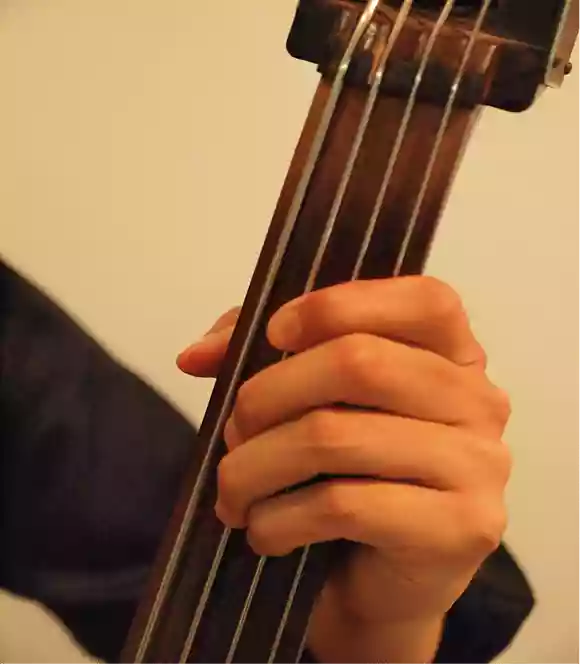
When you’re not used to it, gripping the neck might help you hit the pitch for individual notes, but with this technique you won’t be able to move quickly.
It also becomes difficult to hit/leap wider intervals.
The shapes of the left hand and the finger numbers are designed to minimize wasted movement and enable efficient playing. At first, it can be difficult to learn the spacing of the pitches, but keep practicing patiently and you’ll gradually get used to it.
Let's challenge ourselves with the chromatic scale
In addition to the keys we’re working on in basic ensemble practice, let’s challenge ourselves to play scales in all keys.
The double bass is an instrument on which it’s hard to play in tune, so daily scale practice is very important for developing your sense of pitch.
Because the double bass doesn’t have frets like a guitar, you determine pitch using your ear and the shape/feel of your fingers. Any stickers or pencil marks on the fingerboard are only rough guides.
It would be good to master all the major and minor scales by the time the new members join, and then from April, practice them together one by one.
Practice tempo guideline: ♩ = 60 ~ as you like
Let's get creative using techniques like whole bow, half notes, quarter notes, and eighth notes!
It would be good to start by practicing the major keys (dur) first, and then the minor keys (moll).
Lastly
How was it?
This is a summary of what we’d like those of you to work on who are playing the double bass in a wind ensemble but don’t have many opportunities to receive instruction, and who are the only one in your part and aren’t sure what to do.
If reading this article made you think, “I want to get better!”, be sure to pick up a method book written specifically for double bass in wind ensemble.
These days, many lesson DVDs and instructional books are available, making it possible to access a wealth of information.
The double bass is an indispensable instrument in wind ensembles.
But the reality is that it still exists under very challenging conditions, such as there being no one nearby to teach it as the only string instrument.
After the competition is over, and before the new students arrive, take another look at yourself and work on overcoming your weaknesses.
And please pass on not only the techniques for playing the double bass, but also the knowledge and practice methods, as a fine tradition of the double bass section to the next generation.
somedayNew club member…also comes.
What to convey as a senior and how to teach it.
What should be passed down as the good traditions of the part?
I’d be happy if you could come back and read it again—like opening a map when you’re troubled or lose your way.