

Songs to Listen to on Children’s Day | A Curated Selection of Music for Tango no Sekku!


As Children’s Day approaches, is there a song that you suddenly find yourself humming?Nursery rhymes and seasonal songs related to Tango no Sekku have long been cherished across generations as an important part of Japanese culture.In this article, we’ll introduce songs associated with Tango no Sekku that will fill you with nostalgia the moment you hear them—from those everyone knows to classic tunes whose lyrics you might not actually remember.Singing them with your child will make seasonal traditions feel closer and more fun.Enjoy them together with your family!
- Nursery rhymes and fingerplay songs to enjoy in May! Songs perfect for the fresh green season
- [Children’s Day Hand-Play Songs] A Collection of Nursery Rhymes & Traditional Children’s Songs for Parents and Kids to Enjoy Together
- [Songs for May] Tracks that suit fresh greenery and driving & Mother's Day songs
- [Children's Songs] Cute songs recommended for childcare. List of popular nursery rhymes.
- Children’s Song Rankings [2026]
- Nursery rhymes to sing in spring: a collection of classic songs you'll want to sing with your children
- [Hinamatsuri Songs] A roundup of classic Girls’ Day tunes and unexpected Hinamatsuri tracks
- What karaoke songs can kids sing? Popular karaoke songs for parents and children to sing together as a family.
- Recommended dance music for children. Kid-friendly dance tunes that make you want to move.
- Kids will love it! A collection of dance song ideas with easy-to-follow rhythms
- Children’s songs for Hinamatsuri: A collection of songs everyone can sing together for the Doll Festival
- An anthem to support childcare that I want to dedicate to moms and dads. Inspiring classics and popular songs that keep you going.
- Babies and kids will smile! A heartwarming collection of songs for children
Songs to Listen to on Children's Day | A Curated Selection of Tracks Related to Tango no Sekku (1–10)
rainbowSakushi: Shinzawa Toshihiko / Sakkyoku: Nakagawa Hirotaka

A gem of a song by Toshihiko Shinzawa and Hirotaka Nakagawa, it gently sings of hopeful expectations for tomorrow, themed around meeting a seven-colored rainbow in the garden after the rain.
Since its release in 1990, it has been loved by many for its lyrics that depict small everyday joys and its warm melody.
In 2020, it was featured as the commercial song for Kao’s “Attack ZERO,” revealing new charm alongside striking visuals starring Tori Matsuzaka and others.
It’s a tune you’ll want the whole family to hum together, especially when you’re feeling down.
A I U E O music ♬GReeeeN

It features an appealing, playful melody and rhythm that skillfully incorporate the Japanese syllabary.
This work expresses the beauty of language and music, carrying a message about the importance of communication.
収録アルバム「いいね!(´・ω・`)☆」に含まれ、2013年4月にはテレビ東京系アニメ「LINE TOWN」のオープニングテーマにも起用された。
With GReeeeN’s characteristically positive worldview, the song has gained popularity and can be enjoyed across generations, from children to adults.
It is also well-received as a choral piece for school music classes and events, making it a recommended song for everyone to sing together and feel energized.
Anpanman ExerciseSakkyoku: Makaino Kōji / Henkyoku: Kondō Hiroaki
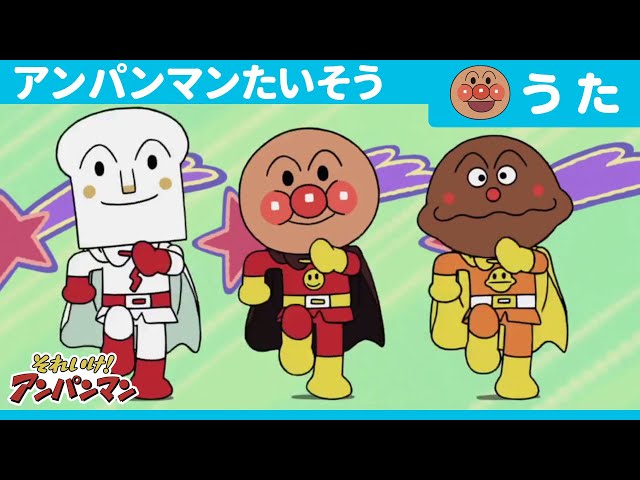
The lyrics written by Takashi Yanase carry deep messages—about the courage to face difficulties and the preciousness of bonds with loved ones.
Thanks to these powerful themes, the song has continued to be loved by a wide range of generations, from children to adults.
It was released by CHA-CHA in July 1991, followed by Dreaming’s version in March 1993.
The song has been used as the ending theme for the TV anime since 1991, and since April 2011 it has been broadcast with animation featuring new characters.
It’s a perfect track for when you want to get moving or enjoy time together with someone.
Songs to Enjoy on Children’s Day | A Curated Selection for Tango no Sekku (11–20)
I love big hugs!Sakushi: Tadokoro Yoko / Sakkyoku: Tayama Masamitsu

A heartwarming song that expresses warm affection.
Broadcast in August 1999 on NHK’s “Okaasan to Issho” as a popular song performed as a duet by Ayumi Shigemori and Kentaro Hayami, it teaches the importance and joy of embracing.
From interactions with family, pets, and friends to conversations with nature, it charmingly depicts various scenes and conveys the richness of expressing love.
This piece is a heartwarming song that parents and children of the child-rearing generation can enjoy singing together.
If you want to deepen your family bonds, why not try singing it with your child?
paprikaFoorin×Yonezu Kenshi

A collaborative song by Foorin and Kenshi Yonezu that brightly sings of children’s dreams and hopes.
The cheerful, energetic voices of the kids and the festive, lively sound create a work that gently resonates with the heart.
The lyrics charmingly depict nature and the changing seasons, imbued with feelings for loved ones and a shining sense of anticipation for the future.
Released in August 2018, it is also known as an official song of the Tokyo 2020 Olympic and Paralympic Games.
Beloved by a wide range of generations from children to adults, it won the 61st Japan Record Award in December 2019.
It’s a heartwarming track perfect for seasonal transitions, taking a new step forward, or spending special moments with someone important.
strollInoue Azumi

The theme song from Studio Ghibli’s hugely popular film My Neighbor Totoro.
Just hearing the intro makes you want to march energetically—it’s a track brimming with excitement.
On Children’s Day, if you sing it together while wishing for kids’ healthy growth, you’re sure to feel a surge of energy! The time spent singing Ghibli’s classic tunes with family and friends will become a lifelong memory for your child.

If you’re happy and you know it, clap your handsAmerika min’yō (sakushi: Kimura Toshihito)

Beloved for many years as a hand-play song, this piece was born in 1959, inspired by YMCA work camp activities in the Philippines.
Its warm melody carries wishes for peace and friendship, and its lyrics charmingly express happiness with the whole body.
In May 1964, Kyu Sakamoto recorded the song, achieving an astonishing 700,000 in sales.
It was chosen as the entry march for the opening ceremony of the 37th National High School Baseball Invitational Tournament in 1965, and in 2007 it was selected for the Agency for Cultural Affairs’ “100 Best Songs of Japan.” Despite its simple structure, it is used in childcare and educational settings as a participatory piece that can be enjoyed while moving the body, with hand claps, foot stomps, and more.