

Classical piano masterpieces: legendary performances from around the world you should hear at least once

“Classical piano sounds interesting, but where should I start listening?” Even within classical piano, the music differs greatly by era, style, and composer—and everyone’s tastes vary.
This feature is an introductory guide just for you.
It broadly covers famous and popular pieces from across times and places, so you’re sure to discover a piece you love.
Once you find a favorite, it’s fun to compare works by the same composer or pieces written in the same period.
- [Masterpiece Classics] A special showcase of gem-like masterpieces so beautiful they’ll move you to tears
- Chopin’s masterpieces. Popular classical music.
- Classical masterpieces. Recommended classical music.
- Masterpieces of classical piano that are too beautiful for words. A gathering of delicate tones that cleanse the soul.
- [Ultra-Advanced] Even challenging for advanced players! A curated selection of highly difficult piano pieces
- François Couperin Popular Songs Ranking [2026]
- Cello Masterpieces: A comprehensive introduction to exquisite classical works that let you savor its profound timbre
- Popular classical piano pieces. A collection of masterful performances by Japanese pianists.
- Pick up Beethoven’s famous and representative works!
- Timelessly beautiful classical masterpieces. Recommended classical music.
- Famous pianists you should listen to at least once. Recommended pianists.
- [Classical] A comprehensive introduction to famous love pieces: recommended popular works
- [Intermediate Level] A curated selection of piano masterpieces featuring strikingly brilliant melodies!
Masterpieces of Classical Piano: World-Class Performances You Should Hear at Least Once (51–60)
Toward the flamesAlexandre Scriabine
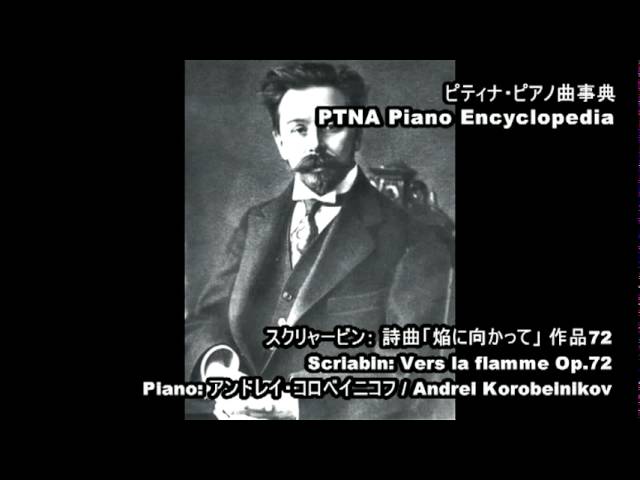
In the era when functional harmony collapsed or was expanded, a great deal of highly individual music was created.
Scriabin, who composed a uniquely harmonic music known as the ‘mystic chord,’ was one such figure.
‘Vers la flamme’ is colored almost throughout by this mystic harmony.
Variations for PianoAnton Webern

Among the Second Viennese School, Webern composed with the most rigorous technique.
He made the twelve-tone method even more stringent, becoming the source of what would later be the mainstream of contemporary music: total serialism.
This piece is also very famous as a root of serial music.
Piano SonataBartók Béla

Bartók was a composer who conducted in-depth research into regional folk music and reflected it in his works, pioneering a new musical idiom.
His Piano Sonata is, among his piano pieces, relatively grounded in the classical tradition.
Even so, distinctive scales such as whole-tone collections appear, making it unmistakably Bartókian music.
The Swan from “The Carnival of the Animals”Camille Saint-Saëns

Saint-Saëns was a French composer of the late Romantic era.
He was a precocious genius who entered the Paris Conservatory at the age of 13.
The Carnival of the Animals is often performed by orchestra or chamber ensemble, but in piano performances it is most commonly played as a duet for four hands.
Invitation to the Dance in D-flat majorCarl Maria Friedrich Ernst von Weber

Composed by Weber, Invitation to the Dance in D-flat major.
It’s even performed at children’s music schools during recitals.
It’s a lovely piece that has everything: charm and passion, lightness and warmth.
It’s also fairly substantial in length, so I highly recommend it for concerts.
A wonderful piece that’s enjoyable both to listen to and to play.

Andante and Variations in F minorFranz Joseph Haydn

In classical music, the period that followed the Baroque was the Classical era.
Strictly speaking, sometimes only the Classical and Romantic periods are referred to as “classical.” Haydn was a great composer who established the golden age of the Classical style.
Among piano pieces, this is probably the most famous.
Woman of the House of BourbonFrançois Couperin

The culture of Baroque music extends not only to Germany but across all of Europe.
The French composer Couperin is also one of the representative composers of the Baroque era.
This piece is included in the First Suite of the first volume of the Pièces de clavecin.