

Let's make it with origami! A collection of ways to fold “dinosaurs”

There are lots of kids who love dinosaurs, aren’t there?
Dinosaurs are so fascinating that not only boys but girls, too, can get totally absorbed in them.
In this article, we’ve put together instructions for folding dinosaurs that are popular with kids, like the Tyrannosaurus, Triceratops, and Pteranodon.
There are a variety of models, from easy to difficult, so be sure to try them together as a parent-child activity.
If you change the size or type of origami paper, you can make them look even cooler—your kids are sure to be thrilled when they see the finished results!
Adults might get hooked, too!
Let’s make all kinds of dinosaurs and have fun.
- For Age 3: Have Fun Making with Your Child! A Collection of Easy Dinosaur Origami Ideas
- Origami ideas boys will want to make!
- Perfect for first-timers! A collection of origami that’s super popular with kids as young as three!
- Simple origami for kids: cute, playable origami ideas
- Let's make dinosaurs with origami! Easy ideas kids can make
- Origami perfect for summer. Fun and easy for kids to make!
- [Childcare] For 4-year-olds! Easy winter origami ideas
- [For 5-year-olds] Let’s make origami! A collection of fun folding ideas
- It moves! You can play with it! Fun origami. How to make origami toys.
- [Kindergartners (Older Group)] Folding is Fun! Recommended January Origami Idea Collection for Senior Kindergarteners
- [For 4-year-olds] Let's fold! A collection of simple rabbit origami ideas
- [For 3-year-olds] Easy snowman origami (how to make)
- [Childcare] Origami Snake Folding Ideas Collection
Let’s make it with origami! A roundup of how to fold dinosaurs (1–10)
Therizinosaurus

The therizinosaurus is a dinosaur known for its sharp, long claws.
It’s still unclear exactly what those claws were used for, but they look powerful and undeniably cool.
While it may not be one of the classic fan favorites, there are probably many people who secretly love this dinosaur.
This origami therizinosaurus perfectly recreates its impressive claws! If you’re a fan of therizinosaurus, this is an origami model you should try at least once.
You’ll use a large sheet of origami paper, but the claw section involves delicate work, so if your own nails are short, you might find it a bit tricky.

Stegosaurus

Why not try making a Stegosaurus—the dinosaur with distinctive jagged plates on its back—out of origami? The video uses 24×24 cm origami paper, but the design is simple enough that 15×15 cm works just fine.
Although the difficulty level is on the lower side, it faithfully reproduces the Stegosaurus’s signature jagged back, making it well worth making! With its classic “dinosaur” look, kids are sure to love it too.
Be sure to check out the video and give it a try.

Quetzalcoatlus

Quetzalcoatlus, one of the largest pterosaurs in history.
It was originally said to glide, but recently there’s been talk that it might actually have been poor at flying altogether.
It was even bigger than Pteranodon, with a long neck and a very large head.
This origami Quetzalcoatlus faithfully captures that somewhat unbalanced appearance.
The step where you open a folded section and create a crease in an uncreased area is tricky, so proceed carefully while checking each fold.
Let’s make it with origami! A roundup of how to fold ‘dinosaurs’ (11–20)
Eoraptor

Eoraptor, a small dinosaur considered one of the most primitive and earliest dinosaur types.
Slender and, at first glance, looking like a lizard with longer legs, Eoraptor was about one meter in length.
Here we introduce how to fold an origami Eoraptor.
To capture its slim body, the folding method includes quite a few fine steps and may be difficult for small children, but with adult support and by taking it slowly and carefully, it will be fine.
At the end, set the angle of the head and fold it firmly into place.

Velociraptor

Velociraptor is a small carnivorous dinosaur said to be one of the most intelligent of its kind.
In the Jurassic World series, there’s a Velociraptor named Blue.
This time, let’s make a Velociraptor out of origami.
You can make it with a standard-sized sheet of origami paper, and it turns out impressively detailed and cool.
If you fold it with gray paper and draw blue markings, you can probably recreate Blue.
Its mouth is open, so you can pretend it’s biting and play with it.
Pteranodon
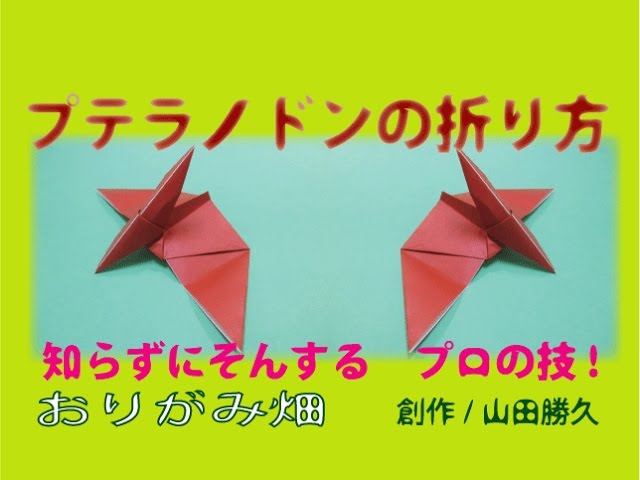
Why not try making the popular winged dinosaur Pteranodon with origami? Pteranodons are well-known because they appear in dinosaur-themed movies, novels, and manga, such as Jurassic Park.
You can make one with a single sheet of standard origami paper, so it’s easy to try! It’s simple to fold while still capturing the sharp head and cool wings, so give it a go! It’s great for parents and kids to make together, and it’s perfect for a summer vacation project.
Giganotosaurus

The giant dinosaur Giganotosaurus is said to have reached a total length of about 13 meters.
It was an even larger dinosaur than Tyrannosaurus and a large carnivore that lived on the South African continent.
Here are the steps to fold an origami Giganotosaurus.
First, fold it into a triangle, then fold it into a triangle again to make creases and open it up.
From there, the folds get a bit more detailed, so you might think it’s difficult, but there are only a few slightly fine folds.
As you continue, it’s not all that intricate.
It can even stand on its own.