

Even beginners can play them easily on the piano! A curated selection of popular and latest J-POP songs.


The piano has such a beautiful tone, and depending on how you play it, it’s a captivating instrument that can produce a grand, resonant sound.
These days, we’re seeing more videos of people casually playing popular J-pop songs at home, as well as impressively performing on street pianos.
Maybe some of you are thinking, “I want to play like that too!”
In this article, we’ll introduce easy-to-play J-pop songs on the piano—perfect for complete beginners or those who’ve just started—along with some of the latest hits.
If you want to try playing your favorite songs or expand your repertoire, be sure to use this as a reference.
- [Piano Beginners] J-POP That Looks Hard but Is Surprisingly Playable [2026]
- Recommended for piano beginners! 10 sheet music picks that adults can enjoy too
- [Piano × J‑Pop] A curated selection of the coolest new hits and anime songs that’ll look great when you play them
- [For Beginners] Recommended Ghibli Masterpieces You’ll Want to Play on the Piano
- It’s so cool if you can play these on the piano! A selection of irresistibly charming masterpieces.
- [Piano × Vocaloid] A selection of recommended songs that are easy for beginners to play
- Disney Classics on Piano: A Curated Selection of Easy Pieces, Perfect for Recitals
- [Piano Etudes] Recommended for Beginners! A Curated Selection of Easy, Playable Pieces
- [For Beginners] I Want to Play These on Piano! Recommended Anime Songs Compilation
- Piano Masterpieces: Surprisingly Easy Despite Sounding Difficult!? A Curated Selection Perfect for Recitals
- [Piano Solo with Vocals] Recommended for Piano-and-Vocal Performances! Hit Songs from the Heisei to Reiwa Eras
- [Piano Pieces] Easy for Children to Play! A Roundup of Simple Classical Works
- [Intermediate Level] Cool Piano Pieces You Can Play [Great for Recitals Too]
Even beginners can easily play these on piano! A curated selection of popular and latest J-POP songs (71–80)
Kaikai KitanEVE

The opening theme for the first cour of the TV anime Jujutsu Kaisen is Eve’s Kaikai Kitan.
It even ranked fifth on Billboard’s download chart.
In the A section, there are parts built around two adjacent notes, and in the chorus, parts centered on the same note an octave apart, which makes it easier to remember which keys to play.
To bring out the uptempo sound of the track, the left hand keeps playing at the same pace, and because there are many repeated notes, it’s beginner-friendly as well.

Ojamajo Carnivalike takeshi
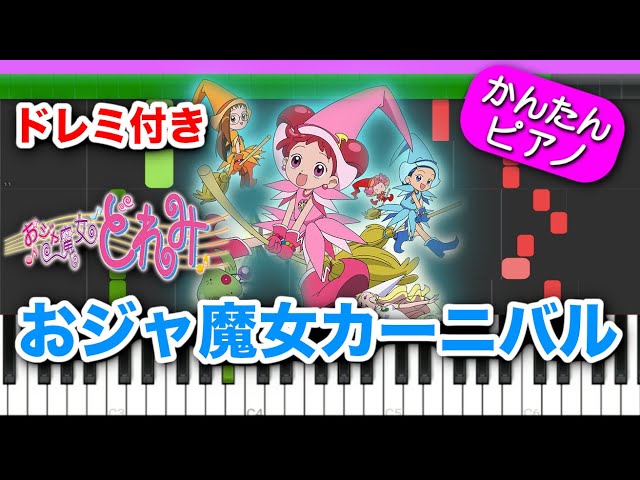
When it comes to the first opening theme of the TV anime series Ojamajo Doremi, produced by Toei Animation since 1999, it’s undoubtedly Ojamajo Carnival!! Even after the show ended, this song has remained enormously popular, and many beginner pianists surely want to try playing it.
As the saying goes, “What one likes, one will do well,” and there’s nothing quite like the joy of improving by practicing a song you love.
It may be difficult to play at full uptempo right away, but the piece is packed with many musical fundamentals: frequent flats, numerous developments, and combinations of complex rhythms.
It also modulates smoothly—such as shifting from the main key to its parallel key—without feeling out of place.
As you become more comfortable reading sheet music, you’ll start to sense the musical seasoning directly from the score and rediscover how wonderful the piece is.
It’s a fun song, so practice little by little and work your way up to playing it!

cherrysupittsu

Cherry, Spitz’s massive hit that became a million seller with over 1.61 million copies sold.
It’s a classic of the Heisei era, with cover versions released by many artists including Masaharu Fukuyama, Sho Kiryuin, and Misato Watanabe.
The simple, quintessential Spitz melody and sound pair perfectly with the tone of the piano! Even with an arrangement featuring only left-hand bass notes and a right-hand single melody line, you can fully savor the feel of the original.
If you practice while humming along, it becomes easier to catch the subtle movements of the melody!

for a long timeKiroro

A heartwarming ballad with a charming, gentle chord progression! This song by Kiroro was released as a single in 1998.
The lyrics, filled with gratitude and affection for loved ones, softly resonate with listeners.
Composed in F major with a steady 4/4 rhythm, it uses basic chords like F and C, making it perfect for chord practice.
Start by holding simple block chords with your left hand and tracing the melody with your right.
Highly recommended as a song for singing and playing.
foreignerKUBOTA Saki

Saki Kubota’s “Ihōjin – Theme of the Silk Road” features a distinctive, exotic-tinged melody that leaves a strong impression.
Released in 1979 as her debut single, it’s a timeless classic that has been loved across generations and covered by many artists.
Since the piece alternates between sections played gently and sections with a firmly articulated rhythm, be sure to create clear contrasts so you don’t pull each other off tempo.
For the rhythmically driven parts, it’s recommended to use staccato effectively.
Like the original, play the opening as the most flamboyant section to capture the audience’s attention right from the start.

sasanqua (Camellia sasanqua)SEKAI NO OWARI
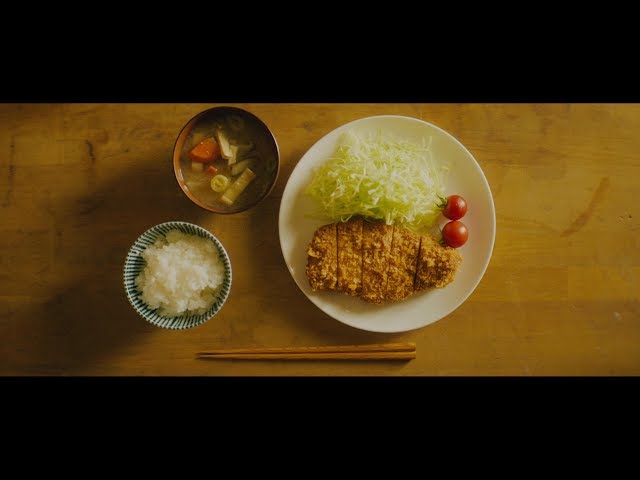
A warm ballad that resonates as an anthem cheering on those who chase their dreams! Created by SEKAI NO OWARI, it became well-loved as NHK’s theme song for the 2018 PyeongChang Olympic and Paralympic broadcasts.
The lyrics are striking, likening resilience to a sasanqua blooming in the cold season—continuing to blossom without giving up even in difficult times.
With a relaxed tempo at BPM 75, it’s easy to practice calmly, and its simple chord progression is also appealing.
Start the left hand with block chords, and once you’re comfortable, try moving on to arpeggios.
migratory bird[Alexandros]
![migratory bird[Alexandros]](https://i.ytimg.com/vi/C0jkZrq_Yms/sddefault.jpg)
A number that’s bursting with the exhilaration of flying through the sky: “Wataridori” by [Alexandros].
Released in 2015 as a double A-side single together with “Dracula La,” this song was chosen as the theme for the film Akegarasu.
While the A and B sections are relatively calm, it’s important to keep a solid beat and maintain the energy throughout the entire track.
Keep the rhythm tight while clearly distinguishing the A and B sections from the chorus to create dynamic contrast and a brilliant performance.
For the chorus’s lift, try playing in octaves or layering parts to enhance the impact.