

Even beginners can play them easily on the piano! A curated selection of popular and latest J-POP songs.


The piano has such a beautiful tone, and depending on how you play it, it’s a captivating instrument that can produce a grand, resonant sound.
These days, we’re seeing more videos of people casually playing popular J-pop songs at home, as well as impressively performing on street pianos.
Maybe some of you are thinking, “I want to play like that too!”
In this article, we’ll introduce easy-to-play J-pop songs on the piano—perfect for complete beginners or those who’ve just started—along with some of the latest hits.
If you want to try playing your favorite songs or expand your repertoire, be sure to use this as a reference.
- [Piano Beginners] J-POP That Looks Hard but Is Surprisingly Playable [2026]
- Recommended for piano beginners! 10 sheet music picks that adults can enjoy too
- [Piano × J‑Pop] A curated selection of the coolest new hits and anime songs that’ll look great when you play them
- [For Beginners] Recommended Ghibli Masterpieces You’ll Want to Play on the Piano
- It’s so cool if you can play these on the piano! A selection of irresistibly charming masterpieces.
- [Piano × Vocaloid] A selection of recommended songs that are easy for beginners to play
- Disney Classics on Piano: A Curated Selection of Easy Pieces, Perfect for Recitals
- [Piano Etudes] Recommended for Beginners! A Curated Selection of Easy, Playable Pieces
- [For Beginners] I Want to Play These on Piano! Recommended Anime Songs Compilation
- Piano Masterpieces: Surprisingly Easy Despite Sounding Difficult!? A Curated Selection Perfect for Recitals
- [Piano Solo with Vocals] Recommended for Piano-and-Vocal Performances! Hit Songs from the Heisei to Reiwa Eras
- [Piano Pieces] Easy for Children to Play! A Roundup of Simple Classical Works
- [Intermediate Level] Cool Piano Pieces You Can Play [Great for Recitals Too]
Easy Piano for Beginners! Carefully Selected Popular and New J-POP Songs (51–60)
mixed nutsOfisharu Higedan Dism

Official HIGE DANDism’s “Mixed Nuts” has plenty of substance in both rhythm and note count to make it a satisfying piece for a recital performance.
Released in 2022, the song was chosen as the opening theme for the anime SPY×FAMILY.
For the opening, ad-lib-like section, it’s recommended to play freely and flamboyantly to create the feeling that things are about to kick off.
Since the notes are densely arranged, be careful not to miss any.
The rhythm can also be tricky, so practice at a slow tempo until you get used to it.
Once you can play it in tempo with a solid groove, it’s an incredibly rewarding piece.

The One and Only Flower in the WorldSMAP

Sekai ni Hitotsu Dake no Hana, one of SMAP’s signature songs, was written by Noriyuki Makihara.
It was included on the 2002 album SMAP 015/Drink! Smap! and released as a single the following year.
The song was also used as the theme for the drama Boku no Ikiru Michi, starring SMAP member Tsuyoshi Kusanagi, and it became a major hit.
The original is performed in the key of A, but beginner-friendly sheet music often transposes it to the simpler key of C.
This makes it easier for those not yet comfortable with sharps and flats to play with confidence.
To start, it’s fine to play single notes with the left hand, just following the root notes of the chords.
As you get used to it, gradually add more notes to enrich your performance.
366 daysHY

HY’s “366 Days” depicts the longing for a loved one who has left.
From the very intro, you can already feel a heartrending tightness in your chest.
The melody spans a slightly wide range and includes intricate rhythms, but there are many parts where you can think, “This is the same rhythm as before,” or “It’s the same phrase, just an octave apart,” which should make practicing easier.
In the chorus, perform as if you’re pouring your heart out—put your emotions into it and play with all your feeling.

dogwood (flowering dogwood)Hitoto Yo

A signature song by Yo Hitoto, released in February 2004.
Inspired by the September 11 attacks in the United States, the piece features lyrics that express a wish for peace and feelings for a loved one.
Set to a magnificent sound centered on piano and strings, Yo Hitoto’s distinctive voice resonates throughout.
It was used as the theme song for Nippon TV’s “Tuesday Suspense Theater” and in commercials for the Japan Racing Association, and it became beloved by many.
Its deep emotional expression and poetic lyrics speak to listeners’ hearts and offer encouragement.
The song employs the Canon chord progression, making the bass movement easy to follow and play.
It’s a bright, singable classic and a great choice as a first piano practice piece.
Easy Piano for Beginners! A Curated Selection of Popular and New J-POP Songs (61–70)
Bling-Bang-Bang-BornDJ matsunaga
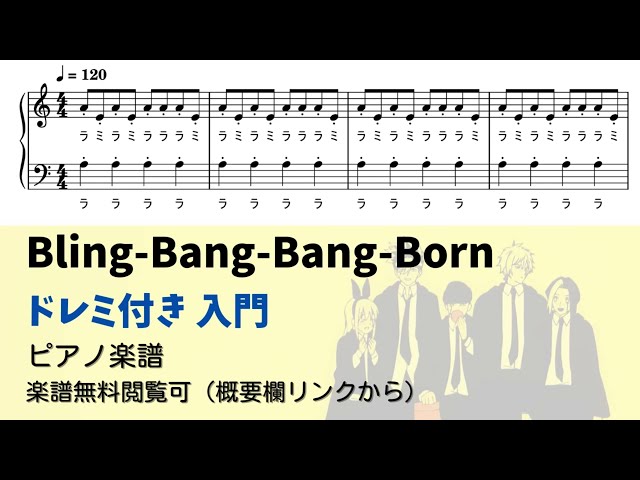
If you want to play anison and are a beginner at the piano, “Bling-Bang-Bang-Born” is highly recommended.
The song was composed by Creepy Nuts, a Japanese hip-hop duo consisting of DJ Matsunaga and R-Shitei, as the opening theme for the second season of the TV anime Mashle: Magic and Muscles, the “Divine Visionary Candidate Exam Arc.” Its catchy, driving rhythm is addictive and will stick in your head after just one listen.
Because the track is rap-style, it features many repeated melodies and rhythms.
Although it’s uptempo, once you can play one phrase, you’ll find it easier to handle the other repeated sections—another point in its favor.
After you can play it slowly without mistakes, try gradually approaching the original tempo.
You’ll be able to play it all the way through in no time!

First LoveUtada Hikaru

A classic love song! Hikaru Utada’s “First Love” is a single cut from the album First Love, which has sold over 8 million copies, and it remains a masterpiece that famous artists in Japan and abroad continue to cover.
Given Utada’s exceptional vocal ability, some may think “it looks hard to play on the piano,” but the rhythm and note patterns aren’t all that complex.
Start by slowly following the notes, and work your way toward performing this romantic classic!
Odoru Pompoko RinOda Tetsurō

The manga and anime Chibi Maruko-chan, created by Momoko Sakura, is a beloved national anime representing Japan, alongside works like Doraemon and Sazae-san.
The song Odoru Pompokolin used in Chibi Maruko-chan is the series’ iconic first ending theme, and it energizes everyone who listens.
It’s a great anime song even for beginners who are just starting piano and still working hard to read sheet music.
Since it involves playing the same notes in rhythm and the bass line is simple, it’s easy to perform.
First, learn the rhythm of the original song’s vocals and try playing the notes along with it.
Little by little, memorize the positions on the keyboard and shape it into a performance.
Once you reach the chorus, you can just ride the groove and enjoy playing to the end.
When you get used to it, try playing along at the original tempo.