

Even beginners can play them easily on the piano! A curated selection of popular and latest J-POP songs.


The piano has such a beautiful tone, and depending on how you play it, it’s a captivating instrument that can produce a grand, resonant sound.
These days, we’re seeing more videos of people casually playing popular J-pop songs at home, as well as impressively performing on street pianos.
Maybe some of you are thinking, “I want to play like that too!”
In this article, we’ll introduce easy-to-play J-pop songs on the piano—perfect for complete beginners or those who’ve just started—along with some of the latest hits.
If you want to try playing your favorite songs or expand your repertoire, be sure to use this as a reference.
- [Piano Beginners] J-POP That Looks Hard but Is Surprisingly Playable [2026]
- Recommended for piano beginners! 10 sheet music picks that adults can enjoy too
- [Piano × J‑Pop] A curated selection of the coolest new hits and anime songs that’ll look great when you play them
- [For Beginners] Recommended Ghibli Masterpieces You’ll Want to Play on the Piano
- It’s so cool if you can play these on the piano! A selection of irresistibly charming masterpieces.
- [Piano × Vocaloid] A selection of recommended songs that are easy for beginners to play
- Disney Classics on Piano: A Curated Selection of Easy Pieces, Perfect for Recitals
- [Piano Etudes] Recommended for Beginners! A Curated Selection of Easy, Playable Pieces
- [For Beginners] I Want to Play These on Piano! Recommended Anime Songs Compilation
- Piano Masterpieces: Surprisingly Easy Despite Sounding Difficult!? A Curated Selection Perfect for Recitals
- [Piano Solo with Vocals] Recommended for Piano-and-Vocal Performances! Hit Songs from the Heisei to Reiwa Eras
- [Piano Pieces] Easy for Children to Play! A Roundup of Simple Classical Works
- [Intermediate Level] Cool Piano Pieces You Can Play [Great for Recitals Too]
Even beginners can easily play these on the piano! A curated selection of popular and latest J-pop songs (41–50)
Is there still anything that love can do?RADWIMPS

The song “Is There Still Anything That Love Can Do?” by RADWIMPS was created as the theme for the animated film Weathering with You.
The film’s soundtrack, which includes this track, topped the Oricon digital chart for five consecutive weeks.
It’s a beautiful piano ballad characteristic of Yojiro Noda, and it’s perfect for singing with self-accompaniment.
Most parts—except for a few sections—use the same chord progression, and it’s just a repetition of four chords, making it very easy to play.
The different sections only add a few chords and change the order slightly, so definitely give it a try!

Easy Piano for Beginners! Carefully Selected Popular and New J-POP Songs (51–60)
A Cruel Angel’s ThesisTakahashi Yoko

The opening theme of the hugely popular anime Neon Genesis Evangelion, A Cruel Angel’s Thesis.
Released in 1995 by Yoko Takahashi, this song is a quintessential anime track.
Even people who don’t know the anime have probably heard it, and many surely want to try playing it! The tempo is fast, though, and it can feel difficult just listening to it.
But if you start slowly and use a simplified arrangement, even beginners can play it without any problem.
For the accompaniment, you can make it sound cool just by switching patterns between parts—keep a steady pulse in the energetic sections, and let notes ring a bit in the more relaxed sections.

Red Sweet PeaMatsuda Seiko

Akai Sweet Pea, a hugely popular song by Seiko Matsuda, an idol who defined the 1980s.
Released in 1982, the lyrics were written by Takashi Matsumoto, the music composed by Yumi Matsutoya under the pen name Kureta Keiko, and the arrangement by Masataka Matsutoya.
The piano melody in the intro is particularly striking.
The original is set in the key of G, making it easy to play, but if you’d like it even simpler, you can switch to the key of C.
Its relaxed tempo also makes it nice for practicing without rushing.
Start by holding the accompaniment chords to practice, and once you’re comfortable, try playing the chords as arpeggios.
LemonYonezu Kenshi

How about playing a bittersweet love ballad? This song by Kenshi Yonezu was released in 2018.
It became a hot topic as the theme song for the TBS drama “Unnatural” and captured the hearts of many.
The lyrics, which sing of feelings for someone lost, and the beautiful melodic line make a strong impression.
The original is in the challenging key of B major, but if you transpose it to C major, you can play it using only the white keys.
The chord progression follows a basic pop structure, making it perfect for those who want to try singing and playing with both hands.
The relaxed tempo also lets you practice without rushing!
Spring Dayaimyon
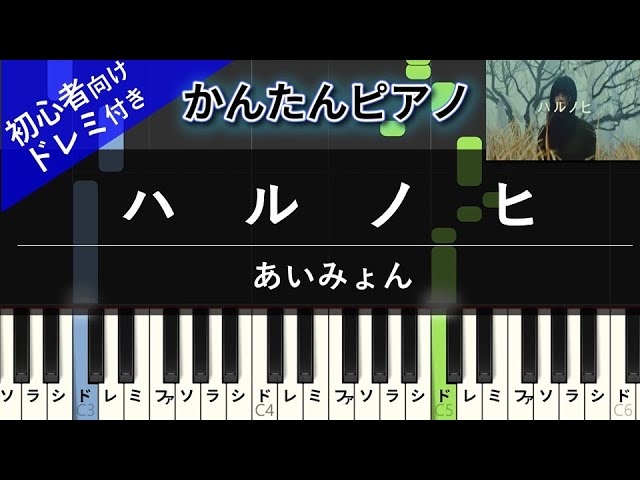
Aimyon’s “Harunohi” is a single released in 2019, written as the theme song for the animated film “Crayon Shin-chan: Honeymoon Hurricane ~The Lost Hiroshi~.” The melody uses only notes from the major scale that matches the song’s key, making it catchy and easy to remember.
The rhythm is based on a simple 8-beat, so there are relatively few difficult patterns.
It’s approachable even for beginner pianists, so please give it a try!
threadNakajima Miyuki

“Ito” by Miyuki Nakajima is a beloved staple for moving moments like weddings.
Its touching lyrics liken fated encounters to threads, sung over a simple yet deeply stirring melody.
Because the song is relaxed, with no sudden rhythmic or harmonic shifts, beginners should find it approachable to play on the piano with a straightforward arrangement.
Featured in numerous dramas, films, and commercials, and covered by many artists, this classic is perfect to try on the piano—won’t you give it a go?

Romantic Flightkome kome CLUB

Roman Hikō, which earned Kome Kome Club their first No.
1 on the Oricon charts, is a classic song beloved across generations as one of the defining J-pop hits of the 1990s.
Many adults who have taken up the piano may feel like giving this song a try.
To recreate its lively feel on the piano, keep the left hand to single notes or chord pulses—you don’t need to add much rhythm.
Since the right hand’s rhythm and note movement are a bit intricate, be sure to practice hands separately thoroughly before putting them together.