

![[For Seniors] Exciting! Ball-Based Recreation](https://i.ytimg.com/vi_webp/eQIfCEAkcKU/maxresdefault.webp)
[For Seniors] Exciting! Ball-Based Recreation

Don’t many care facilities incorporate physical activity into their recreational programs? Some even include exercise as a daily routine.
Because it helps improve diminished physical and mental functions, moving the body is very important for older adults.
This time, we’ll introduce ball-based exercises and games for seniors that can be used in recreation.
Using a ball allows for safe, low-strain strength training that is enjoyable.
Balls are familiar to many older adults, making them easy to incorporate into recreation and likely to liven things up.
Please consider adding these to your recreation plans!
[For Seniors] Exciting! Ball-Based Recreations (1–10)
Recreation using a ball and paper cups

This is a recreation activity that tests strength and concentration: while seated in a chair, you bounce a ball at your feet and then catch it.
First, have participants get used to the ball’s movement and how much force to use by bouncing it at their own feet and catching it with one hand.
Next, pair up.
One person bounces the ball toward their partner, and the person receiving it tries to catch it with a paper cup.
Since everyone applies force differently, judging how the ball will bounce becomes crucial—another point that boosts concentration.

ball throwingNEW!

How about using a cardboard box with holes as a target and enjoying a ball-toss game? The holes are small, making it challenging, but since the balls are connected in a set of about three while still in their packaging, they might roll across the top and drop into a hole.
Try aiming for the hole closest to you first—even if you miss, you might get lucky! Count how many balls end up in the holes, and the person who gets the most wins.
You can also vary the hole sizes to create different point values and make the game more exciting.
Make sure everyone uses their arm strength and really throws the balls.

Easy! Beach Ball Recreation

Beach balls are light, easy to throw, and designed with safety in mind.
This time, we’ll introduce some recreational activities using a beach ball.
First, have older adults sit on chairs facing each other.
Place the beach ball on their outstretched legs and pass it to the next person in a relay style.
You could make it a team competition and prepare prizes for the winners to boost excitement.
Another lively option is beach ball soccer target toss: players kick the ball, and whoever gets it into the container first wins.
Since it involves a lot of leg movement, it helps strengthen older adults’ muscles and is also ideal for rehabilitation.

Color Ball Fishing GameNEW!

Let’s fish up colorful balls like you’re catching fish! Attach a paper cup to the end of a long, thin stick with a string sandwiched in between.
Turn the paper cup upside down so the rim faces downward, and stick double-sided tape around the rim.
The idea is to catch and lift the balls by sticking them to the tape.
Put a variety of colorful balls into a large tub or onto a vinyl sheet with raised edges, and start fishing! Decide in advance which color each person is supposed to catch so they only fish for specific colors, or keep it simple and compete by the number of balls caught regardless of color.
Try different ways to play and have fun!

bowlingNEW!

Many older adults have probably played bowling at least once, right? It feels great when the ball you roll knocks down all the pins.
You can roll the ball while seated, so it’s an activity that people who have difficulty standing can enjoy.
Another nice thing about bowling is that you can play competitively in teams or on your own.
It would likely be a hit as an activity at a care facility event.
Bowling sets with balls and pins are sold at 100-yen shops, so preparation is easy.

BasketballNEW!
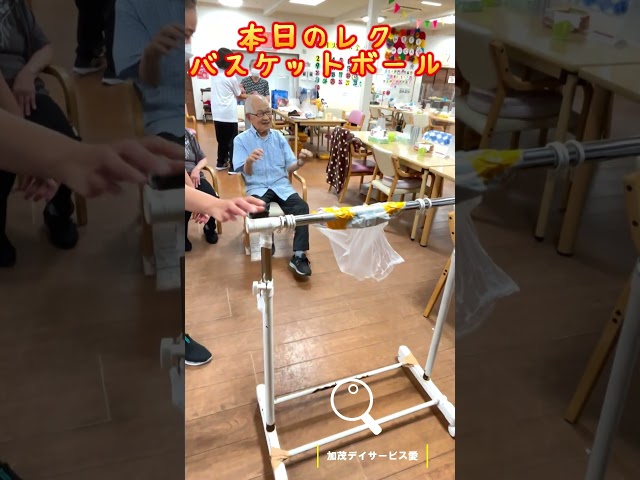
Basketball is a fast-paced sport with constant movement.
But if the goal is simply to get the ball through the hoop, you can do it while seated.
You can easily make a hoop using cardboard, newspaper, bags, or a net, and you can buy a ball at a 100-yen shop.
The act of throwing the ball toward the goal helps build strength, and when it goes in, it brings a sense of achievement and joy.
It’s a simple game, which is exactly why anyone can enjoy it over and over.
Give it a try!
basketball shotNEW!

While seated, try throwing a ball and see how many you can score in 30 seconds.
Use your arm strength and upper body momentum to toss the ball upward from below.
If you want to adjust the difficulty, try changing the height of the goal.
Even those not familiar with basketball will likely feel happy when the ball goes in.
Once they make a shot, they might get absorbed and keep throwing.
Try making a basketball hoop using materials like cardboard or netting.