

[For Seniors] Liven Things Up! Fun Fish Trivia Quiz

Fish are an indispensable ingredient for Japanese people.
Even older adults casually eat fish in their daily lives, but there are many kinds, and there’s still so much we don’t know about their ecology.
This time, we’re introducing a quiz all about fish.
Each question is a fun, trivia-like challenge, so enjoy thinking them through!
It’s a multiple-choice quiz with three options, making it easy for anyone to answer.
It’s great that you can learn about fish while taking the quiz, too.
Please feel free to use it as a recreation activity in senior care facilities.
- Recommended for seniors’ brain training! Kanji quiz workbook of fish names
- [For Seniors] Trivia Multiple-Choice Quiz
- [For Seniors] Looks readable but you can't read it! Fish Kanji Quiz
- [For Seniors] Fun and Lively! Recommended Quiz Questions
- [For Seniors] Laugh-Out-Loud, Crowd-Pleasing! Fun Quiz
- [For Seniors] Great for killing time! A fun three-choice trivia quiz
- [For Seniors] Fun Food Trivia Quizzes You'll Want to Share
- [For Seniors] Recommended Trivia Quizzes & Fun Facts for November
- [For Seniors] Sports Trivia Quiz & Fun Facts. Easy and Entertaining
- [For Seniors] Nostalgic quizzes that bring back memories! Showa-era entertainment and sports questions
- [Knowledge Expander!] A Three-Choice Quiz about Fish for Elementary School Students
- [Interesting] Compilation of Trivia Quiz Questions
- [For Seniors] Lively Wordplay Game: Fun Recreation for Elderly Care
[For Seniors] Lively and Fun! Fish Trivia Quiz (21–30)
What fish is called the “queen of the mountain stream”?

- yamame (landlocked masu salmon; Oncorhynchus masou masou)
- char (Iwana; white-spotted char)
- Ayu
See the answer
char (Iwana; white-spotted char)
Yamame, also known as a high-end fish, only inhabits clean waters and rich natural environments. It belongs to the salmon family (order Salmoniformes), and in many regions there are closed seasons when fishing is prohibited. Written in kanji as “山女” (mountain woman), it’s nicknamed the queen of mountain streams—a very noble epithet, isn’t it?

The bluestreak cleaner wrasse approaches even large fish without fear—but what is the reason for that?

- Because I don't mind being eaten.
- Because it's poisonous.
- Because I'm in charge of cleaning.
See the answer
Because I'm in charge of cleaning.
The bluestreak cleaner wrasse is a small fish about 10 cm long that lives in warm seas. It feeds on parasites and damaged scales on other fish. Because of this, even large fish will approach the cleaner wrasse to have themselves cleaned.

[For Seniors] Lively and Fun! Fish Trivia Quiz (31–40)
Kanji quiz with the fish radical
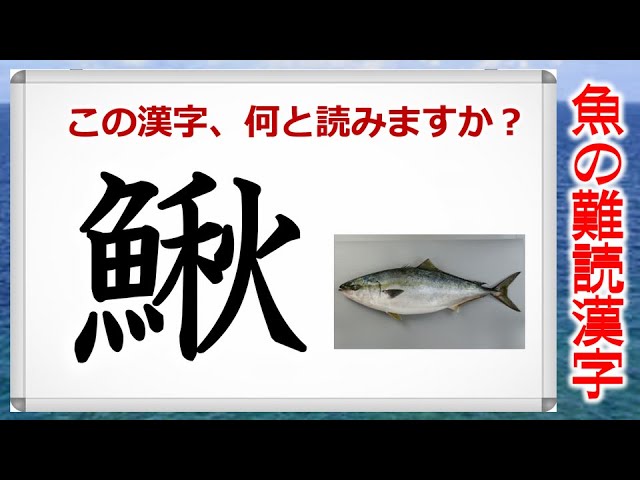
Here are some ideas for a tricky quiz on kanji with the “fish” radical.
The exact count varies depending on the dictionary and what you include, but it seems there are actually more than 200 such characters.
We might think we know the kanji for fish that commonly appear on the dining table, but if you don’t fish or work with fish, many of them can be quite difficult.
For example, there’s a quiz with 25 questions where a fish-radical kanji is shown and you’re asked, “How do you read this kanji?” The questions get more difficult in the latter half, but it really piques your curiosity.
What do you call bonito that is in season in May?

Delicious foods come with each season, and of course there are foods considered delicious in May as well.
Katsuo (bonito), which is sometimes introduced as being in season in May, is known by what name? It’s said that katsuo has two peak seasons a year: the autumn season from September to October is called “modori-gatsuo” (returning bonito).
Corresponding to this, if you think of the bonito that arrives at the beginning of the year, you can probably guess the answer.
The answer is “hatsu-gatsuo” (first bonito).
It is said to be lean, light in flavor, and well-suited for processing.

What is the origin of the name of the anglerfish?
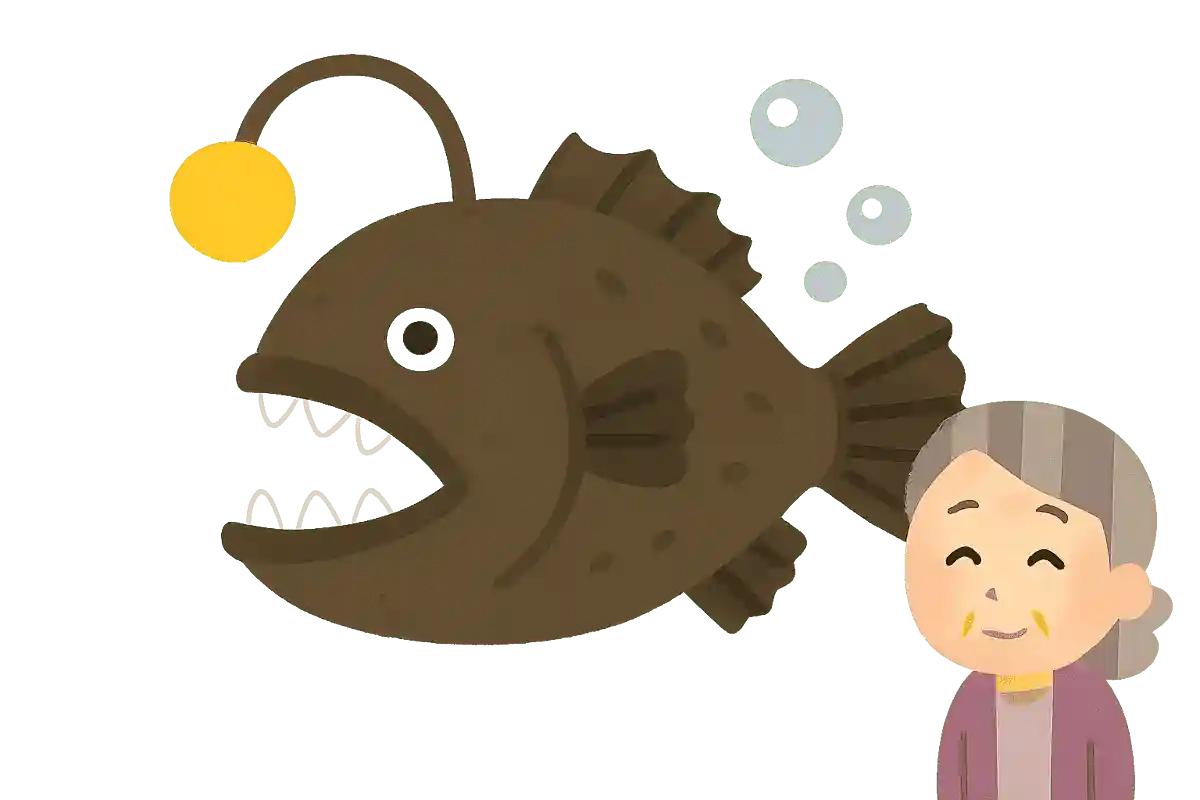
- Because they have a glowing tongue.
- Because it has a bioluminescent organ hanging from its head.
- Because it has shining scales.
See the answer
Because it has a bioluminescent organ hanging from its head.
The name “chōchin-ankō” (lanternfish angler) comes from the bioluminescent organ hanging from its head, which looks like a lantern. Because they live on the dark seafloor where light doesn’t reach, they use this glowing organ to lure in prey.

Which part of tuna contains the most DHA?
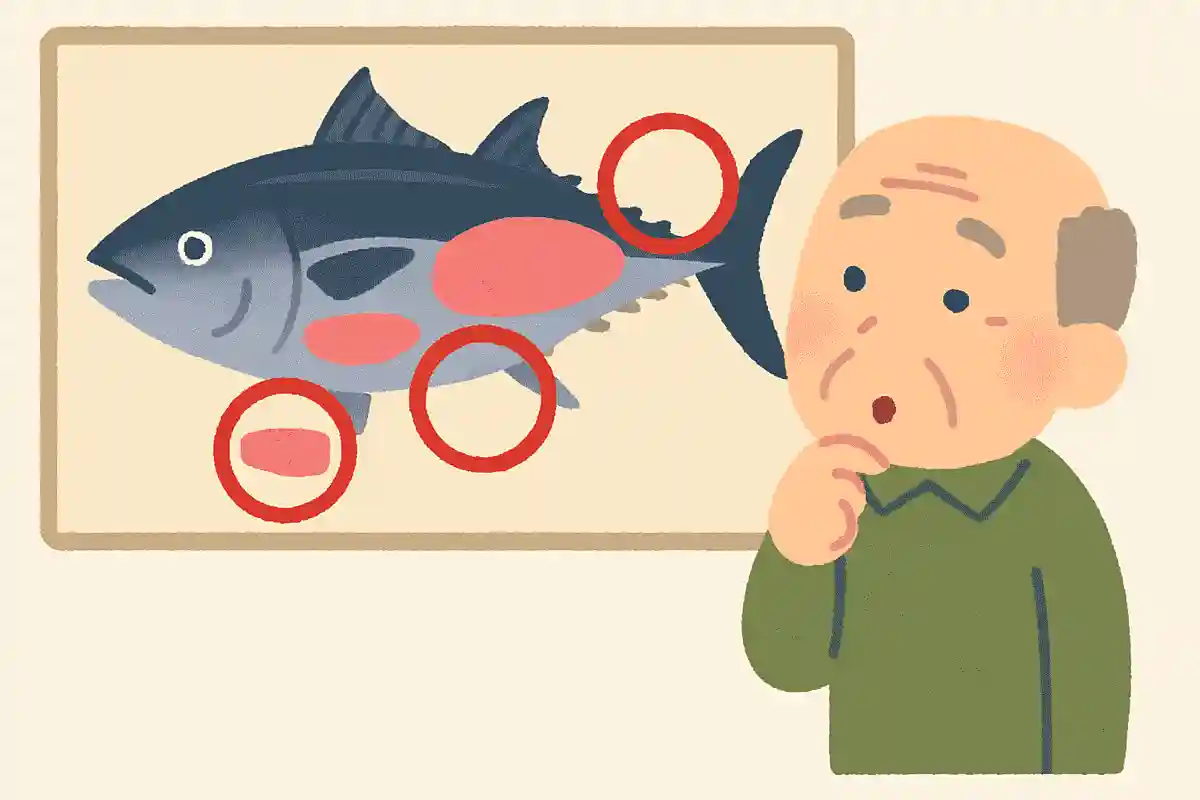
- lean meat
- Otoro (fatty tuna)
- Medium fatty tuna (chūtoro)
See the answer
Otoro (fatty tuna)
Among tuna cuts, otoro is the fattiest, and its fat is rich in DHA. DHA, which is considered beneficial to health, plays various roles, such as modulating immune function and promoting fat burning. It is also expected to help prevent and improve lifestyle-related diseases such as stroke, hypertension, and arteriosclerosis.
What exactly are the sharp spines that appear when a porcupinefish feels threatened made of?

- A transformed scale
- one with exposed bone
- changed skin; altered skin; something with skin that has changed
See the answer
A transformed scale
When you think of porcupinefish, the image of them having lots of sharp spines is strong, isn’t it? In fact, those spines are modified scales. Normally, they lie flat along the body, but when the fish senses danger, it inflates its belly and raises the spines to intimidate predators. That’s how it protects itself from enemies.