

[For Seniors] Perfect Finger Exercises! Seasonal Flower Origami

We’d like to introduce various flower origami projects especially for seniors.
In Japan, beautiful flowers bloom with each of the four seasons.
In spring, there are cherry blossoms; during the rainy season, hydrangeas; in summer, sunflowers; in autumn, cosmos; and in winter, Christmas roses.
Why not try making seasonal flowers with origami?
We’ve gathered many easy projects so that even beginners can enjoy them.
If you love flowers—or if you’re looking for a fine-motor rehab activity—please join us in creating lovely origami flowers together.
- [For Seniors] Add Color to Your Room: A Collection of Flower Craft Ideas
- Easy origami that delights the elderly. Enjoy a heart-lifting time with seasonal origami.
- [For Seniors] Easy Origami Recommended for Winter
- Recommended Origami for Seniors: Fun December Theme
- [For Seniors] Autumn Origami to Enjoy in October
- [For Seniors] Lovely Crafts Made with Tissue Paper: Ideas Collection
- [For Seniors] Enjoy Something New Every Day! Today’s Origami
- Craft ideas with plum blossoms for seniors
- [Recreation] Summary of Recommended Origami Ideas for Seniors
- [For Seniors] Make with Origami: Enchanting Wisteria Hanging Decoration Ideas
- [For Seniors] Easy Sunflower Origami Craft
- [For Seniors] Make an April Calendar: Fun Ideas to Brighten Your Mood
- [For Seniors] Recommended September Origami to Feel the Autumn Season
[For Seniors] Perfect Finger Exercises! Seasonal Flower Origami (1–10)
Tulip wreath
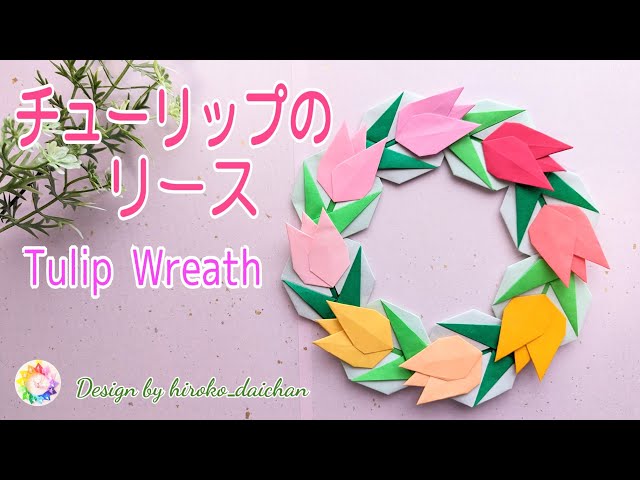
This wreath, which arranges tulips into a circle while highlighting their shape, is an origami piece whose impression changes depending on how the flowers are placed.
Whether you align the direction of the flowers and stems or vary their angles slightly will affect how cohesive the design feels.
By considering color combinations, you can tighten the overall look or steer it toward a softer mood.
Introducing variations in the flowers’ heights helps prevent a flat appearance.
Finally, surveying the whole and adjusting the placement stabilizes the shape and improves how it looks when displayed.
The bright colors of the finished wreath gently stand out in a space and evoke the arrival of spring.

Sakura wreath

This is a three-dimensional, cute cherry blossom wreath made by linking origami cherry blossom and leaf parts into a ring.
The key is how to make the cherry blossoms: first create each petal, then assemble them into a three-dimensional, fully bloomed flower.
Fold the paper into a triangle, lift both ends, trim off the excess, then open it into a tube to complete a petal.
Line up the petals and shape them into a flower.
Finally, attach the cherry blossoms and leaf parts to a ring-shaped base you’ve cut out, and the whole piece is complete.
Adding a string so it can be hung is also recommended.

hydrangea

Let’s all try making hydrangeas with origami together.
The fun part is using colorful paper to create hydrangeas in your favorite shades.
As you carefully fold each piece, your hand movements become smoother.
Displaying the finished hydrangeas in your room will help you enjoy the rainy season.
Working together makes for lively conversation and an enjoyable time.
Through origami, why not spend a fulfilling moment feeling the season?
[For Seniors] Perfect Finger Exercises! Seasonal Flower Origami (11–20)
Cosmos like a medal

Origami cosmos that resemble a medal are perfect as a gift for celebrations! First, fold a 3.75 cm × 3.75 cm yellow sheet of origami into a small octagon to make the pistil.
Next, for the petals, prepare a 15 cm × 15 cm sheet and fold with the side you want as the petal color facing inward.
Fold vertically to create a crease, then fold both edges toward that crease and flip it over.
Fold all four corners into triangles, unfold everything, then fold the same shapes in the opposite direction.
Using the creases, form shapes like two boats, then make four squares, and from each square create two diamond-like shapes.
Finally, fold the corners, make a slit in the center of each diamond and open it up, then attach the pistil in the center, and you’re done! Using tweezers to lift the petals will add a three-dimensional look.

Three-dimensional hanging scroll of morning glories

We’d like to introduce a morning glory hanging scroll that’s perfect for the season when the rainy season ends and the heat sets in.
Make the morning glories by folding and cutting origami, then attach paper straws to them.
Cut a base into a long rectangular shape like a hanging scroll and punch holes for the straws.
Insert the morning glories with the attached straws into the holes in the base.
If you thread a string through the straws, you can hang it up as a decoration.
Curving the base will give the morning glories a three-dimensional look.
Many older adults associate morning glories with summer, so creating this piece can also help them feel the season.

cherry blossom twig

Introducing a cherry blossom twig decoration that symbolizes spring in Japan.
Once you have pink origami paper ready, let’s make the blossoms.
Using a round dish or similar object makes it easy.
Cut out a circle, fold it in half, then fold it again so it becomes one-third the original size.
Sketch a petal shape with a pencil and cut along the line.
When you unfold it, you’ll have a cherry blossom with six petals.
Overlap one petal onto the neighboring petal to give it a three-dimensional shape.
Make a branch from brown origami paper and leaves from green origami paper, then attach them along with the blossoms to finish.
It looks adorable when added to a message card or gift box.
Give it a try!

poinsettia

Poinsettias, which vividly brighten up the winter season, strongly evoke Christmas with their red and green appearance.
How about recreating a poinsettia with origami to feel a touch of warmth amid the cold? The method involves cutting origami into shapes that look like spread leaves and layering them, but by giving each part crisp creases, you create depth when they’re stacked.
Make sure to press firm creases into each piece, fold and cut, and then layer them while keeping a sense of softness in mind.