

[For Seniors] Brain Training with Olympic Quizzes: A Collection of Questions to Recall Memorable Classic Moments


Which event was the first in which a Japanese athlete won an Olympic gold medal?Can you answer this question right away?The Olympics are full of hidden histories and stories that will make you say, “Wow, I didn’t know that!”In this article, we present an Olympic quiz designed for seniors to enjoy.It’s packed with questions you may think you know but actually don’t—like the meaning behind the Olympic colors and what the five rings represent.Take a trip down memory lane to past Games and try the quiz together with those around you.
- [For Seniors] Lively and Exciting! Sports Quiz for Recreational Activities
- [For Seniors] Brain Training! Recall Quiz Collection!
- [For Seniors] Recommended for Brain Training! Nostalgic Showa-Era Quiz
- [For Seniors] Sports Trivia Quiz & Fun Facts. Easy and Entertaining
- Personality Test: Fun! Psychology Test Collection
- [For Seniors] Fun Brain Training! Lively Whiteboard Activities
- [For Seniors] Nostalgic quizzes that bring back memories! Showa-era entertainment and sports questions
- [For Seniors] Lively True-or-False Quiz: Fun Questions You Think You Know but Don’t
- [For Seniors] Fun and Lively! Recommended Quiz Questions
- Recommended for seniors! Liven up your event with a Respect-for-the-Aged Day quiz!
- For Seniors: Useful Trivia Questions! Introducing Fun Facts Quizzes You'll Want to Share
- [For Seniors] Fun and Informative! Health Trivia Quiz
- [For Seniors] Fun and Informative Trivia Quiz Collection
[For Seniors] Brain Training with Olympic Quizzes: A Collection of Questions to Recall Nostalgic Famous Moments (11–20)
What was the first event in which Japan won a medal?
When it comes to the Olympics, what we’re most curious about is, of course, how many medals Japanese athletes can win.
So I’ve prepared a question related to medals: “What was the first sport in which Japan won an Olympic medal?” The correct answer is tennis.
Specifically, it was at the 1920 Antwerp Olympics, in the men’s singles event, where Ichiya Kumagae won a silver medal.
Since few people today would remember that time, you could say it’s a difficult question.

Why were the Olympic colors chosen to be blue, yellow, red, black, and green?
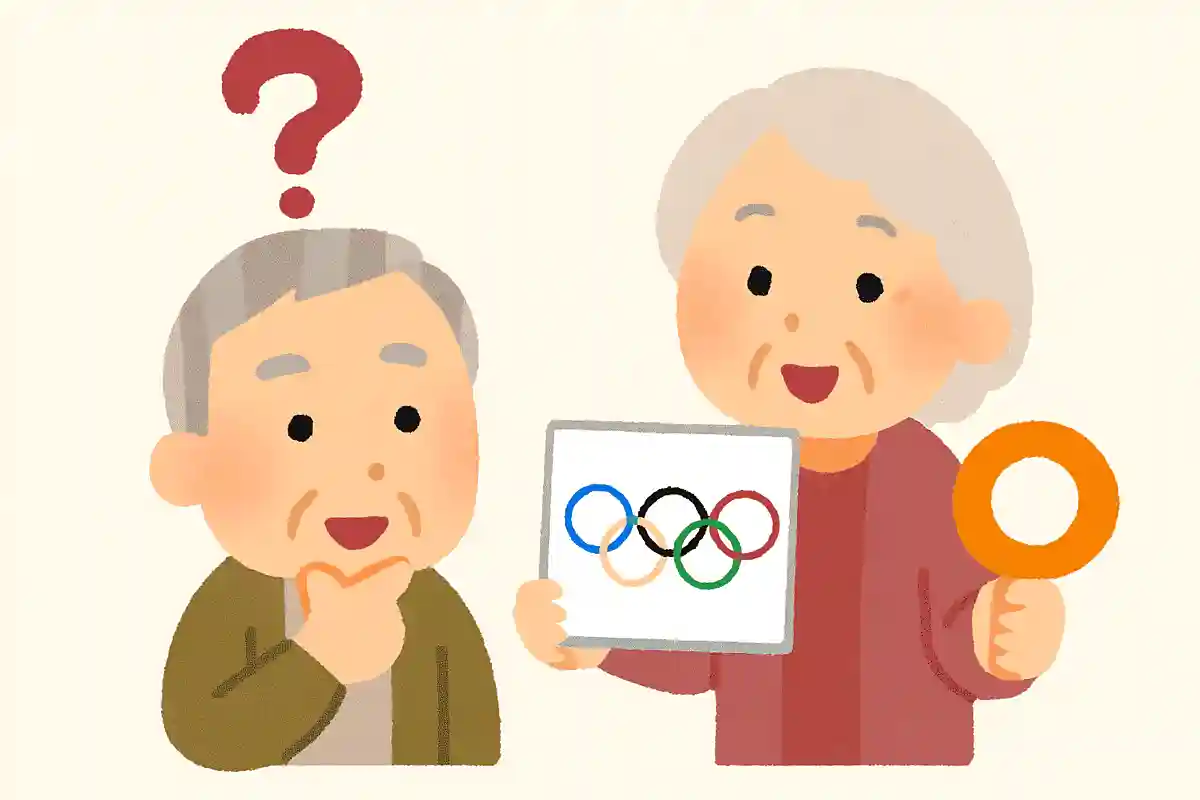
One symbol of the Olympics is its logo—the one that looks like interlinked rings.
Those rings are blue, yellow, red, black, and green, and that color scheme is also called the Olympic colors.
So here’s the question: Why were those five colors chosen? The answer is: With blue, yellow, red, black, and green—plus white—you can reproduce the flags of most countries.
In other words, the message is that the world comes together as one.
By the way, the five rings represent the five continents.
In the ancient Olympics, victors received crowns made of plants instead of medals. What plant were they made from?
The Olympics have continued since ancient times, right? Some of you might have wondered whether they gave out medals back then as well.
In fact, in the ancient Olympics, they handed out crowns made from plants instead of medals.
Here’s a question: What plant was it? The correct answer is the laurel tree (read as “gekkeiju” in Japanese).
In mythology, it was depicted as a sacred plant, which is likely why it was used in place of medals.
What were the Japan national volleyball team, who won the gold medal at the 1964 Tokyo Olympics, called the ‘something of the Orient’?
Among the events at the 1964 Tokyo Olympics, one that especially thrilled the entire nation of Japan was volleyball.
Japan displayed overwhelming strength and won the gold medal with five straight victories.
Here’s a quiz: What was the nickname given to Japan’s national volleyball team—“the Witches of the Orient.” It’s impactful and pretty cool, isn’t it? By the way, this nickname is said to have been coined during the European Championship held three years before the Olympics.
At which Olympics did Japan win its first gold medal?
At the Olympics, many people are probably paying attention to how many gold medals Japanese athletes will win.
It’s also striking that news of Japan’s first-ever gold medal at each Games is widely reported.
So here’s a quiz: “At which Olympics did Japan win its first gold medal?” The correct answer is the 1928 Amsterdam Olympics.
The event was athletics, men’s triple jump, and it was won by Mikio Oda.
You could also turn it into a question like, “What was the first sport in which Japan won a gold medal?”
How old is the oldest medalist at the time they won their medal?
There are many athletes who have had long careers, aren’t there? So here’s a question: How old was the oldest medalist at the time they won their medal? If you don’t know, try to guess roughly how old they might have been.
The correct answer is 72.
It was Oskar Swahn, a Swedish shooter who competed at the 1920 Antwerp Olympics.
To be precise, he was 72 years and 280 days old when he won the medal, so you could almost say he was 73.
[For Seniors] Brain Training with Olympic Quizzes: A Collection of Questions to Recall Memorable Scenes (21–30)
In what year of the Showa era was the Tokyo Olympics, the first held in Asia, held?
The Tokyo Olympics, held in 1964 (Showa 39), saw Japanese athletes achieve great success.
It was also the first Olympics ever held in Asia.
Yoshinori Sakai, who was a track and field athlete at the time, served as the final torchbearer.
Although Sakai had been considered a candidate for Japan’s Olympic team, he was ultimately not selected.
He was chosen as the final torchbearer because he was born on August 6, 1945, the day the atomic bomb was dropped on Hiroshima.
His role embodied a tribute to the victims of the atomic bombing and a wish for world peace.
