

[For Seniors] Have Fun with Recreation! Origami Ideas

Origami, which is incorporated into recreational activities at care facilities.
Origami seems familiar to many older adults, as they often folded paper when they were young and it was a common pastime.
Because you can fold while chatting with other seniors, it also helps promote communication!
So this time, we’ll introduce origami that’s perfect for recreation activities for older adults.
Using your fingertips and thinking about what shape it will become when finished also serves as brain training.
Please make good use of these origami ideas in your recreational programs!
- [Recreation] Summary of Recommended Origami Ideas for Seniors
- [For Seniors] Enjoy Something New Every Day! Today’s Origami
- [For Seniors] Perfect Finger Exercises! Seasonal Flower Origami
- Easy origami that delights the elderly. Enjoy a heart-lifting time with seasonal origami.
- Enjoyable for seniors! Easy heart origami
- [For Seniors] Simple Handicrafts Recommended for Finger Exercise
- [For Seniors] Fun Origami That Also Works as Rehabilitation
- For Seniors: Effective Recreation for Preventing Care Needs—Have Fun While Staying Healthy
- [For Seniors] Simple and Fun: Craft Ideas You Can Make with Everyday Items
- Recommended for seniors! Origami gifts
- [For Seniors] A Collection of Fun Classic Caregiving Activities
- [For Seniors] Fun to Make! Paper Quilling Ideas
- [For Seniors] March Origami: Ideas to Brighten Your Room with Seasonal Flowers and Events
[For Seniors] Have Fun with Recreation! Origami Ideas (11–20)
Hina dolls made with round origami

Let’s make Hinamatsuri dolls out of chiyogami with a cute, gently rounded shape.
Fold a circular sheet of origami in half twice, then cut a slit at the center to form the neck.
Fold the left and right edges inward to align with the collar area, shaping the kimono.
Fold the Odairi-sama in the same way, then attach the fan, ladle, and crown, draw the faces, and you’re done.
Using round origami enhances the warm feel of the Ohina-sama and Odairi-sama.
Prepare patterned origami and try making your own original Hinamatsuri dolls.

Hina dolls with distinctive kimonos

Let’s make a perfect set of the imperial couple (the emperor and empress) for Hinamatsuri.
First, mark the origami by folding it in half, then into quarters, in order.
Create creases at the corners and around the edges to form the shape of the kimono.
For the hair, take a small square of black origami paper, fold it into a triangle, then fold both sides toward the center to shape the hairstyle.
Attach the empress’s body and hair, then add the fan to finish.
For the emperor, the key is to make a crisp fold at the collar and fold the sleeves of the kimono upward to create the right angle.
Fold a crown from black origami paper to complete the emperor.
Feel free to draw the facial expressions in your own original style.
Self-standing Hina Dolls you can make even if you’re super clumsy

Let’s make some cute hina dolls that will look adorable even displayed at the entrance.
Cut a sheet of origami paper in half, fold it in half, then overlap and fold the left and right sides to create the kimonos for the empress (ohinasama) and the emperor (odairisama).
Tuck the triangular flap inside to finish.
For the face parts, prepare one sheet of black origami paper, fold it in thirds, then fold one third in half; as you fold the corners, shape the hair while checking the balance.
Finally, fold up from the bottom to complete the face parts.
For the odairisama, make the crown by shaping the tip to a point, then fold the corners to give it a rounded form.
Once you make the fan, ladle, and crown, it’s complete.
Tulip wreath
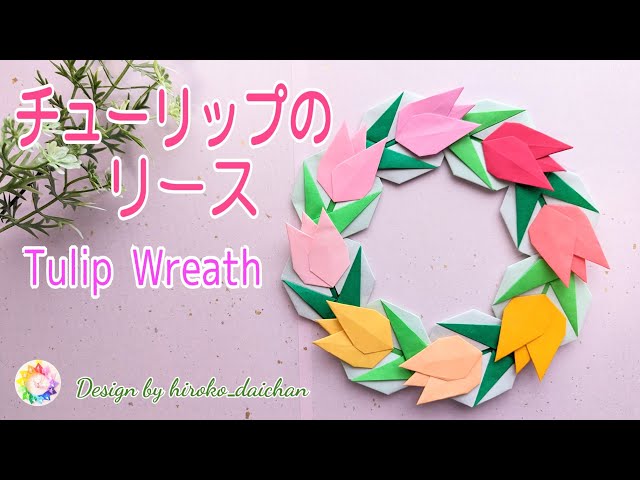
This wreath, which arranges tulips into a circle while highlighting their shape, is an origami piece whose impression changes depending on how the flowers are placed.
Whether you align the direction of the flowers and stems or vary their angles slightly will affect how cohesive the design feels.
By considering color combinations, you can tighten the overall look or steer it toward a softer mood.
Introducing variations in the flowers’ heights helps prevent a flat appearance.
Finally, surveying the whole and adjusting the placement stabilizes the shape and improves how it looks when displayed.
The bright colors of the finished wreath gently stand out in a space and evoke the arrival of spring.

Marguerite Wreath

Margaret’s wreath is an origami piece whose charm lies in how freely you can arrange it.
By changing the flower colors within a single wreath and varying their sizes for emphasis, you create a look that avoids being overly uniform.
Placing the leaves so they extend outward adds movement to the ring shape and gives a light, airy impression.
The key is to adjust the placement while watching the overall balance rather than aiming for strict symmetry.
The finished mood changes depending on the combinations you choose, making it easy to style the wreath to suit where it will be displayed.
Do try making one and enjoy the feeling of spring.
A school backpack from a single sheet of origami paper

The school backpack made from a single sheet of origami paper is a piece that combines folding and cutting steps to create its shape.
By proceeding in order, the structure is easy to understand, and you can work with your hands while keeping the finished form in mind.
Since you assemble parts with different roles—the body, shoulder straps, flap, and so on—the process of the shape gradually taking form is also easy to follow.
Though small, the finished piece is instantly recognizable as a school backpack, making it a handy origami craft for spring-themed displays or decorations.
Give it a try!
[For Seniors] Have Fun with Recreation! Origami Ideas (21–30)
Mini wreath of rape blossoms

This mini wreath, compactly shaped into a small ring and packed with the bright cheer of rape blossoms, is an origami piece that combines easy display with a touch of splendor.
Its hallmark is the process of making each yellow flower individually and arranging them with an eye for balance, advancing while envisioning the final look.
Rather than a simple repetition of steps, the placement of each flower changes the impression, making it enjoyable to experiment.
Another appeal is that once finished, it can be displayed almost anywhere—on walls, doors, or bulletin boards.
Lining up multiple wreaths creates a cohesive look that brightens the entire space.
It’s a seasonal origami idea that lets you enjoy both the making and the decorating.