

[For Seniors] Simple pelvic floor exercises: various trainings in standing, sitting, and supine positions

As we get older, have you ever had that sudden “uh-oh” moment after a sneeze or cough? The pelvic floor muscles are essential for supporting everyday movements, but because we rarely engage them consciously, they can weaken without us noticing.
In this article, we introduce simple pelvic floor exercises that older adults can do without strain.
We’ve gathered routines you can do while seated in a chair or lying down at a relaxed pace, so you can continue at your own rhythm.
Why not make them a daily habit and start building a body that lets you live with confidence?
- [For Seniors] Gluteus medius strengthening exercises: simple training you can do lying down, seated, and standing
- [For Seniors] Improve Your Body Concerns! A Summary of Exercises for Urinary Leakage
- [With Video] Lower-limb strength training for seniors that can be done in bed
- [For Seniors] Rehabilitation exercises targeting each body part: Introducing easy routines you can incorporate without strain
- Summary of exercises for seniors: introducing preventative care movements by body part.
- [Seated] Fun Health Exercises for Older Adults and Seniors
- [For Seniors] Recommended exercises to relieve constipation.
- Grip strength training for seniors: Introducing gentle exercises, stretches, and strength workouts you can stick with
- [For Seniors] Core Training: Recommended Simple Rehabilitation
- For Seniors: Back-Strengthening Exercises, Calisthenics, and Stretches—Workouts Women Can Do Without Strain
- Recommended simple exercises for recreational activities for the elderly
- For Seniors: How to Strengthen Your Inner Muscles. Fall Prevention
- [For Seniors] Recommended Easy Strength Training
[For Seniors] Simple Pelvic Floor Exercises: Various Standing, Seated, and Supine Trainings (1–10)
Pelvic floor muscle training in a kneeling position

Pelvic floor exercises performed in a kneeling position not only strengthen the muscles but also enhance stability around the pelvis and help support the entire core.
The pelvic floor supports structures like the rectum, and by engaging and tightening it firmly as shown in the video, its function can more easily normalize.
In a kneeling position, the deep muscles of the glutes and lower abdomen are also naturally stimulated, offering the benefit of improved core stability in daily life.
Another advantage is that it’s easy to continue and safe to practice.
Rather than using maximum force, gently tighten while maintaining your breath; this makes it easier to sense the pelvic floor and leads to strength gains that are useful in everyday activities.

Pelvic floor muscle exercise: squat
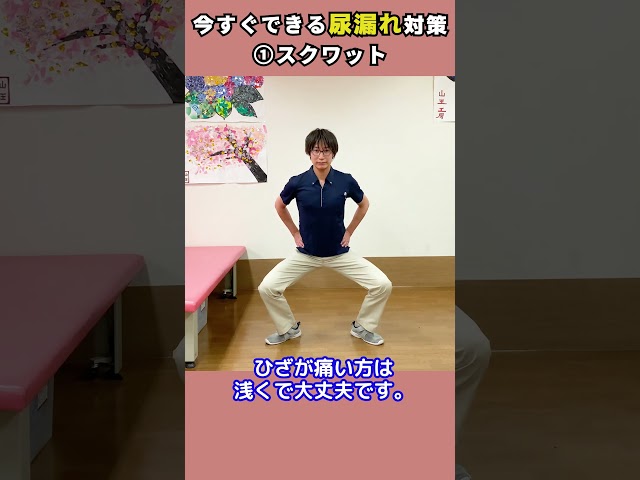
Stand with your feet just a bit wider than shoulder-width and your toes pointed outward.
As you slowly exhale, lower your hips as if pulling your buttocks back.
At this time, gently focus on and engage the anus and lower abdomen to effectively stimulate the pelvic floor muscles.
If your knees hurt, you don’t need to squat deeply—do a shallower range within your comfort.
When the pelvic floor muscles work together with the inner thighs and glutes, it becomes easier to develop core stability.
Inhale as you slowly return to the starting position, and repeat about five times without holding your breath.
If you can do three sets, you’ll find it easier to feel your pelvic floor working in everyday movements.
Pelvic floor exercise: lunge

The “lunge,” done standing with one foot stepped forward, is also an exercise that helps you gently engage your pelvic floor.
As you slowly exhale, shift a little of your weight onto the front foot and try tightening your abdomen and around the anus.
It’s fine to hold onto something for balance.
When you slowly return to the starting position while inhaling, the key is to keep breathing without holding your breath.
If you can do three slow reps on each side, alternating, for three sets, it will help your pelvic floor and surrounding muscles work together more easily.
Try incorporating it into your daily routine.
[For Seniors] Simple Pelvic Floor Exercises. Various Trainings in Standing, Sitting, and Supine Positions (11–20)
Pelvic floor muscle training performed while lying prone

This is a simple muscle-strengthening exercise done while lying face down.
Continuing this movement helps stabilize the pelvis and hip joints and strengthens the pelvic floor muscles.
Training the pelvic floor can help prevent urine leakage, relieve lower back pain, and ease PMS.
First, lie face down and bend both knees to 90 degrees.
Then bring your heels together and apart.
Key points: relax your body, and when closing your legs, engage your inner thighs and your pelvic floor.
Aim to do 10 reps every day.

Pelvic floor muscle training with a towel

Here’s a seated strength exercise using a towel.
First, sit on a chair and roll the towel into a cylinder.
Place it lengthwise under your buttocks.
From here, you’ll train the pelvic floor with two movements.
First, squeeze the towel with your buttocks 10 times.
Second, keep squeezing for 10 seconds.
It’s important to focus on tightening your buttocks, so be mindful as you do it.
Strengthening the pelvic floor helps prevent and improve urinary leakage.
Continue within a comfortable range, and let’s work toward waking up feeling refreshed in the morning.
Urinary leakage prevention: pelvic floor exercises you can do while sitting

The pelvic floor muscles are a hammock-like group of muscles that support the internal organs, including the bladder.
They play an important role in controlling urination, so let’s train them properly to prevent leakage.
In this pelvic floor exercise, while sitting in a chair, you’ll alternately lift your left and right buttocks to move your pelvis, and open/close and raise/lower your knees.
All of these are simple movements, but do them at your own pace without overexertion.
You might not notice much effect from a single session, but continuing every day should bring results.
You can do it standing! Pelvic floor muscle training

This is a standing pelvic floor exercise.
First, bring your heels together and open your toes about the width of a fist.
Then slightly open your knees, engage your thighs and bring your knees together, and raise your arms overhead while shifting your weight onto your toes.
When shifting your weight to your toes, imagine pushing your hip joints forward.
As you move your hips forward, be careful not to let your belly protrude.
Focusing on the tops of your thighs/hip creases can help.
Move slowly to avoid falling.