


For Seniors: Back-Strengthening Exercises, Calisthenics, and Stretches—Workouts Women Can Do Without Strain


As we get older, many of us may feel that our backs tend to round more easily.
Strength training for the back is an important habit that supports daily life, helping maintain good posture and prevent falls.
That said, intense exercise can be unappealing.
So this time, we’ll introduce back exercises that can be done while sitting in a chair or lying down—routines that older women can continue without strain.
There are also stretches effective for relieving stiff shoulders and preventing lower back pain.
Why not work them into small pockets of free time and regain vitality from your back?
For Seniors: Back Muscle Training, Exercises, and Stretches. Gentle Movements Women Can Do Comfortably (1–10)
Back Muscle Training for Seniors

Strengthen your back muscles with training introduced by an occupational therapist.
Benefits of training the back include preventing rounded shoulders and lower back pain, and by building a strong upper body, improving balance so posture and walking become more stable.
While back exercises are typically done lying face down, this routine is performed standing.
Cross your arms to hold your shoulders and bow.
Keeping your torso tilted forward, raise your arms overhead as if cheering and then pull them back.
These are simple movements anyone can imitate, so give them a try if you like.

Training to straighten a hunched back

As we get older, our backs can start to round.
This is said to be caused by a decline in muscle strength.
When the spine curves, it can interfere with walking and cause pain in various parts of the body.
To prevent that, let’s use this training to thoroughly strengthen the muscles that support the body.
We’ll mainly move the muscles around the shoulders, chest, and shoulder blades to align the spine.
It’s also possible to correct a back that has already rounded, so don’t give up just because it’s begun to curve!
Spinal Stretches to Balance the Autonomic Nervous System
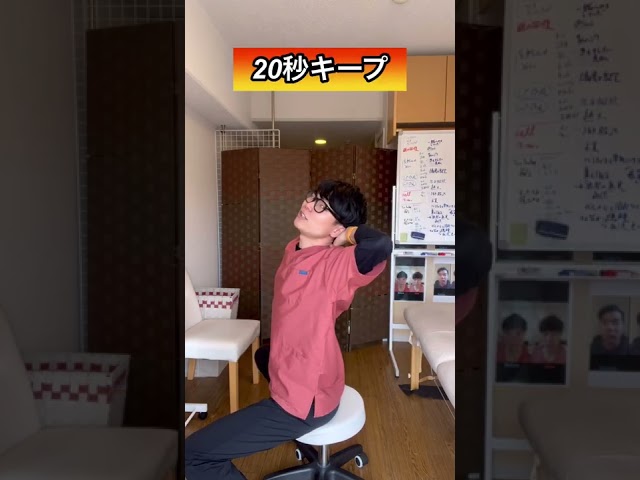
When the autonomic nervous system becomes unbalanced, you may experience headaches and fatigue, and in severe cases it can lead to depression.
One possible cause is thought to be misalignment of the spine.
Here, I’ll introduce some spinal stretches.
Clasp your hands and raise them overhead with your palms facing the ceiling.
Then lean your upper body backward to stretch your spine.
Next, clasp your hands behind your neck and try the same movement.
It’s also effective to tilt your body to the left and right in that position.
Let’s regulate the autonomic nervous system within a comfortable range for you.
Banzai workout
https://www.tiktok.com/@user8673152313321/video/7565166950503042326Why not try incorporating a simple exercise into your daily routine that trains your back muscles and calves at the same time? Strength training isn’t just about changing your appearance.
It also helps maintain the essential muscle strength that declines with age.
Even a little is fine—try to do some strength training every day.
The exercise we’re introducing today involves swinging both hands up from below into a full overhead “banzai” and stretching upward.
Before swinging your arms up, draw your shoulder blades firmly together, and when you raise your arms overhead, be careful not to arch your back.
7 Stretches to Straighten Your Posture
https://www.tiktok.com/@hapreha/video/7598859560283082002When your back is held straight and tall, you can look younger than your age, and above all, it can lift your mood and make you feel brighter, don’t you think? In this stretch routine, we’ll introduce seven movements that help correct your posture: hamstrings, hip joints, spinal erectors, glutes, upper back, neck, and pelvic tilt.
You can do all of them while seated in a chair, so try them even while watching TV.
For the latter movements, be mindful of keeping the soles of your feet firmly on the floor.
Let’s aim for a beautifully elongated, upright posture!
Towel exercises that strengthen your back
https://www.tiktok.com/@user8673152313321/video/7568085085006695702How about training your back using things you have at home? For this exercise, you’ll use a towel.
Sit on a chair, hold both ends of the towel, and spread it in front of your chest.
Then, lean your upper body forward and move your arms from bottom to top.
This movement effectively works your back muscles.
However, since it engages the entire upper body, please don’t overexert yourself if you have back pain or chronic lower back issues.
This training also serves as aerobic exercise, so it’s recommended for those who want to work out indoors.
Latissimus dorsi stretch

Let’s try a training exercise to loosen the large back muscle, the latissimus dorsi.
Sit cross-legged somewhere your legs won’t get sore, and you’re ready to go.
Extend one arm overhead, then lean your torso to the opposite side of that arm.
Focus on feeling the latissimus dorsi stretch and hold this position for 30 seconds.
Keep your other hand planted on the floor with the palm down.
Next, get on all fours.
Reach your left arm forward, then thread your right arm under your body and extend it to the left side.
Keep your right palm facing down and turn your face to the left.
Try progressing through the other stretches slowly as well.