

![[For Seniors] Exercises to Walk Again. Fall Prevention](https://i.ytimg.com/vi_webp/-NwJrpQnxQ8/maxresdefault.webp)
[For Seniors] Exercises to Walk Again. Fall Prevention

As we age, our legs and lower back can weaken, making stumbles and falls a concern.
However, by continuing simple exercises, you can maintain your walking ability and build a body that’s less likely to fall.
If you make easy, manageable exercises a habit, you’ll be able to go about your daily life with greater peace of mind.
In this article, we introduce exercises that can be easily done at home—even by older adults—to improve walking and prevent falls.
Let’s start with what you can do, move your body while having fun, and keep walking energetically for years to come.
[For Seniors] Exercises to Walk Again. Fall Prevention (1–10)
Iliopsoas Walking ExerciseNEW!

Here’s an iliopsoas walking exercise you can do even if actual walking is difficult.
First, lie on your back.
Then draw one knee toward your chest, and, imagining you’re walking on the ceiling, extend your leg straight up.
Slowly lower it back down as is.
The key is to lower it slowly—if you drop it quickly because it’s hard, you won’t get the full benefit.
Also, inhale through your nose and exhale through your mouth as you lower your leg.
By continuing this exercise, you can master a hip-centered walking pattern and reduce the strain on your knees and ankles.

Sit-to-stand training using parallel barsNEW!

This is a standing-up exercise using parallel bars for rehabilitation.
Hold the bars firmly with both hands and stand up on the count of three.
Then try to maintain a standing position for about 10 seconds.
If you can hold it, slowly sit back down.
Since you won’t always have support when standing up, practice repeatedly standing and sitting like this.
Doing so will strengthen your legs and lower back and help you learn a way of standing up that doesn’t put unnecessary strain on your body.
Parallel bars can also be purchased from online shops.
Glute training for standing up smoothly from the floorNEW!
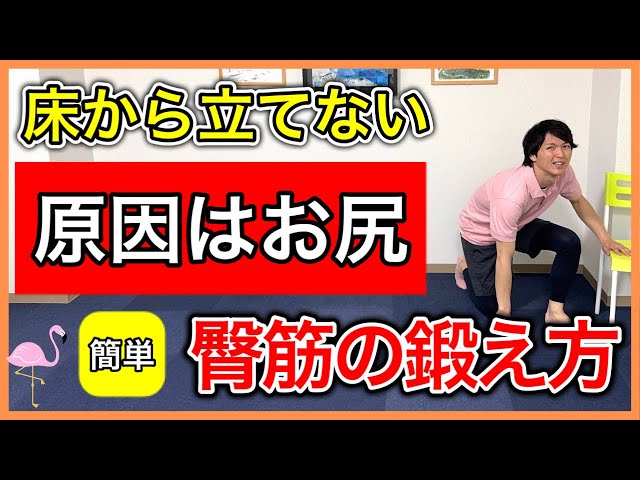
The gluteal muscles are the muscles that make up your buttocks.
By strengthening them, you’ll be able to stand up smoothly from the floor.
First, step one foot forward and the other back, and bend your knees slightly.
Place your hands on your knees for support, and repeatedly hinge your upper body forward and then return upright.
Next, in the same stance, move your hips up and down to do knee bends.
As you do this, focus on shifting your weight onto the front leg.
If you feel unsteady, it’s a good idea to hold onto a chair or a wall for support.
Sit-to-stand exercise using a chairNEW!

This is a training exercise using chairs that strengthens your legs and glutes.
It directly helps you perform the standing motion with less strain, so give it a try.
First, sit on a chair.
Place another chair facing the same direction in front of you, at a distance where you can touch its backrest with your arms extended.
Grab the front chair with your hands and lean your upper body firmly forward.
Then slowly lift your hips and stand up.
If you stand up with your torso upright, it puts strain on your legs and lower back, so be sure to lean forward well.
Pelvic training for people who shuffle their feet

Do any of you find yourselves accidentally scuffing your heels while walking, like during a stroll? It’s said this happens due to a decline in the muscles that lift the pelvis.
Weakness around the legs increases the risk of falls, so let’s do pelvic training to strengthen the muscles that lift the pelvis and help you walk energetically! If you don’t like strenuous exercise, don’t worry.
All you’ll do is “butt walking.” That’s it.
Start with about three round trips forward and backward.
Once you get used to it, you can increase the number.
It also engages your abdominal and back muscles, so it may help you maintain your figure as well.

Improve side-to-side wobbling! Core exercises

When you sway from side to side while walking, it not only puts a strain on your lower back but also increases the risk of falling.
So let’s strengthen your core to reduce the swaying.
The muscles of the lower back play a role like a set of supports for the upper body, so we’ll focus on training that area thoroughly.
Move your lower back muscles with exercises such as shifting your upper body horizontally while seated in a chair and lifting your legs.
The key is to proceed while checking that your lower back muscles are engaged and making sure your body doesn’t lean.

Ankle flexibility exercises

If your stride is short and you take quick, tiny steps when you walk, your ankles might be stiff.
So this time, we’ll introduce stretches to loosen up the ankle area.
First, use a desk or the back of a chair to stretch your calves.
Do it slowly on both sides, without overexerting yourself.
Next, focus on the ankles.
While holding onto the back of a chair as before, lift your toes as if stretching your calves, then tilt your foot to the side.
You should feel the muscles around your ankle stretching.
You can get a similar effect by placing your foot on a chair and pressing down as if you were stepping on a car’s accelerator.
To get your ankles working, it’s also important to support your body by moving it forward and backward while actively moving your toes and heels.
These exercises are simple, but you can expect results if you keep at them.