

![[For Seniors] Four-character idioms that include numbers. How many do you know?](https://i.ytimg.com/vi_webp/OI7PV0X03rM/maxresdefault.webp)
[For Seniors] Four-character idioms that include numbers. How many do you know?

“Killing two birds with one stone,” “writhing in agony,” “surrounded on all sides”… Four-character idioms that include numbers can enrich your expressions when you drop them casually into conversation.
In this article, we’ve gathered number-containing four-character idioms that older adults can enjoy for brain training or recreational activities.
You can present them as a quiz, use them to spark conversation while recalling their meanings—the possibilities are endless.
Enjoy them with your own twist.
From nostalgic sayings to expressions that make you think, “So that’s what it means!”, why not rediscover the charm of language?
[For seniors] Four-character idioms that include numbers. How many do you know? (1–10)
Ten people, ten colors (to each their own; everyone has their own tastes and preferences)
https://www.tiktok.com/@kotobaano/video/7325465747990318337This four-character idiom is often used in situations where different feelings or states are acknowledged, or where preferences and ideas vary depending on the situation or person.
“Jūnin” refers to many people, and “toiro” expresses a variety of ideas and personalities.
For example: “People’s tastes in clothing are all different and interesting,” “Even when watching the same drama, the way people feel and interpret it varies and that’s enjoyable,” and “In this day and age, work styles differ from person to person, and that’s good.” It’s recommended to use this expression when recognizing individuality and preferences in contexts where many opinions and ways of thinking are present.

advantages and disadvantages; merits and demerits; pros and cons
https://www.tiktok.com/@dbdsjohn2008/video/7572471516156169479Ichō-ittan (lit.
“one strength, one weakness”) is a phrase that means something isn’t perfect.
Ichō refers to a strong point, and ittan to a weak point.
It’s often used when telling someone that everyone has things they’re good at and things they’re not.
While “not perfect” can sound negative, this expression is frequently used kindly to mean accepting a person as they are.
It’s also used when choosing between options: “Each has its pros and cons, so I can’t decide.” It’s one of the four-character idioms that’s easy to use in everyday conversation.

Besieged on all sides
https://www.tiktok.com/@yoji_jukuko/video/7417571154786782482Being surrounded by enemies or opposing forces with no escape and left in isolation is called “shimen soka” (literally, “Chu songs on all sides”).
Its origin is a Chinese tale in which Xiang Yu’s army was driven into a corner by the Han forces and holed up.
The story is recorded in Sima Qian’s Records of the Grand Historian, in the chapter Annals of Xiang Yu.
The phrase is still commonly used today when someone is in a hopeless situation.
Although it describes an unfavorable state, it can also appear in success stories, as in “We broke through a shimen soka situation and achieved results.”
Three in the morning, four in the evening (a play on words meaning to cheat with tricks or to soothe with superficial changes; refers to fooling someone with the same total by changing the distribution)
https://www.tiktok.com/@hiroaki946/video/7373667481249910023Being fixated on immediate matters and failing to notice that the outcome is the same is called “morning three, evening four.” It is said that this phrase originates from a Chinese anecdote.
A man named Yugong who lived in the Song state decided, due to poverty, to change the number of chestnuts he gave to the monkeys he kept.
He first told them, “Three in the morning and four at night,” but the monkeys got angry, so he rephrased it as, “Four in the morning and three at night.” The monkeys were delighted.
Although the total number of chestnuts was seven in both cases, the monkeys only noticed that the morning portion had increased.
Kill two birds with one stone

A four-character idiom used when you gain two benefits with one action is isseki nichō (literally “one stone, two birds”).
It’s widely known in Japan, but in fact it’s a translation of the English proverb “kill two birds with one stone.” The phrase is said to have originated from the idea that when a stone was thrown at one bird, two fell.
People sometimes say “one stone, three birds” or “one stone, four birds,” but those are coinages derived from “one stone, two birds.” A famous antonym is the saying “He who chases two rabbits catches neither.”
writhe in agony
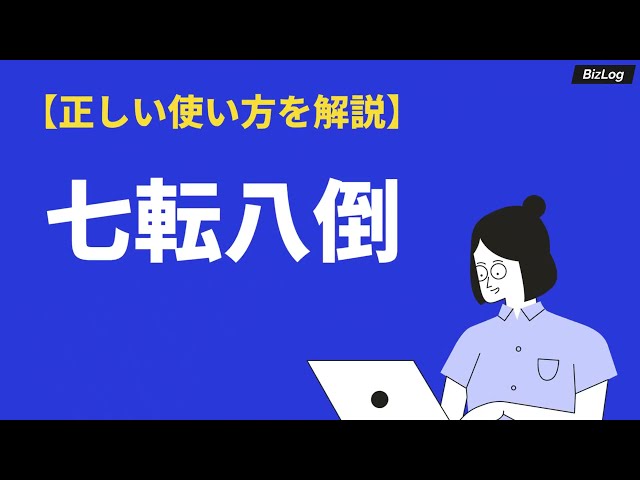
This is a four-character idiom used when someone is in intense pain or in a state of severe confusion.
As the kanji “七転八倒” literally depict “falling seven times and collapsing eight,” you can imagine the severity of the pain or turmoil.
The phrase originates from a Chinese anecdote and is said to describe a world in chaos.
In everyday conversation, it’s used to express situations like being injured or experiencing an event so sad you can’t even stand.
Although the kanji look similar to '七転八起,' their meanings are completely different, so be sure not to mix them up.
Trinity

Trinity (Sanmi-ittai) is a four-character idiom derived from Christian doctrine.
In Christianity, there is a teaching that God the Father, Jesus Christ the Son, and the Holy Spirit are not separate beings but manifestations of the one and only God.
However, as an idiom, it is often used differently—for example, to say that three rivals join forces to work on a project: “becoming one in trinity.” This departs from the doctrine’s original emphasis on the nature of existence, but it’s one of the idioms you can use in positive, collaborative contexts.