

[For Seniors] Four-character idioms that include numbers. How many do you know?

“Killing two birds with one stone,” “writhing in agony,” “surrounded on all sides”… Four-character idioms that include numbers can enrich your expressions when you drop them casually into conversation.
In this article, we’ve gathered number-containing four-character idioms that older adults can enjoy for brain training or recreational activities.
You can present them as a quiz, use them to spark conversation while recalling their meanings—the possibilities are endless.
Enjoy them with your own twist.
From nostalgic sayings to expressions that make you think, “So that’s what it means!”, why not rediscover the charm of language?
- [For Seniors] Interesting Four-Character Idioms: Introducing four-character idioms whose appearance, words, or meanings are uniquely entertaining
- For seniors: A four-character idiom quiz perfect for brain training. A collection of problems that will refresh both mind and spirit.
- For Seniors: A Collection of Four-Character Idioms with Cool Meanings and Stylish Look—Great as Personal Mottos Too
- [For Seniors] Beautiful four-character idioms: Introducing words whose appearance and meanings are elegant, expressed with rich nuance
- [For Seniors] Recommended for Kakizome! Introducing Popular Four-Character Idioms and Their Meanings
- Four-Character Idioms for Seniors as New Year’s Resolutions: A Collection of Uplifting, Heartfelt Words
- [For Seniors] Uplifting four-character idioms: Introducing beautiful, heart-touching words
- Four-character idioms for seniors that express goals, effort, and aspirations: words that stir the heart
- Four-Character Idiom Slogans That Resonate with Seniors: A Collection of Beloved Quotes for Facilities and Communities
- [For Seniors] Quiz on Kanji with Many Strokes
- Four-character idioms expressing the spirit of perseverance for seniors: encouraging words that give you a gentle push forward
- [For Seniors] Beautifully Resonant and Memorable! Popular and Stylish Four-Character Idioms
- [For Seniors] Four-character idioms that wish for happiness: auspicious, lovely words to gift to someone special
[For seniors] Four-character idioms that include numbers. How many do you know? (1–10)
Three cold days, four warm days

Sankan-shion refers to a pattern in which cold days and warm days alternate in a seven-day cycle.
The sharp weekly swings in weather are said to be caused by the Siberian High.
This term is actually a proverb describing winters in northeastern China and the Korean Peninsula, which are influenced by the Siberian High.
Japan, however, is also affected by the Pacific High, so true sankan-shion is relatively uncommon there.
As a result, in Japan the term is increasingly used to describe the temperature fluctuations in early spring, when low- and high-pressure systems arrive alternately.

In all likelihood; nine times out of ten; almost certainly
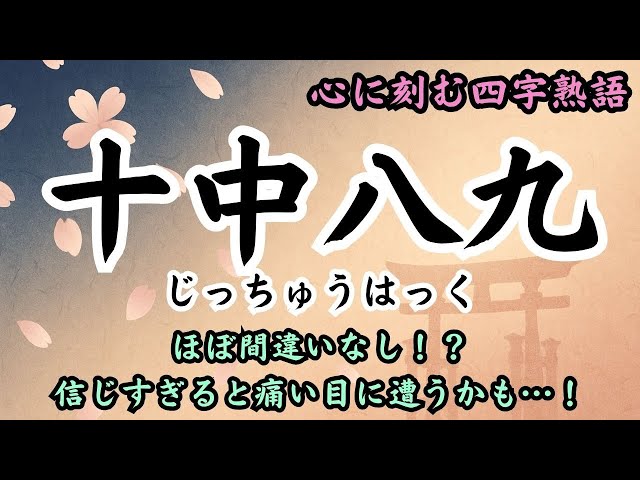
One example of a four-character idiom that uses numbers is jūchū hakkun (十中八九).
文字どおり「十のうち八か九」を意味し、そこから「ほとんど」や「大部分」を表すようになりました。日常会話では、「ほぼ確実にそうなるだろう」のように、実質的に確実な結果を示すのに使われます。同じニュアンスをもつ類似の慣用句に「九分九厘(kubun kurin)」があります。
Both are easy to remember because they contain numbers, and they’re handy expressions you can use casually in daily life.
Take this opportunity to memorize them.
around the clock

When it comes to four-character idioms that people from children to adults often hear, isn’t shiroku-shichū the one that comes to mind? The “shiroku” refers to 4×6=24—meaning twenty-four hours—and it’s commonly used when you’re doing something or thinking about something all day long.
For example: “He’s on his phone around the clock,” or “Work is on my mind around the clock.” It’s a four-character idiom frequently used in daily conversation and business settings, and it’s easy for anyone to adopt.
Try replacing “all the time” with “around the clock” when you speak.
For seniors: Four-character idioms that include numbers. How many do you know? (11–20)
to struggle desperately; to have a hard time; to be in dire straits (shiku-hakku)

Shiku-hakku is a four-character idiom that means to struggle greatly.
It is said to originate from Buddhist terminology.
The initial “four sufferings” are birth, aging, sickness, and death; the subsequent “eight sufferings” add separation from loved ones, contact with those one hates, frustration from unfulfilled desires, and the suffering arising from the five aggregates.
In Buddhism, these eight sufferings are considered unavoidable for humans.
An example of usage would be: “Even though I struggled mightily, I finally reached the goal.” Also, be careful not to misread it as “shikku-hakku.”
next to nothing; dirt cheap; worth almost nothing
@yojijyukugo.seizan translationworking adultTranslationstudy
Original Song – Four-character Idioms/Holy Mountain – Four-character Idioms/Holy Mountain
It is often used for things that have little value, or that are treated unfairly cheaply with their value unrecognized.
It applies, for example, when something took a lot of effort to make and is labor-intensive but yields little profit, or when selling unwanted items.
Try using the four-character idiom in sentences like: “I took brand-name goods to a recycle shop, but they were bought for next to nothing,” or “They were vegetables I had worked hard to grow, but the price was a pittance.” If you explain the origin of the term while posing quiz questions, it will make for a deeper, more engaging quiz.

Once-in-a-lifetime encounter

Let me introduce the four-character idiom often associated with the tea ceremony: ichigo ichie.
This phrase means that each encounter or opportunity happens only once in a lifetime, and in the tea ceremony one is taught to approach a gathering with that mindset.
When we think, “We’ll meet again,” or “There will surely be another chance,” our attitude and words tend to become careless.
But if we treat it as ichigo ichie, we naturally aim to respond with sincerity and care.
It’s precisely in our task-driven modern era that this is a four-character idiom worth remembering.
three-legged race

It’s famous as a sports day event, but this four-character idiom is also often used in everyday life when spouses or families work together, or when you proceed with a task alongside a partner at work.
It’s commonly used when two people combine their efforts to tackle a single task or goal.
Examples include: “Thanks to his support, the new project is progressing smoothly as a two-person, three-legged race,” “Parent and child take on the entrance exams together, like a three-legged race,” and “As a married couple, we joined forces and started the company together, like a three-legged race.” It’s frequently used to describe taking on a long journey while mutually supporting each other.
It’s a good phrase to use when talking about family, too.