

[For Seniors] Four-character idioms that include numbers. How many do you know?

“Killing two birds with one stone,” “writhing in agony,” “surrounded on all sides”… Four-character idioms that include numbers can enrich your expressions when you drop them casually into conversation.
In this article, we’ve gathered number-containing four-character idioms that older adults can enjoy for brain training or recreational activities.
You can present them as a quiz, use them to spark conversation while recalling their meanings—the possibilities are endless.
Enjoy them with your own twist.
From nostalgic sayings to expressions that make you think, “So that’s what it means!”, why not rediscover the charm of language?
- [For Seniors] Interesting Four-Character Idioms: Introducing four-character idioms whose appearance, words, or meanings are uniquely entertaining
- For seniors: A four-character idiom quiz perfect for brain training. A collection of problems that will refresh both mind and spirit.
- For Seniors: A Collection of Four-Character Idioms with Cool Meanings and Stylish Look—Great as Personal Mottos Too
- [For Seniors] Beautiful four-character idioms: Introducing words whose appearance and meanings are elegant, expressed with rich nuance
- [For Seniors] Recommended for Kakizome! Introducing Popular Four-Character Idioms and Their Meanings
- Four-Character Idioms for Seniors as New Year’s Resolutions: A Collection of Uplifting, Heartfelt Words
- [For Seniors] Uplifting four-character idioms: Introducing beautiful, heart-touching words
- Four-character idioms for seniors that express goals, effort, and aspirations: words that stir the heart
- Four-Character Idiom Slogans That Resonate with Seniors: A Collection of Beloved Quotes for Facilities and Communities
- [For Seniors] Quiz on Kanji with Many Strokes
- Four-character idioms expressing the spirit of perseverance for seniors: encouraging words that give you a gentle push forward
- [For Seniors] Beautifully Resonant and Memorable! Popular and Stylish Four-Character Idioms
- [For Seniors] Four-character idioms that wish for happiness: auspicious, lovely words to gift to someone special
For seniors: Four-character idioms that include numbers. How many do you know? (11–20)
Five viscera and six bowels
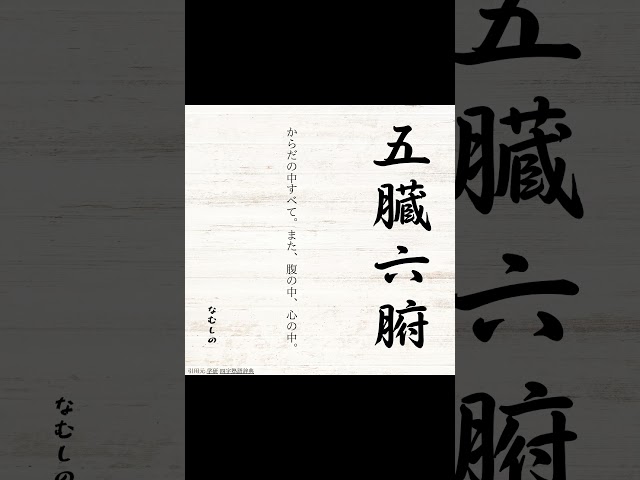
This four-character idiom originally means “all the internal organs of the human body,” but nowadays it’s used in the sense of “from the depths of one’s being” or “with one’s whole body.” The “five viscera” refer to the liver, heart, spleen, lungs, and kidneys, while the “six bowels” refer to the gallbladder, small intestine, stomach, large intestine, bladder, and triple burner (san jiao).
This idiom is often used when a drink or food permeates the body, or when one is deeply moved or feels something intensely.
A quiz that uses this idiom while asking questions about body parts could be a fun way to liven things up.

Buddha-lands numbering in the hundreds of billions

A distinctive four-character idiom that uses very large units like ten-thousand and hundred-million, it literally indicates an extremely great distance.
“Soil” here refers to the Buddha’s realm, and by extension “juuman-okudo” (literally “a hundred million times ten thousand lands”) signifies the Buddha-land far, far beyond—namely, the Pure Land of Ultimate Bliss.
The Pure Land is the realm of the Buddha to which one is guided after death.
Although it is a Buddhist term, this idiom can also be used to describe an endlessly distant journey one could never reach, or an unattainably high goal.
Pronunciation: juuman-okudo.

Three Thousand Worlds

Originally a Buddhist term, it is said to refer to all the worlds that spread out infinitely.
Today, it is often used simply to mean “the whole world” or “everything in this world,” serving as an expression that captures vastness and complexity in a single phrase.
It evokes the layering of human endeavors and ideas, joys and sufferings, lending depth to language.
Its stacked characters create a distinctive atmosphere that leaves a strong impression, and incorporating it into writing can instantly broaden the sense of worldbuilding.
It is a four-character idiom that symbolizes grandeur, combining a vast scale with a spiritual dimension.

In conclusion
Four-character idioms that include numbers can serve as great materials for enriching interactions with older adults, by evoking memories and sparking conversation. Enjoying their sounds and rhythms while learning the meanings and origins behind each one may lead to new discoveries. If you recall and use them in everyday moments, they can make your communication more nuanced and rewarding.