

[For Seniors] Fun Recreational Activities Without Equipment


Moving your body is important for staying healthy.
Still, for those who find it hard to move as they’d like, seated recreations are a perfect fit.
You can move your hands and feet to music, sing together, and cooperate with friends.
It’s also effective for stimulating the brain, creating a time that naturally fills with smiles.
This time, we’re introducing simple exercises and activities you can enjoy without any equipment.
Why not try incorporating them into your daily routine?
- [For Seniors] Simple Recreational Activities You Can Enjoy While Seated
- [For Seniors] Easy and fun seated activities you can do in your room
- [For Seniors] Refresh Your Mood! Lively, Get-Moving Games
- [For Seniors] Recreational Activities Enjoyable in Large Groups
- [For Seniors] Enjoy safely even during the COVID-19 pandemic: Seated activities
- [For Seniors] Simple Tabletop Games: Fun and Engaging Recreational Activities
- Hand games that liven things up for seniors—also great brain training
- [For Seniors] Fun Small-Group Recreation
- [For Seniors] Enjoyable Indoor Activities! Recreations and Games That Engage the Mind and Body
- [For Seniors] Today’s Recommended Activity: Fun and Engaging
- For Seniors: Fun and Lively Exercise Recreation
- [For Seniors] Fun Brain Training! Lively Whiteboard Activities
- [For Seniors] Recommended Easy Strength Training
Brain Training and Quiz-type Recreations (11–20)
health exercises

This is a brain-training exercise guaranteed to make you burst into laughter, modeled on the Three Wise Monkeys of Nikkō Tōshōgū—“see no evil, speak no evil, hear no evil.” First, learn the gestures: cover your eyes for “see no evil,” cover your mouth for “speak no evil,” and cover your ears for “hear no evil.” Next, someone calls out one of them, and after a “ready, go!” everyone strikes the corresponding pose.
The difficulty ramps up when the facilitator in front throws a feint by performing a different gesture, which is sure to get big laughs, even from older participants! It’s also fun to adapt it into a rhythm game by combining hand claps with the Three Monkeys’ gestures.

Number Exercises

Let’s try a group exercise game that’s even more fun with lots of friends.
Assign specific poses—like clapping your hands or touching your head—to the numbers 1 through 3.
The leader says a number while doing its pose and leads as a model in front of everyone.
If everyone can follow along, great! It’s a game that uses your head and body at the same time.
Of course, it’s fine if you can’t keep up or don’t understand right away.
The goal isn’t to succeed, but to enjoy participating.
Making mistakes and bursting into laughter also leads to fun communication.

Brain Training and Quiz-Style Recreations (21–30)
Say-It Game
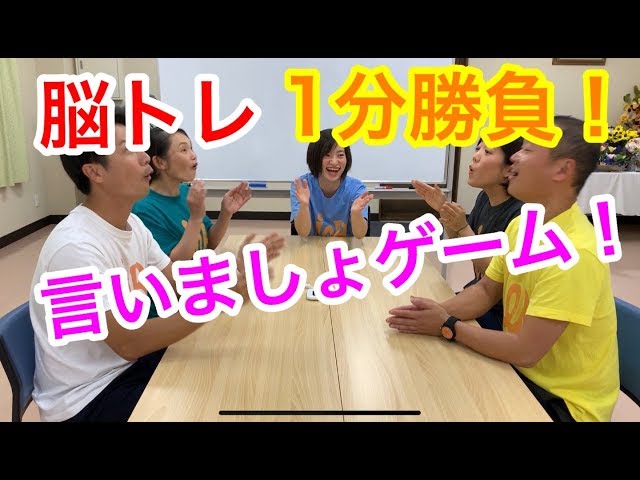
The lively and fun “Let’s Say It” game that you can enjoy with lots of friends is an easy recreation even for seniors.
The rules are simple and nothing is difficult.
You choose a topic, then take turns saying words related to it while clapping your hands.
Of course, you can’t repeat a word someone else has already said.
The key is to keep it moving with a steady rhythm—clap, clap—and pass it along.
Let’s see how much you know and how long you can keep it going.
Even if someone gets stuck, gently waiting for the word to come makes it a good brain exercise.
Stepping exercise

We’d like to introduce a brain-training sports game that you can do without running or jumping—and even while seated.
It’s not an intense sport, but it’s a recreational activity that combines light exercise with mental engagement, making it easy for older adults to enjoy.
While seated, march your feet and add hand claps at specific timings to get some aerobic exercise.
It can help with weight loss, stabilize blood pressure, and improve cardiovascular function.
You don’t need any equipment, and if you have friends around, it’s a great group game—perfect for combating lack of exercise.
In conclusion
We introduced a variety of exercises and activities that naturally bring out smiles, set to bright rhythms and songs. These seated-friendly recreations make it easy for everyone to join in and create enjoyable moments together. Please enjoy a delightful time that energizes both body and mind.