

Let's sing together! A collection of nursery rhymes everyone knows

Nursery songs that many people have sung in day-care centers, kindergartens, and schools.
These children’s songs, passed down through generations, are still sung today in childcare settings, schools, and even senior facilities.
That said, fewer people are singing them nowadays, and some children can be found who don’t know nursery songs at all.
In this article, we’ll introduce nursery songs that everyone—young and old—will recognize.
If you’re not very familiar with nursery songs, start by listening to the ones we introduce here.
Try singing nursery songs together with your child, your friends, or your grandparents, and have fun!
- Children’s Song Medley: A playlist of classic and popular hits everyone knows
- Get pumped with popular songs from “Okaasan to Issho”! A collection of timeless tunes everyone will want to sing together
- [Minna no Uta] Beloved Across Generations: Nostalgic Classics and Popular Songs
- [Warabe-uta] Beloved Classic Songs Passed Down Through Generations
- Collection of winter nursery rhymes, folk songs, and children's songs. Includes fun winter hand-play songs too.
- [Children's Songs] Cute songs recommended for childcare. List of popular nursery rhymes.
- Nursery rhymes to sing to your baby! Recommended songs enjoyable from 0 months
- Nursery rhymes you’ll want to sing at karaoke: classic and popular songs everyone can enjoy together.
- [Children’s Songs of Autumn] Autumn songs, school songs, and traditional children’s rhymes. A collection of classic pieces to sing in autumn.
- Nursery rhymes, folk songs, and children's songs about animals
- Get pumped with kids’ favorite songs! A memorable collection of classics that will make you want to sing along
- [Hand Play] Popular with kids! A collection of trendy hand-play songs and nostalgic traditional children’s songs
- [For Seniors] Spring Songs You'll Want to Hum: Feel the Season with Nostalgic Classics
[Let’s Sing Together!] A Collection of Well-Known Children’s Songs (21–30)
Adorable foalSakushi: Satō Hachirō / Sakkyoku: Niki Takio

This song warmly portrays the life of a foal and a child, while carrying a curious, poignant sense of the times quietly creeping in.
You dry the foal’s wet mane, run together, and eventually part ways.
Such scenes unfold alongside rhythmic calls and responses.
The lyricist, Hachirō Satō, was active across a wide range from children’s songs to popular music, and the composer, Takio Niki, was a seasoned talent also known for film scores.
The work was released in December 1940 and broadcast nationwide the following January 1941 on NHK’s “National Songs.” It is closely connected to the film “Uma” (Horse), and has long been loved, later even featured in animated films.
Singing it as a family invites reflections on life in earlier times, and in early childhood settings it can be enjoyed as a play activity by imitating a foal’s movements.
Song of the Resounding GrasslandsSakushi: Kubota Yuzuru Sakkyoku: Maruyama Aki

This piece opens a series based on Mongolian folk tales.
Poet Yuzuru Kubota and composer Aki Maruyama joined forces, and it was first unveiled at a premiere concert held at the Nagoya Civic Hall in May 2000.
It was later formally published in September 2002 as the opening number in the score collection Aki Maruyama Song Collection [Supplement]: Suho’s White Horse.
The lyrics weave in images of a steppe where wind and light resonate, and its bright, easy-to-sing melody makes it accessible for children.
It works beautifully in many settings—sung alongside a story reading in schools or preschools, or used as an introductory piece for recitals and concerts.
Horse’s tail, pig’s tail.Sakushi: Abe Hitomi / Sakkyoku: Yamamoto Naozumi

Broadcast on NHK’s Minna no Uta in August 1983, this song is a humorous children’s tune themed around the tails of a horse and a pig.
Written by Hitomi Abe and composed by Naosumi Yamamoto, it was selected as an outstanding piece in NHK’s Children’s Song Lyrics and Composition Contest.
The story charmingly likens a boy’s puppy-love—teasing the girl he likes—to animal tails, sweetly capturing that childish urge to tug on her pigtails.
Sung by Kyu Sakamoto and the NHK Tokyo Children’s Choir, it became well-loved and was rebroadcast in 2010 and 2015.
There are also covers by various artists, including Seiji Tanaka, and it is widely sung in kindergarten and nursery school choirs.
Its lively melody and catchy refrain make it perfect for parents and children to sing together.
Foal’s Rhythm PlayMonbushō shōka

This children’s song, which depicts a lively foal moving forward to the chant “Hai-shii, hai-shii,” was included in the Ministry of Education’s Shoka for the Elementary School Reader, edited in July 1910 (Meiji 43).
Its hallmark is the way it expresses the foal’s hoofbeats—pressing on along mountain paths and up steep slopes—through an even beat and rhythm.
Today it is used in early childhood education and eurhythmics as a “rhythm play” activity, ideal for children to walk, run, and stop in time with the piano.
Because changes in pitch and tempo can be expressed through body movement, it’s perfect for group movement play and parent–child bonding time.
By imitating a horse’s gait, it offers a fun way to foster a sense of rhythm.
All mothersamerika min’yō
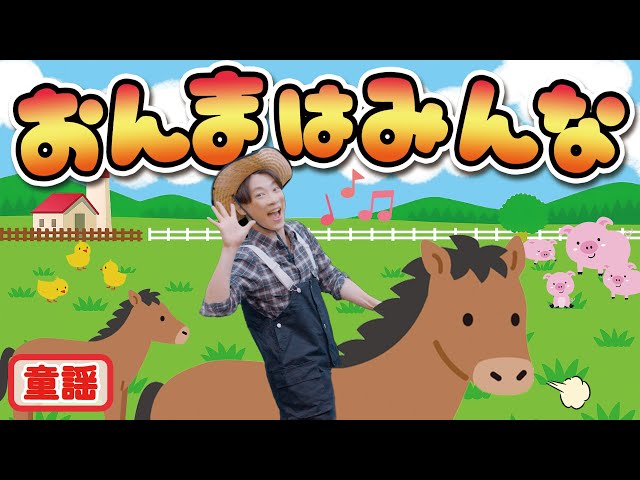
This is a song arranged for Japanese audiences from a folk tune that originated in 19th-century America.
Tomoko Nakayama’s Japanese lyrics pose questions like why a horse goes clip-clop as it runs and why a piglet’s tail curls—“no one knows why.” Easy-to-remember onomatopoeia is repeated to the rhythm, making it appealing and well-suited for creating parody verses.
Sung on NHK’s children’s programs, this piece has reached many homes and childcare settings through performances by Yuko Kanzaki and Osamu Sakata.
Combined with fingerplay or marching movements, it’s a perfect nursery song for parents and children to enjoy together.
horse (childish/affectionate term)Sakushi: Hayashi Ryūha / Sakkyoku: Matsushima Tsune

This piece portrays a foal walking clip-clop alongside its mother, set to a gentle rhythm.
Lyricist Yanaha Hayashi is said to have written the words based on the scene of a mare and foal he saw at the Imperial Stock Farm in Chiba, weaving the affection between animal mother and child in simple language.
Composer Tsune Matsushima aimed for a vocal range and phrasing that are easy for lower elementary grades to sing, and created accompaniment that is easy to play on keyboard or harmonica.
After being included in the February 1941 national school textbook “Uta no Hon, Upper,” it continued to be adopted in textbooks by various publishers after the war, and in 2007 it was selected for the “100 Best Japanese Songs.” It fits naturally into kindergarten and preschool choruses, and it’s easy to incorporate into fingerplay or instrumental ensembles.
If parents and children sing it together, they can have fun imitating the sound of hoofbeats.
Teacher and friendsSakushi: Yoshioka Osamu / Sakkyoku: Koshibe Nobuyoshi

It’s a memorable song with warm lyrics that gently support children’s hearts.
It cherishes encounters with teachers and friends and carries the hope of starting school life with joy.
The lyrics—holding hands, greeting each other—naturally bring smiles to children’s faces, which is part of its charm.
Created by Osamu Yoshioka and Nobuyoshi Koshibe, this piece is often sung in April, when new terms begin at kindergartens and nursery schools.
How about singing it together with your child during the season of entrance or advancement? You’re sure to share a heartwarming moment as a family.