

![[For Wind Bands] A Compilation of Common Questions About the Double Bass and Preparations for the New School Year](https://media.ragnet.co.jp/img/1200__jpg__https://www.ragnet.co.jp/files/2016/09/c851d6727f9d522dba7993a1fbf1788e.webp)

When I go to coach school wind bands, I often get questions and consultations from members who play the double bass.
These cover not only performance and daily practice, but also things like which ensemble category to enter for ensemble contests, or how to find suitable pieces when they want to try a solo contest but can’t find the right repertoire.
Players who are the only one in their part, or who don’t have anyone around to teach them, tend to have especially many concerns.
I’ve compiled these consultations and questions into a Q&A about the double bass.
If you’re struggling, please feel free to use it as a reference.
I’ve also put together what you should work on before the new school year starts and before new members join.
For those becoming seniors for the first time, I’ll share tips on how to teach, so I hope this helps you become a supportive section leader.
- To you who are thinking about quitting the brass band club: You shouldn’t quit for reasons like these.
- [Saxophone] Recommended practice songs for saxophone beginners: Famous tunes you’ll want to try playing
- [History] A roundup of popular set pieces from the All-Japan Band Competition
- Perfect for free selections and concert programs! Introducing famous and classic favorites in wind ensemble music.
- Recommended pieces for a wind band contest
- [Brass/Wind Band] Recommended for Beginners! A Collection of Classics and Popular Pieces Perfect for Practice
- [Practice!] Practice Songs for Beginner Bassists During Spring Break
- [Wind Band] Guaranteed to hype up the school festival! Recommended pieces the brass band will want to play
- A Must-See for Middle and High Schoolers! Recommended Free-Choice Songs for Choir Competitions Catalog
- [Low End] A Collection of Japanese Songs Featuring Standout Bass Solos [2026]
- Wind Ensemble: Brass Band Pieces Popular with Girls. Masterpieces of Wind Music Recommended for Women.
- [2026] Easy J-Pop and Japanese Rock Songs Recommended for Beginner Bassists
- Practice pieces for beginner trumpet players
A roundup of common questions about the double bass in school wind bands
http://www.photo-ac.com/
Q1. Can you hear the double bass?
If you master the correct playing technique and can produce proper sound—if you can make the instrument resonate—you are hearing it!
But once the band’s volume reaches a certain level, you can no longer hear it as an individual sound.
Instead of thinking about projecting the sound to the audience, try to imagine producing a solid sound within the low-end section.
The ease of playing the other parts will change.
Since there isn’t a single definitive “this is correct!” way to play the double bass, I chose the phrase “proper technique” with the idea of performing based on a solid foundation.
Q2. In a competition, is it better to have the f-holes facing the audience?
It depends on the band’s lineup and setup, but if the idea is to make the bass sound solid within the section, I don’t think there’s much need to aim it toward the audience.
Q3. Where should I go for the part practice?
The contrabass in wind ensembles has two sides.
- The identity of the woodwind as a bass
- The face of a low-brass player
Look at the score of the piece you’re working on now, identify which parts move together, and practice with those partners.
Even during ensemble playing, I think about whether I should lean more toward a woodwind or brass character at that moment, and shape a tone color that fits the scene.
Q4. I’m playing the tuba part. Some notes are out of my range and I’m not sure how I should adjust the octaves.
Some people play the tuba part an octave higher, while others play it as written.
Both are acceptable; for example, we sometimes switch between them depending on how it balances with the tuba or other parts.
Q5. Where should I enter the ensemble contest?
The double bass also pairs well with woodwind instruments, and recently, sheet music for “flexible ensembles,” which can be performed with a selection of specified instruments, has been released. I think using that music would be a good option.
I'm glad there's a double bass part.
Q6. I’d like to enter a solo contest—do you have a piece/song for me?
There is!/We have it!
There’s a wide variety, from pieces written for the double bass to works for other instruments.
If it’s a piece written for double bass, it’s a bit hard to obtain, so you would need to purchase it at an instrument shop in Tokyo or online.
For example, collections like “Selected Famous Cello Pieces” are recommended; they include sheet music arranged so that classical masterpieces are about 3–4 minutes long, along with accompaniment scores.
New club members are coming! But before that…
http://www.photo-ac.com
When the new term starts and you move up a grade, you become a senpai.
And then in April, the new club members will finally be joining, won’t they?
So, as seniors, here are the things we should take care of before the new club members arrive.
Is my junior’s instrument in good condition? Let’s find out with a checklist.
Let's say you took your instrument out of its case for the first time in a while.
Are there any cracks or peeling on the instrument, any wear on the strings, is the bridge in the correct position, and is there enough bow hair? These are items you’ll want to check.
Let's refer to the instrument condition checklist and take a look.
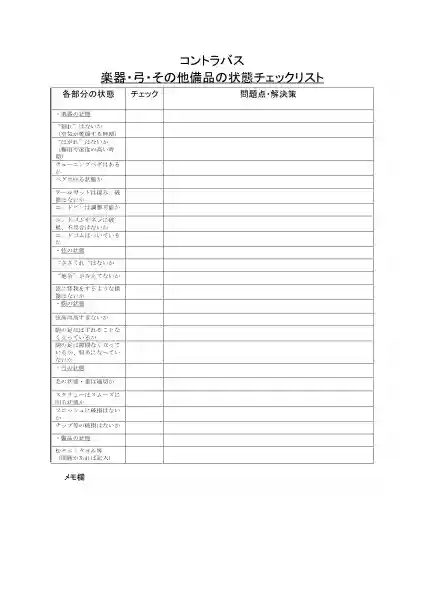 This is a checklist for assessing the condition of a double bass.
Check each item to see if there are any issues, and if you find any problems that might interfere with performance, please consult your advisor.
Before new students join, when you take out an instrument you haven’t used in a while, or when you borrow instruments from other schools, please use this as a reference to assess the condition of the instruments.
Is it hard to teach? I'm a little worried.
It’s certainly difficult to teach things to others, isn’t it?
But it’s okay—I’ll share a little tip.
Please imagine a home shopping program (it really makes you want to buy, doesn’t it?).
Yes, and don’t forget not only to tell them in words, but also to demonstrate it.
Don’t hesitate or think “Am I the one who should do it?”—just go ahead and demonstrate it boldly.
Demonstrate, explain, and let them do it.
Let's wrap it up!
- I’ll show you how it’s done (Senpai will demonstrate as an example).
- Explain why this is so, saying it yourself (explain it in your own words).
- Let them try (Alright, go ahead and play!)
- Praise them when they succeed! (Everyone feels happy when they’re praised.)
That's it! I think that's the key to the teaching.
- Can I put the charm of the double bass into words?
- Playing the double bass is this much fun!
- You can do this, too!
The unsung hero supporting everyone—please share its appeal.
Lastly
How did you find the common double bass Q&A and the preparations you’d want to complete before the new school year?
This is a summary of things I want everyone to work on—those of you who play double bass in the wind ensemble but rarely get chances to receive instruction, or who are the only one in your part and aren’t sure what to do.
If reading this article made you think, “I want to get better!”, be sure to pick up a method book written for the contrabass in wind ensembles.
Nowadays, many lesson DVDs and instructional books are being sold, making it possible to obtain a lot of information.
The double bass is an indispensable instrument in wind ensembles.
But the reality is that the conditions are still quite tough—for example, there isn’t anyone nearby who can teach it as the only string instrument.
After the competition is over, and before the new students arrive, take a fresh look at yourself and work on overcoming your weaknesses.
And of course, please pass on not only the technique of playing the double bass but also the knowledge and practice methods to the next generation as a proud tradition of the double bass section!