

From classic folk dance staples to hidden gems. Introducing recommended tracks!


Folk dancing, a familiar sight at school events and recreational activities.There are many nostalgic tunes that make your body start moving the moment the music begins!When it comes to folk dance songs, there’s an incredible variety—from timeless standards everyone has danced to at least once, to pieces that let you enjoy traditional rhythms from around the world.You might have suddenly wondered, “What was the name of that song again?”In this article, we’ll present a broad list of folk dance tracks.Whether you’re unsure what to pick for an event or searching for a song filled with memories, we hope you’ll find this helpful!
- Popular Dance Songs Ranking [2026]
- Songs you can dance to around the campfire. A roundup of recommended tracks for dancing.
- Top Songs to Hype Up Sports Day and Athletic Festivals [2026]
- Dance/popular songs ranking for the school cultural festival
- [Dance Tracks] Perfect for School Sports Days! A Curated Selection of Fun, Popular Songs to Dance To [2026]
- [Childcare] Recommended for sports day performances and dances! A collection of classic and popular songs
- [For Seniors] Fun Small-Group Recreation
- For Seniors: Festive Attractions to Liven Up Festivals—Games and Recreational Activities
- [Camp Songs] Classic camping songs. Campfire songs you can play along with
- [Sports Day] Entrance songs that will hype the crowd! A comprehensive roundup from classics to the latest hits
- [For Creative Dance] A Collection of Easy-to-Dance Japanese and Western Tracks
- Popular songs recommended for nursery and kindergarten sports days! A collection of classic and latest tracks to liven up the event
- Entertainment and Performances That Delight at Day Services for the Elderly
From classic folk dance tunes to hidden gems. Introducing recommended tracks! (31–40)
Elizabeth Quadrille

Here is a piece used for a somewhat advanced folk dance where eight people face inward in a square to dance.
This dance, called the quadrille, is said to have originated in France, and it originally involved not person-to-person dancing but four pairs of people and horses forming various figures via reins.
The music is in triple meter, giving it a more elegant feel.
The choreography was created in the 1950s by the couple Marian and Ned Gault.
It’s interesting that we can clearly identify who devised the choreography.

Ace of Diamond

This dance originated as a Danish farmers’ dance.
Because Denmark has severe cold weather and few opportunities to exercise outdoors, indoor folk dances became popular.
The music is an old folk song called “Ritchi Ratchi.” It has been danced in Japan since before the war, and the song also has Japanese lyrics; it was included in music textbooks, so many people may be familiar with it.
As for the choreography, holding hands is common, but linking arms and turning is a refreshing twist.
Grand Square

It’s an American old-time square dance.
Eight people each trace a small square, and together they form a large square called a “grand square.” It’s an interesting dance with that movement, but it’s the kind of dance where you might end up wandering around, unsure of where you’re supposed to go next.
Mexican Hat Dance

The Mexican Hat Dance is a traditional Mexican dance song, originally based on the piece Jarabe Tapatío.
It’s danced by a man and a woman, with the woman fluttering a beautiful skirt from traditional Mexican attire.
The music is beautiful, lively, and quintessentially Mexican—perfect for fun events.
A gentle folk dance is nice too, but thanks to its bright tone and guitar timbre, this energetic song is also recommended for anyone looking to liven things up.
It could be fun to think about costumes as well!

ZorbaMiosu Deokiratosu
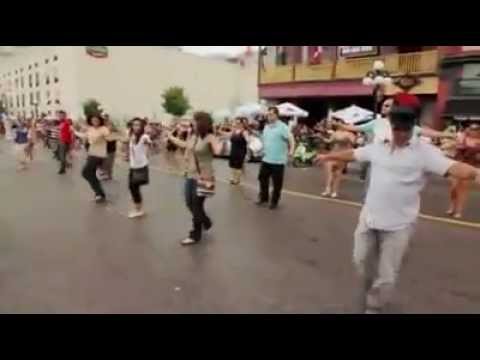
It’s the dance that became famous because the protagonist, Zorba, danced it in the final scene of the renowned Greek film Zorba the Greek.
After the film’s release, it was also staged as a musical, and in the Japanese version, Makoto Fujita played the lead role.
From folk dance classics to hidden gems: Recommended songs (41–50)
Sagapo

It’s a very fast-tempo dance performed in Israel.
The movements themselves aren’t particularly difficult, but because the tempo is quick, if you don’t have the dance fully down, you might fall behind.
However, once you’ve learned it, you’re sure to enjoy dancing along with the music.
Ten Pretty Girls

It’s an American folk dance.
Several people line up side by side and dance with their arms linked behind each other.
Since the arms stay linked, the dance focuses mainly on footwork.
Even first-timers can probably jump right into the line and dance together.
The music has a bright feel with an easy-to-follow tempo.