

Let's take on a four-choice quiz that everyone can enjoy together!


“What’s the official name for a train?” “What language is the word ‘coupon’ from?” and more…
We’ll introduce trivia about culture and everyday life—things you think you know but actually might not—in a four-choice quiz format! You can have fun learning interesting facts about Japan and the world with your family and friends.
With answers that will make you say, “Wow!”, it’s sure to get everyone excited! Let’s uncover the secrets behind the things we use and see every day by solving quizzes.
So, how many questions can you answer?
- Become a trivia master with a multiple-choice quiz for elementary schoolers! A fun problem collection that captivates both kids and adults
- [Trick Quiz] Quiz Questions That Excite Everyone from Kids to Adults
- [Interesting] Compilation of Trivia Quiz Questions
- Surprisingly unknown? Trivia Quiz [Multiple Choice: 3 Options]
- Fun quizzes that liven up the party. Quizzes everyone can enjoy.
- [Killing Time] A Collection of Fun Trivia Quizzes You'll Want to Share with Someone
- Fun quizzes for elementary school kids: a collection of questions everyone can enjoy together
- Let's get excited with a two-choice quiz that everyone—from kids to adults—can enjoy!
- [For Seniors] Surprising Facts! Multiple-Choice Trivia Quiz (4 Options)
- [Battle of Wits] Stimulate your intellectual curiosity! Quiz questions that get adults excited
- Fun Quiz Questions That Will Liven Up the Office [2026]
- A fun quiz you can use to kill time by yourself or with everyone
- A quiz of fun trivia: bite-sized knowledge that leads to new insights.
Unexpected trivia about culture and life (1–10)
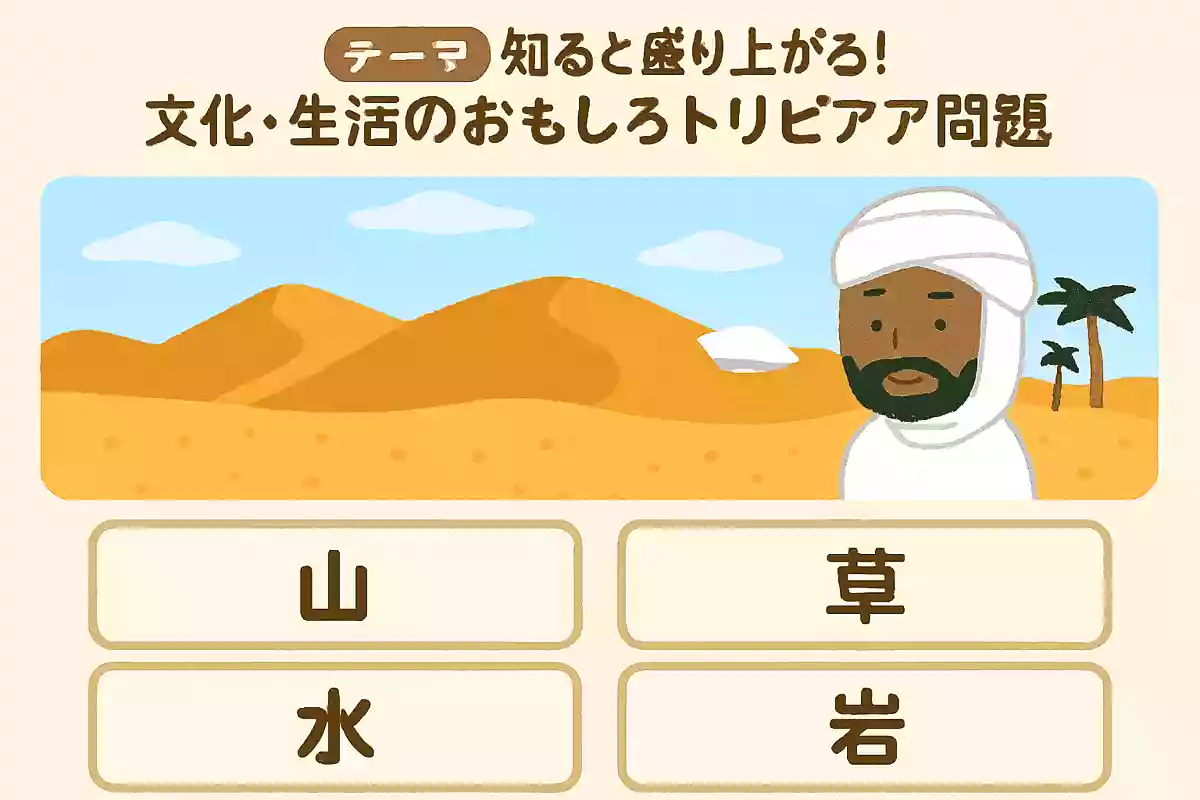
What is “Sahara” in Japanese in the term “Sahara Desert”?
- Sun
- oasis
- desert
- drying
See the answer
desert
The “Sahara” in the Sahara Desert actually means “desert” in Arabic. In other words, a literal translation of “Sahara Desert” would be “Desert Desert,” making it a redundant expression. The Sahara Desert is one of the largest deserts in the world, spanning North Africa and covering about 9 million square kilometers.

It’s said that green is good for the eyes—but why?

- Because it has a relaxing effect.
- Because it's a color that doesn't strain the eyes.
- Because the wavelength of visible light is short.
- Because green is the color of the forest
See the answer
Because it's a color that doesn't strain the eyes.
The wavelength of visible light that appears green lies in the middle range, and it is said to be perceived without straining the eyes. This is a major reason why green is considered good for the eyes. Incidentally, in color psychology, green is believed to stabilize the mind and body and help ease tension. It’s also said that looking at greenery in the distance is beneficial for relieving eye fatigue.

Which prefecture is the birthplace of the tear-off (daily) calendar?
- Tokyo Metropolis
- Osaka Prefecture
- Kyoto Prefecture
- Hokkaido
See the answer
Osaka Prefecture
The tear-off daily calendar is said to have originated in Osaka Prefecture. During the Meiji era, a printing company in Osaka devised and put into practical use a calendar format in which you flip a page for each day. In Osaka, which had developed as a merchants’ city, managing daily schedules and transactions was crucial, so the daily tear-off format was highly valued. Today it has spread nationwide, and various types—such as versions featuring proverbs and famous quotes—are widely appreciated.
Unexpected Trivia of Culture and Life (11–20)
For what original reason were buttons attached to suit sleeves?
- decoration
- so as not to wipe my nose
- spare button
- To change the width of the cuffs
See the answer
so as not to wipe my nose
The origin of suit sleeve buttons is said to go back to Napoleon, who is known as a French hero. When France invaded Russia, it is said that the soldiers, suffering from the extreme cold, wiped their runny noses with their jacket sleeves. Since the sleeves of soldiers on the march became crusted with mucus, a leading theory holds that metal buttons were added to the sleeves to prevent them from wiping their noses on them.

Why do so many pencils have a hexagonal shape?
- Easy to hold
- Design quality
- The strength increases.
- It can stand upright.
See the answer
Easy to hold
The reason pencils are hexagonal is that they’re easy to hold. Another advantage is that they don’t roll easily. As for why they aren’t pentagonal or octagonal, we hold pencils with three fingers, right? So it’s said that a hexagon, being a multiple of three, is ideal.
What is the train’s official name?
- electric passenger car
- motorized passenger car
- electric train
- electric automobile
See the answer
motorized passenger car
It’s surprising to learn that trains have an official name, isn’t it? Passenger cars that run by powering electric motors are called “densha” (electric trains), so it makes sense that their formal name is “electric multiple unit (EMU).” Although electric locomotives also run on electricity, they don’t carry passengers, so they aren’t called trains (densha).
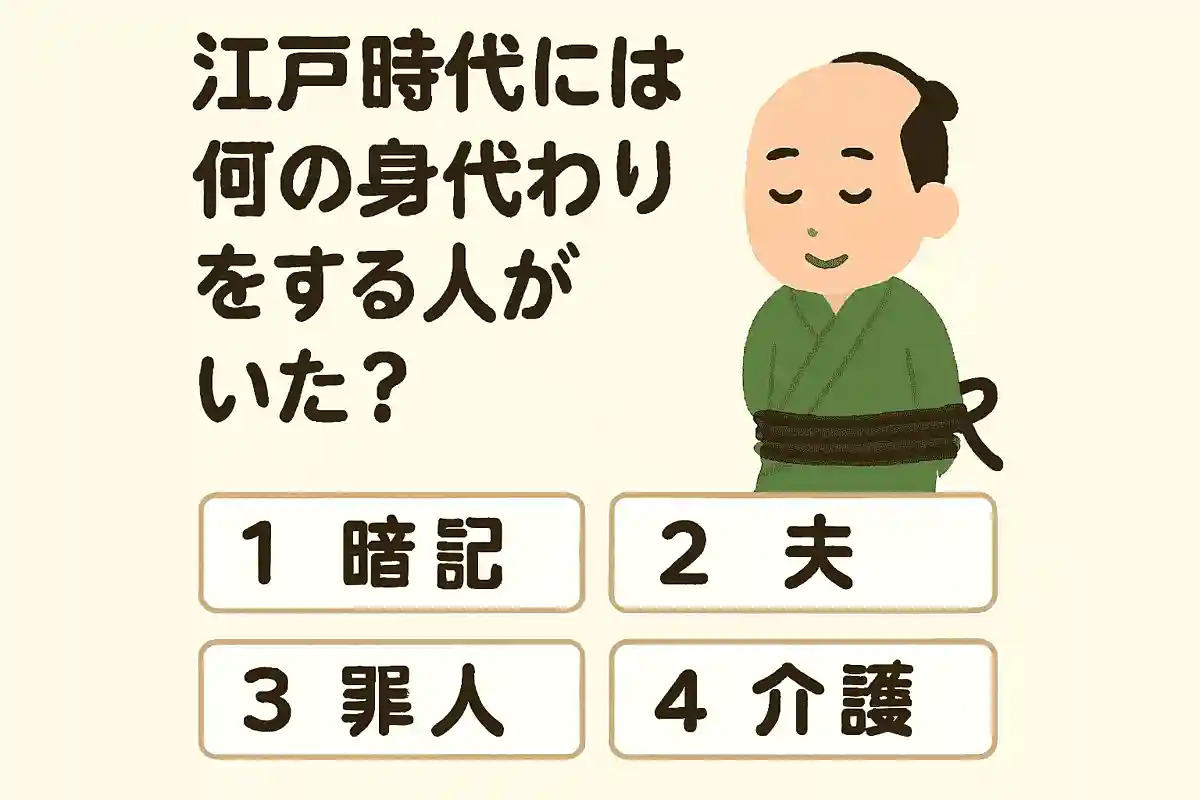
In the Edo period, what kind of stand-in (substitute) did people have?
- dine and dash
- fart
- sneeze
- snatching
See the answer
fart
It is said that during the Edo period there was a profession called heoi-bikuni—women who would take the blame for someone else’s fart. It was a unique custom characteristic of an era that placed great importance on etiquette. Although farting has always been considered embarrassing, these women were so necessary that the role existed as a legitimate job.