



Fukuoka Prefecture is full of attractive food-related spots, from Hakata ramen and spicy cod roe (karashi mentaiko) to its yatai street-food stall culture.
Beyond food, it’s also home to plenty of must-see sightseeing spots, such as PayPay Dome, the home stadium of the Fukuoka SoftBank Hawks, Mojiko Retro, and Miyajidake Shrine.
In this article, we’ll share trivia and fun facts about Fukuoka Prefecture.
Some of these are “of course” moments locals will recognize, but they may be surprising to people from other prefectures.
Let this article be your gateway to discovering even more of Fukuoka’s charm!
- [For Elementary School Students] Collection of Local Quizzes from Fukuoka Prefecture
- Trivia and fun facts about food (summary)
- Bursting into laughter! A roundup of Hakata dialect tongue twisters
- Trivia & Fun Facts about Miyazaki Prefecture
- Trivia quiz about schools: a roundup of fun facts you’ll want to brag about
- Useful right away in daily life! Surprising trivia and handy tips
- Trivia & fun facts about Osaka Prefecture
- [Common Sense & Trivia] True-or-False Quiz with Knowledge for Elementary School Students
- Fukuoka’s folk songs and children’s rhymes: History and sentiments conveyed by the nostalgic melodies of home
- Trivia quiz with useful tips to know: fun facts that come in handy at school or at home [for kids]
- A famous song about Fukuoka. The heart of the hometown passed down through song.
- Get Healthy with Vegetables: Trivia Quiz About Vegetables
- Trivia about Tokyo: A collection of fun facts useful for sightseeing
[City of Food] Trivia & Fun Facts about Fukuoka Prefecture (1–10)
The specialty product “Amaou” was named after the initials of akai (red), marui (round), ookii (large), and umai (delicious).

There are famous strawberry-producing regions across Japan, such as Fukuoka and Tochigi.
During strawberry season, you often see special features on strawberry picking online and elsewhere.
Some strawberry names are apparently derived from their characteristics.
The name of Amaou, which is harvested in Fukuoka, comes from the initials of akai (red), marui (round), ookii (large), and umai (delicious).
Amaou is a branded strawberry that Fukuoka Prefecture spent six years developing.
The aim was to improve farmers’ profits by producing high-quality strawberries.
For this reason, to enhance its brand value, Amaou is not allowed to be produced outside Fukuoka Prefecture.

“Issē no se” is Fukuoka dialect for “san no ga hai.”
A shout used when people want to coordinate their timing, such as when lifting something heavy.
Nationwide, there are various calls with regional differences.
In Fukuoka Prefecture, instead of “issei-no-se,” people say “san-no-ga-hai.” According to one theory, its origin is the “san, hai” used when starting to sing.
Many people who use this shout may not have realized it was a dialect, since the phrase blends naturally into everyday life.
Besides “san-no-ga-hai,” people also use calls like “san hai,” “se-no,” “yaa,” and “oisa,” choosing the one that fits the situation.
In PE class, students respond to commands like “Sit!” or “Stand!” by answering with “ya!”
There are regional differences in the commands used at schools across Japan.
In Fukuoka Prefecture, it’s said that students respond with “yaa” during P.E.
when given commands like “sit” or “stand.” There are several theories about the origin: one links it to the shout “yaa” used in Hakata’s representative festival, the Hakata Gion Yamakasa.
Another traces it to the 1940 Tripartite Pact among Japan, Italy, and Germany, after which German educational ideas spread to Japan; the German word for “yes,” which sounds like “ja,” may have been heard as “yaa.” By the way, outside of Fukuoka, there are also regions in Osaka, Shikoku, and Hyogo where “yaa” is used.
Hakata is the birthplace of udon, soba, and manju.
Did you know that Hakata is the birthplace of udon, soba, and manju—foods that often appear on our dining tables? It is said that the monk who founded Jotenji Temple in Fukuoka City brought back milling technology when he returned from China in 1241.
This was a groundbreaking milling technique that had never existed in Japan before.
As a result, the flour-based food culture of udon and soba spread throughout the country.
There is also a tradition that the monk from Jotenji taught the method for making sake manju to the owner of a teahouse who had kindly hosted him.
At Jotenji, there is even a stone monument marking it as the birthplace of udon and soba.
There is the largest seated wooden statue in Japan.
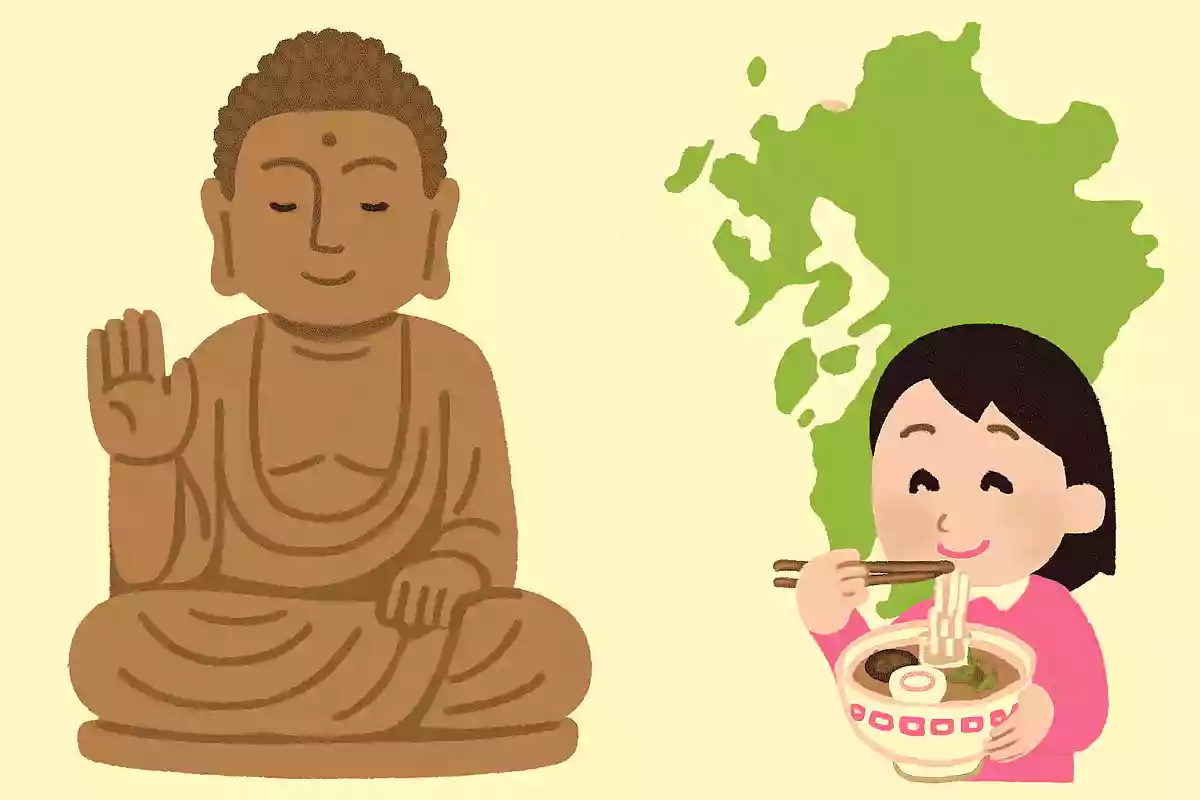
The largest Great Buddha in Japan is located in Fukuoka Prefecture.
Some of you might be thinking, “Isn’t the largest Great Buddha the one in Nara?” Or perhaps the Ushiku Daibutsu in Ibaraki Prefecture came to mind.
In fact, what counts as the “largest” Great Buddha varies by type—whether the statue is standing or seated, for example.
They can also be categorized by materials and construction methods.
The Buddha statue in Fukuoka, among seated wooden statues, is the largest in Japan.
Carving began in 1988 (Showa 63) and was completed after four years.
Inside the Buddha’s pedestal, there is a “Hell and Paradise Tour,” where visitors can experience depictions of hell, such as terrifying illustrated scrolls displayed in the darkness.
If you have a chance to visit Fukuoka Prefecture, be sure to see Japan’s largest Great Buddha and try the tour inside the pedestal.
The origin of White Day is Fukuoka Prefecture.

Although Valentine’s Day is said to have originated overseas, White Day was born in Fukuoka Prefecture.
It is said that a long-established Japanese confectionery shop in Hakata Ward, Fukuoka, which has been in business since the Meiji era, first started it as Marshmallow Day.
The company president, who was reading girls’ magazines to look for new product ideas, was inspired by a particular line he came across.
It reportedly read, “It’s unfair that there’s no return gift for Valentine’s Day.” Thinking, “Could we create a day when men give marshmallows to women, based on the products we sell?” they developed an item consisting of chocolate wrapped in marshmallow.
It began as Marshmallow Day, a day to sell the marshmallows they had created.
To turn it into a broader culture of returning gifts for Valentine’s Day, the name was changed to White Day, inspired by the white color of marshmallows.
The boundary between JR Kyushu and JR West is located within Hakata Station.
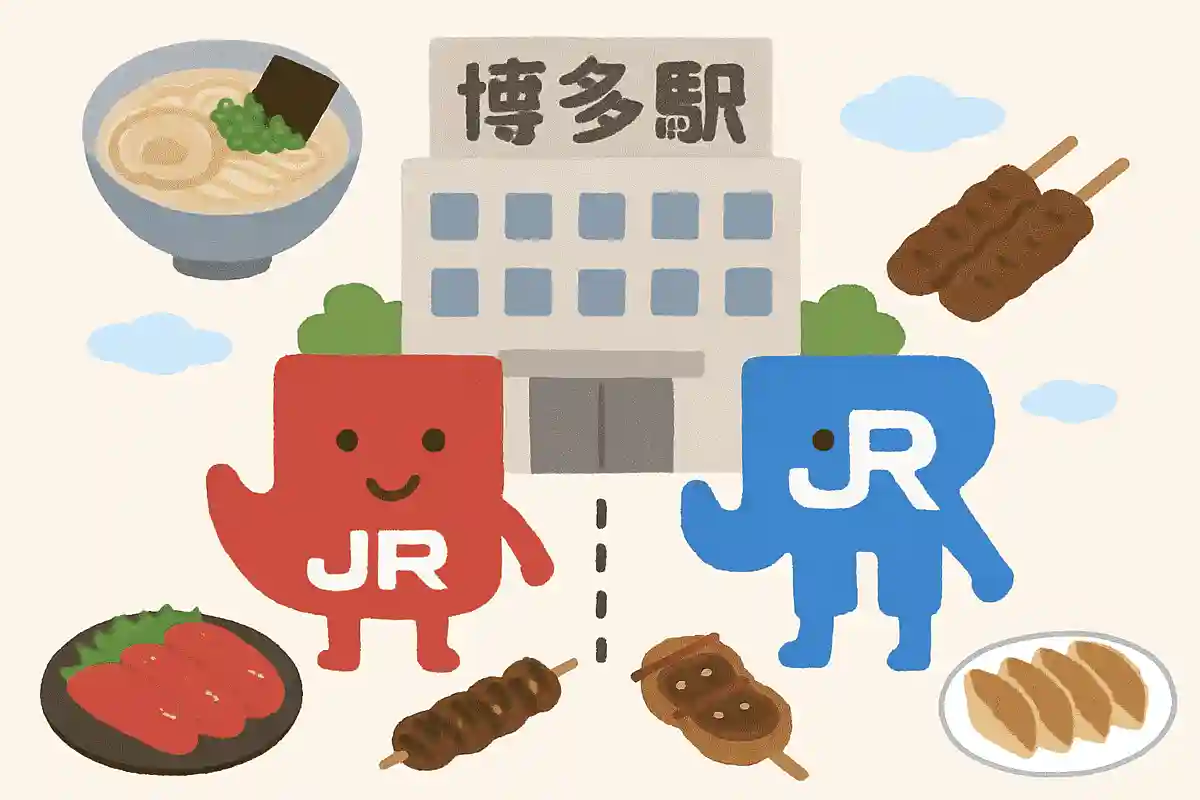
When you visit Hakata Station, be sure to look for the boundary line between JR Kyushu and JR West.
If you look closely at the floor near the Shinkansen entrance, you’ll find a small marker indicating the border! In fact, the floor color and even the logo colors can change right at that line.
It’s easy to miss if you’re just walking without thinking, but once you notice it, it’s pretty fun.
Why not check it out with your own eyes and see what differences you can spot? By the way, the areas inside the station are clearly divided by jurisdiction as well, so take care to ask the appropriate staff if you need assistance.
