

Four-character idioms that help you achieve goals! Phrases you can use in everyday situations

Four-character idioms like “united as one” (icchi danketsu) and “fall down seven times, get up eight” (shichiten hakki) are familiar parts of our everyday language.
Simple yet powerfully persuasive, these idioms can support us when we set goals.
Among the commonly used idioms, some even contain hints for achieving your dreams and ideals.
In this article, we’ll introduce four-character idioms that are helpful for people working toward their goals, along with their meanings and example sentences.
Let these resonant words help you take steady steps toward the future you envision.
- General: Four-character idioms that encourage determination—powerful, heart-stirring words
- Become positive with four-character idioms that resonate with the heart! Common yet deeply meaningful words.
- Strive toward your goals! Four-character idiom ideas that resonate with elementary school students
- Four-character idioms for New Year’s resolutions! A collection of motivational phrase ideas
- [For Elementary School Students] Four-character idioms you can use in sports! Words that are helpful for cheering and goal setting
- Recommended for elementary school class goals! A collection of impactful ideas using four-character idioms
- [Kakizome] Four-character idioms fit for the New Year: Introducing words that resonate with the heart and their meanings
- Easy for elementary school students to remember! A four-character idiom that expresses the feeling of trying your best
- Learn the meanings too! Cool four-character idioms that elementary school students will want to remember
- For Elementary School Students: Four-Character Idioms You Can Use for New Year’s Resolutions — How to Set Cool Goals!
- Four-character idioms that pioneer the future: powerful words that express challenge and effort, perfect as personal mottos.
- A collection of four-character idioms perfect for baseball: words to rouse both teams and individuals
- [Four-Character Idioms] Impressive and Cool Sound! A Collection of Famous Quotes Worth Knowing as General Knowledge
Four-character idioms that help you achieve goals! Phrases you can use in everyday situations (11–20)
to devote oneself body and soul; to make every possible effort; with utmost dedication
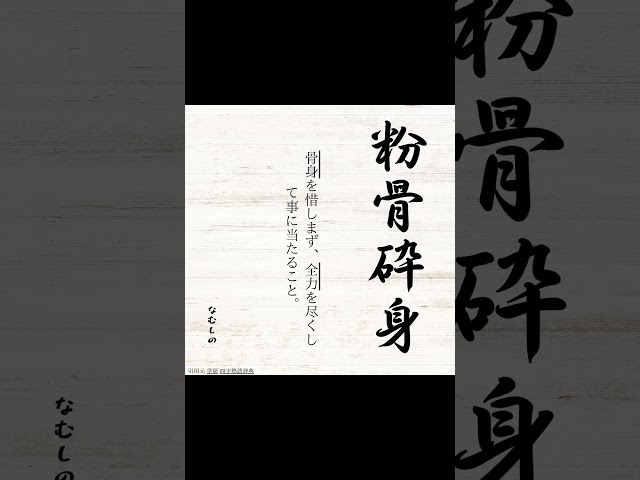
I feel it’s a phrase that expresses an attitude of giving your all.
It’s a very powerful expression, implying the resolve to work so hard you’d grind your bones to dust and exhaust yourself.
In everyday life—whether it’s work, studying, housework, or hobbies—there are moments when we’re tempted to cut corners, but remembering this phrase makes me feel like I can tell myself, “Let’s give it our best here.” It may sound exaggerated, but thinking that even small daily efforts and moments of focus connect to the spirit of this phrase is encouraging.
It’s a four-character idiom that reminds us of the importance of facing things wholeheartedly and gives us a push forward.

calm and composed

What were your reflections on last year? If asked that, everyone would probably recall various mistakes.
Among them, there may be experiences where you think, “If only I had stayed calm and taken my time, I wouldn’t have failed.” With that in mind, why not set your resolution this year as taizen-jijaku—a state of being calm and unshaken? Taizen-jijaku refers to maintaining a composed mind and never losing your cool.
If you can make taizen-jijaku your ally, you’ll be able to judge things calmly with a broad perspective, and your mistakes might decrease dramatically.

to cover the sky and the earth
From the idea of using the sky as a roof and the earth as a mat, this four-character idiom expresses broad-mindedness and lofty ambition.
It’s used as in, “He is a makuten-sekichi type of person, unbound by worldly conventions.” Its origin traces back to a phrase in Ode to the Virtue of Wine by Liu Ling, a thinker of the Jin dynasty: “幕天席地 縱意所如,” meaning to use the sky as a ceiling and the ground as a seat, living as one’s heart leads.
By the way, in English, it might be akin to “ambitious,” as in the phrase “Boys, be ambitious.”
majestic and dignified
This four-character idiom describes a dignified and imposing attitude or conduct.
“Ifu” refers to an aura of dignity and a forcefulness that overwhelms others, while “dōdō” means being unflinching, confident, and splendid.
It can describe people—“The victorious athlete cut an imposing and dignified figure”—as well as things, such as buildings—“The Western-style mansion was so grand and imposing that it overshadowed the other structures.” The phrase “Ifūdōdō” also brings to mind Elgar’s march “Pomp and Circumstance.” It’s a familiar tune, often used as background music in commercials.
firm principles

Shisō-kengo is read “shisō kengo” and seems to mean firmly upholding one’s own ideals, convictions, and code without ever changing them.
Even in the days when you’re striving toward the future you’ve chosen, your feelings may waver and your convictions may seem to falter.
But that’s exactly when you should recall your beliefs and keep the promises you’ve made to yourself as you move forward.
Writing this four-character idiom somewhere visible at home or in your office could serve as a switch to fire you up.
single-mindedly; with undivided focus

It’s a phrase that expresses the attitude of focusing on one thing and working without being swayed by your surroundings.
No matter what obstacles stand in your way, unwavering, strong concentration—like this phrase conveys—is essential to keep striving without giving up.
It proves especially powerful in situations that demand time and patience before results appear, such as studying, sports competitions, or important work.
When you’re shaken by noise or anxiety, holding this phrase close helps you set aside distractions and tackle the task at hand.
The foundation that supports an unyielding spirit lies in steady, unshakable focus.
When you want to keep moving straight ahead, this phrase will be a reliable force pushing you forward.

Four-character idioms that help you achieve goals! Useful expressions for everyday situations (21–30)
unite efforts with one heart
@kurukoba Four-character idioms translationWork together with united strength
♬ Original Song – Bird v🔍💙 – Hour of Four Ripe
This four-character idiom is especially recommended for those who play team sports or group competitions.
Rikuryoku kyōshin (戮力協心) means “to unite hearts and work together,” with everyone joining forces as one.
In sports, things don’t go well if only one person tries hard, right? It’s essential for everyone to share the same goal and keep in step.
Doing so multiplies your strength many times over.
Developing a sense of camaraderie brings teammates closer and helps you support each other emotionally, so take this opportunity to remember it.