

![[Four-Character Idioms] Impressive and Cool Sound! A Collection of Famous Quotes Worth Knowing as General Knowledge](https://i.ytimg.com/vi_webp/ypL5o2rOrUA/maxresdefault.webp)
[Four-Character Idioms] Impressive and Cool Sound! A Collection of Famous Quotes Worth Knowing as General Knowledge

“Lion-like valor,” “a match for a thousand,” “battle-hardened”…
There’s an undeniable coolness to four-character idioms, isn’t there? If you can use them well, your everyday conversations and writing will feel much tighter, and your intellectual appeal will rise.
What’s more, the world of these idioms is incredibly deep—from phrases everyone knows to rare ones that make you go ‘Wow!’ In this article, we’ll introduce stylish four-character idioms you can use in daily life.
It’s packed with expressions that shine not only in business settings but also on social media and in messages.
[Yojijukugo] Impressive sayings with a cool ring! A collection of famous quotes you should know as general knowledge (1–10)
lightning speed
https://www.tiktok.com/@hakatacraftcola0701/video/7472897101492440328It is a four-character idiom that describes extremely swift action and the briefness of such a moment, like a flash of lightning or the spark from flint.
The phrase comes from the fact that both a lightning flash and a flint spark are lights that vanish in an instant, and it also conveys the awe unique to natural phenomena.
If you understand how quick the originating phenomena are, you can clearly picture the speed expressed by this idiom.
It’s a term used to convey admiration when witnessing rapid movement, and it carries a sense of respect for transcendent ability.

Single-minded pursuit of truth
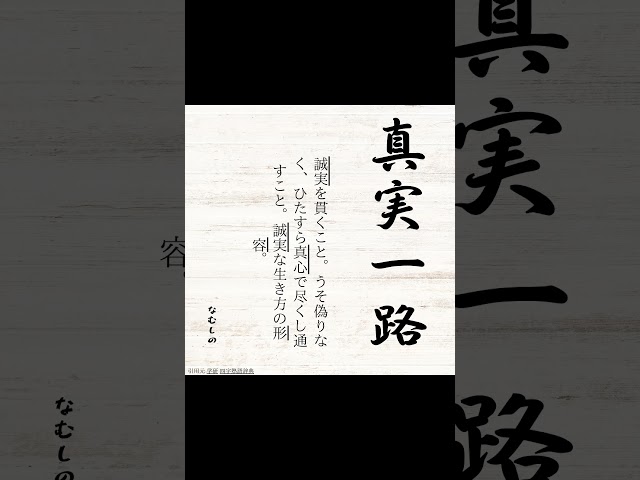
It’s a four-character idiom that conveys a straightforward mindset and attitude—believing only in the truth and seeing it through.
Yamamoto Yuzo’s novel “Shinjitsu Ichiro” (The Road of Truth) is also well known, and in that work the phrase appears as a key word expressing the characters’ stance.
The term not only communicates a will to advance toward the truth, but also evokes a pure heart that refuses to deceive itself and strives to live with integrity.
In the sense of staying true to one’s convictions, the word also clearly carries a sense of strength.
a match for a thousand
https://www.tiktok.com/@hakatacraftcola0701/video/7446191213650136328This four-character idiom expresses that a single mounted warrior is so strong he can take on a thousand enemies—someone possessing such exceptional ability.
Its prototype is the phrase “ichinin tōsen” (one person equal to a thousand) found in Chinese classics and Buddhist texts.
Adapted to fit Japanese samurai culture, it spread after appearing in the Taiheiki as “these are all soldiers who, each on one horse, are worth a thousand.” While it strongly evokes fighters, especially samurai who battle with strength, it’s also used more broadly to describe outstanding talent.
It’s often used with a sense of respect when witnessing someone’s abilities firsthand.
Single-minded focus spanning a vast distance
https://www.tiktok.com/@yoji_jukuko/video/7410414121776254215This is a four-character idiom that expresses the attitude of continuing to strive without losing sight of a single goal, even over a long journey.
“Banri” refers to a vast distance, and “ikkū” means a single sky, so it is also used in the sense that the world is connected.
The fact that it originates from Miyamoto Musashi’s The Book of Five Rings is another key point, and you can feel the persuasiveness precisely because these are the words of a swordsman remembered through the ages.
With the bright imagery of the sky, it gives the impression that the hardship of sustained effort is expressed in a positive light.
lion-like heroic effort; dauntless, furious valor (acting with extraordinary vigor)
https://www.tiktok.com/@hakatacraftcola0701/video/7486299289984027911This four-character idiom describes doing things with fierce, tremendous force, like the king of beasts—the lion—rousing itself with vigor.
It originates from Mahayana Buddhist sutras such as the Lotus Sutra and the Great Perfection of Wisdom Sutra, where it portrays how the Buddha, through passionate and dynamic preaching and action, overwhelmed his audience and non-Buddhists.
By likening it to an animal, it clearly conveys a powerful and courageous figure.
It is used to praise someone’s achievements or efforts, expressing respect.
power over life and death
https://www.tiktok.com/@hiroaki946/video/7376629959302925569This four-character idiom expresses having complete control: the power to keep someone alive or kill them, to grant things or rights or take them away—everything can be done at one’s discretion.
By pairing kill with life and take with give, it conveys that the choice between the two is entirely up to the person in control.
Because it describes a disadvantageous situation of being controlled, it is also used as a lesson advising not to leave such power to others.
Since it appears in the ancient Chinese work Xunzi, it is a saying that has long been passed down together with its moral lesson.
Blue sky beyond the clouds
https://www.tiktok.com/@az0202za/video/7324620137733049602This four-character idiom conveys hope that beyond overcoming difficulties lies a bright future and good things, inspired by the idea that blue skies spread beyond the clouds.
It is said to originate from a poem by the Chinese literatus Xie Fangde, “The crane pierces the clouds and ascends into the blue sky,” and has been passed down since ancient times.
It is the perfect phrase for moments when you face hardship and feel like giving up, giving you the courage to take a step toward hope.
By envisioning the blue sky beyond the clouds through this saying, it feels like you can face anything with a positive mindset.