

[Four-Character Idioms] Impressive and Cool Sound! A Collection of Famous Quotes Worth Knowing as General Knowledge

“Lion-like valor,” “a match for a thousand,” “battle-hardened”…
There’s an undeniable coolness to four-character idioms, isn’t there? If you can use them well, your everyday conversations and writing will feel much tighter, and your intellectual appeal will rise.
What’s more, the world of these idioms is incredibly deep—from phrases everyone knows to rare ones that make you go ‘Wow!’ In this article, we’ll introduce stylish four-character idioms you can use in daily life.
It’s packed with expressions that shine not only in business settings but also on social media and in messages.
- Amusing four-character idioms you’ll want to use right away! A collection of expressions to remember as general knowledge.
- Enrich your heart with beautiful four-character idioms! A collection of expressions you'll want to use in everyday life.
- General: Four-character idioms that encourage determination—powerful, heart-stirring words
- Become positive with four-character idioms that resonate with the heart! Common yet deeply meaningful words.
- Learn the meanings too! Cool four-character idioms that elementary school students will want to remember
- Four-character idioms that help you achieve goals! Phrases you can use in everyday situations
- [For Elementary Students] A Collection of Beautiful Four-Character Idioms to Know
- Interesting four-character idioms for elementary schoolers! Words you'll want to use once you understand their meanings
- Four-character idioms for New Year’s resolutions! A collection of motivational phrase ideas
- Intellectual beauty that shines! Stylish four-character idioms you can use in everyday situations
- Popular even among elementary school students! Stylish and easy-to-remember four-character idioms
- [Kakizome] Four-character idioms fit for the New Year: Introducing words that resonate with the heart and their meanings
- Boost your vocabulary with four-character idioms that include numbers! A collection of four-character idioms for elementary school students to learn.
Yojijukugo: Strikingly Cool Expressions! A Collection of Quotations Worth Knowing as General Knowledge (11–20)
daring and fearless
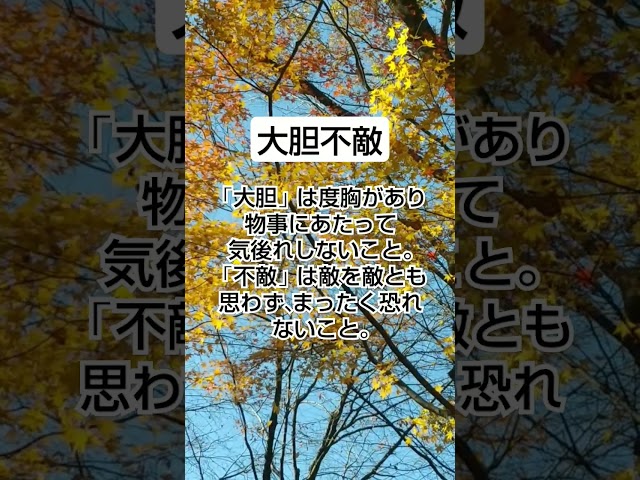
This is a four-character idiom used to describe a bold, fearless attitude and inner strength.
It’s used to praise someone with a big heart who isn’t intimidated and doesn’t even regard opponents as threats, but it can also be used mockingly to suggest recklessness that ignores risks.
It’s notable that the term originated in Japan, evoking the way of life of the samurai.
It’s a phrase that conveys respect for someone different from oneself—while also carrying a nuance that could verge on satire.

a carefree and comfortable life

Those of us living in the modern era are, often without realizing it, chased by the clock and buried in tasks, and before we know it the day is over—that’s the kind of busy life many of us lead.
Some may find that enjoyable, but surely there are also those who feel they want rest and more free time.
As a four-character idiom to set as a New Year’s resolution, I recommend yūyū-jiteki.
This phrase means living free of mental and physical stress, spending your time just as you wish.
How about writing this phrase in your first calligraphy of the year as a way to put a brake on your tendency to overwork?

Late bloomer

“Taiki-bansei” (literally, “a great vessel matures late”) is a four-character idiom meaning that even if talent or ability doesn’t show right away, it will grow over time and eventually blossom greatly.
If you adopt it as a New Year’s resolution, it helps you keep striving without rushing, even when results don’t come immediately.
Whether it’s studying, sports, art, or music—whatever you’re challenging yourself with—even if things don’t go well at first, daily efforts accumulate and lead to significant achievements in the future.
It’s a phrase that teaches the importance of continuing small efforts and ingenuity, fostering a mindset that enjoys your growth over the long run.
It’s a practical resolution that helps you stay aware of the value of developing your abilities from a long-term perspective.

profound and vast

It’s a highly refined four-character idiom that simultaneously conveys the depth and breadth of thought, scholarship, and the spiritual realm.
Rather than superficial knowledge, it communicates deeply probed reflection and an embracing expansiveness that knows no bounds.
It’s also an apt expression for evaluating a person’s way of thinking or philosophy, as well as a long-cultivated attitude toward inquiry, and it lends intellectual gravity when used in writing.
It suits situations where you want to express grandeur in terms of quality rather than quantity, and I felt it is a word that, though quiet, leaves a strong impression.

majestic and grand

A grand and splendid scale is expressed by the four-character idiom “yūdai-gōsō.” It’s read as “yūdai gōsō.” Yūdai conveys something majestically large, while gōsō describes something big and magnificent.
This term is used not only for structures like castles but also for people who live unbounded, unconventional lives.
If you don’t want to stay small and instead wish to become greater and more impressive, try projecting this idiom onto your future self.
By striving to approach yūdai-gōsō, you may find yourself moving forward a bit more proactively than usual.
boundless and vast

Four-character idioms that signify grandeur have the power to greatly expand our imagination through the sheer sense of scale embedded in the words themselves.
This particular term describes something boundlessly vast, with no end in sight, and has been used not only for natural landscapes but also when discussing ideas and character.
It is invaluable for expressing the expanse of the sky or sea, of course, but also for conveying breadth of perspective and largeness of heart.
Simply adding this term communicates depth of thought, inclusiveness, and magnanimity—that’s its appeal.
In contrast to its brevity, its meaning extends without limit.
It is, truly, a single word that leaves an impression as an emblem of grandeur.
[Four-Character Idioms] Strikingly Cool-Sounding! A Collection of Quotations You Should Know as General Knowledge (21–30)
to uproot mountains and cover the world (i.e., possessing overwhelming, world-shaking power or momentum)

This phrase is a four-character idiom whose overwhelming force comes across just by hearing it.
It means “to have the power to uproot mountains and cover the world,” and is used mainly to describe extraordinary martial strength or talent, or the grand scale of a heroic figure.
Originating in Chinese classics, it characteristically exaggerates abilities and presence far beyond those of ordinary people.
The characters themselves feel bold, evoking an image that layers the vastness of nature with human might.
Used in character appraisals or narrative descriptions, it creates a majestic atmosphere and powerfully stimulates the reader’s imagination.
Truly, it is a four-character idiom befitting the discussion of great capacity and an overwhelming presence.