


Intellectual beauty that shines! Stylish four-character idioms you can use in everyday situations

Yojijukugo are a linguistic art form that distills the beauty and depth of the Japanese language.
They’re popular as stylish calligraphy pieces and interior decor, and using them casually in everyday conversation can create an intellectual impression.
However, if you don’t know their correct meanings or usage, you might end up embarrassed.
So this time, we’ll introduce a world of chic yojijukugo that you can easily incorporate.
Why not enjoy discovering lovely expressions that add richer color to your daily life?
Intellectual beauty that shines! Stylish four-character idioms you can use generally (1–10)
Ephemeral as a bubble; an illusion like a dream

This four-character idiom originates from the final passage of the Buddhist Diamond Sutra and refers to things that, like dreams, illusions, bubbles, or shadows, lack substance and vanish quickly.
Taken paradoxically, it also carries the meaning that precisely because of this, we should live the present moment to the fullest.
Nothing about human beings—or anything else—is infinite, but this expression teaches the importance of making each fleeting moment fulfilling.
It may be worthwhile to reflect deeply on why we live and where we are headed.

a clear and serene mind
https://www.tiktok.com/@kurukoba/video/7389565189189815560This four-character idiom describes a mirror without the slightest cloudiness and a water surface that is still and unshaken by wind or current; it also expresses that state of mind.
The phrase comes from the Chinese philosophical work Zhuangzi as a classical anecdote: the “bright mirror” suggests that if you harbor prejudice or arrogance, the mirror of your heart becomes clouded, while the “still water” implies that a person with a calm, water-like heart naturally draws others around them.
Reaching such a state of mind would be ideal—and pretty cool, wouldn’t it?
cherry, plum, peach, and apricot (each flower/thing has its own unique beauty)
https://www.tiktok.com/@yoji_jukuko/video/7410061341974744338This four-character idiom, originating from China and infused with Buddhist teachings, goes as follows.
Cherry, plum, peach, and apricot blossoms may look similar, but each blooms in its own way.
Some are admired for their flowers, others valued for their fruit—each possesses a distinct character.
The phrase encourages you to make the most of your own nature and keep blooming in a way that suits you.
There is no single standard for values or beauty.
Noticing your strengths early and nurturing them may be essential.
A blaze of fireworks and silver blossoms

Here is a four-character idiom that originates from a poem composed by the Tang dynasty poet Su Weidao.
The poem depicts the fireworks and city lights shining on the night of the Lantern Festival, and today the idiom is used to describe city nightscapes, among other things.
It has even been used as the title of projection mapping shows.
Seeing this idiom, you can almost picture the scene from the characters alone.
It’s one of the most beautiful four-character idioms, so why not learn it and try using it when the opportunity arises?
A hundred flowers in full bloom
https://www.tiktok.com/@hiroaki946/video/7381834339350236436Here is a four-character idiom that expresses the image of many flowers blooming in profusion.
Its meaning has expanded to describe situations where numerous talented people or works appear all at once, or to liken a gathering of many beautifully dressed individuals.
It conveys a very lavish and luxurious feeling, doesn’t it? Ryōran is a difficult word, but it means things intermingling or flowers blooming riotously.
特に、「繚(りょう)」という文字は、この文脈以外ではめったに目にしません。
A similar four-character idiom is senshi bankō (千紫万紅).
Try using it yourself!
The beauties of nature — flowers, birds, wind, and the moon (a poetic expression appreciating nature’s elegance)
https://www.tiktok.com/@hiroaki946/video/7382198410473901313This four-character idiom refers to the beauty of nature—like flowers, birds, wind, and the moon.
It appears in The Transmission of the Flower Through Form and Style (Fūshi Kaden), a Noh treatise written by Zeami, famed for Noh theater, in the phrase: “As for the proverb of flowers, birds, wind, and moon, one must imitate it most minutely.” Another way to interpret this idiom is that as people grow older, they come to appreciate, in turn, flowers, then birds, then wind, and finally the moon.
It’s certainly an intriguing reading, isn’t it?
Fallen blossoms carried by flowing water
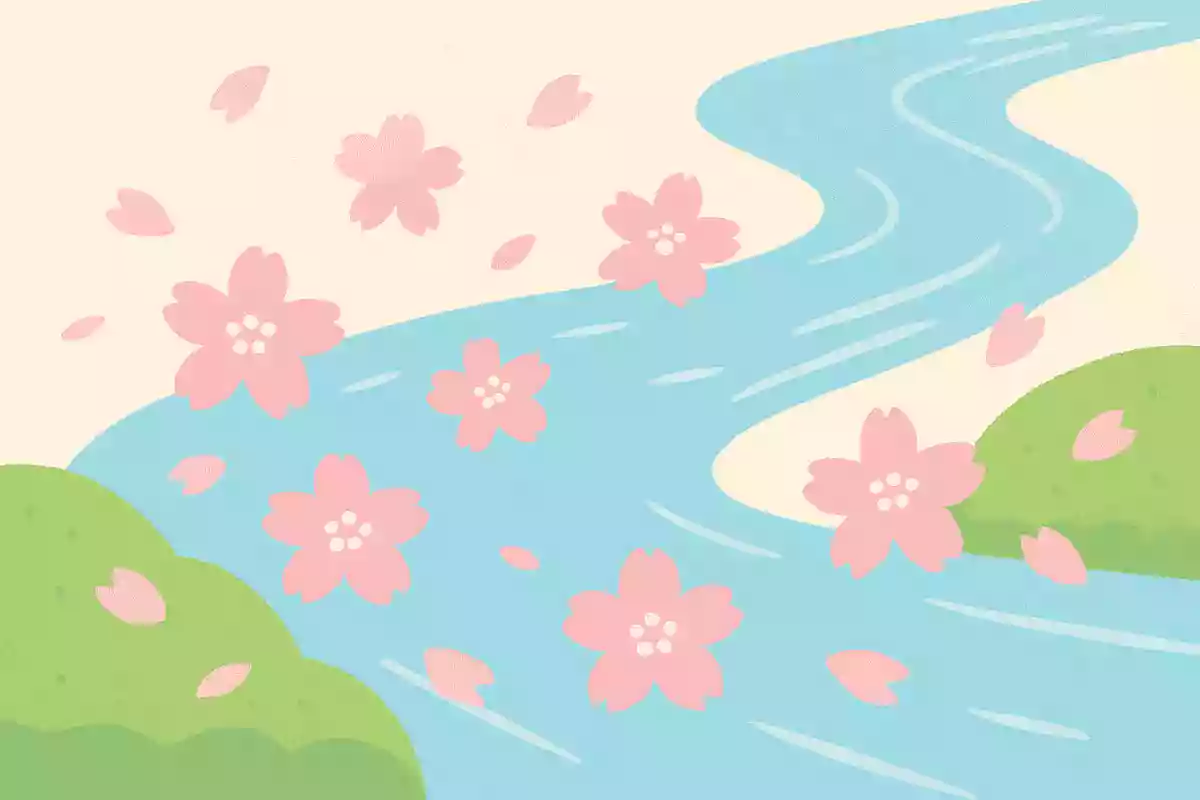
This four-character idiom comes from a poem by the Chinese poet Gao Pian.
It carries two meanings: the first expresses the merciless passage of time and the decline of things, captured in the image of blossoms falling and being carried away by the water.
The second, a slightly more nuanced interpretation, suggests that the fallen blossoms wish to be carried by the water, and the water, in turn, wishes to carry the blossoms—symbolizing mutual understanding and reciprocated love.
It’s interesting that this latter meaning is the one more commonly used.