

Intellectual beauty that shines! Stylish four-character idioms you can use in everyday situations

Yojijukugo are a linguistic art form that distills the beauty and depth of the Japanese language.
They’re popular as stylish calligraphy pieces and interior decor, and using them casually in everyday conversation can create an intellectual impression.
However, if you don’t know their correct meanings or usage, you might end up embarrassed.
So this time, we’ll introduce a world of chic yojijukugo that you can easily incorporate.
Why not enjoy discovering lovely expressions that add richer color to your daily life?
- Enrich your heart with beautiful four-character idioms! A collection of expressions you'll want to use in everyday life.
- Become positive with four-character idioms that resonate with the heart! Common yet deeply meaningful words.
- [Four-Character Idioms] Impressive and Cool Sound! A Collection of Famous Quotes Worth Knowing as General Knowledge
- Amusing four-character idioms you’ll want to use right away! A collection of expressions to remember as general knowledge.
- Popular even among elementary school students! Stylish and easy-to-remember four-character idioms
- [For Elementary Students] A Collection of Beautiful Four-Character Idioms to Know
- Learn the meanings too! Cool four-character idioms that elementary school students will want to remember
- Interesting four-character idioms for elementary schoolers! Words you'll want to use once you understand their meanings
- General: Four-character idioms that encourage determination—powerful, heart-stirring words
- Four-character idioms that help you achieve goals! Phrases you can use in everyday situations
- Surprisingly tricky! Check your general knowledge with a four-character idiom quiz
- [Kakizome] Four-character idioms fit for the New Year: Introducing words that resonate with the heart and their meanings
- Easy-to-remember, positive four-character idioms for elementary school kids! Words that brighten the heart
Intellectual beauty that shines! Stylish four-character idioms you can use generally (71–80)
Excellence in both academics and sports

A four-character idiom that means “Let’s work hard at both studying and sports!” It says that it’s important to study properly at school while also playing energetically with friends and getting exercise.
For example, if you memorize kanji and read books every day while also enjoying soccer or basketball, both your mind and body will grow stronger.
By aiming for bunbu ryōdō—excellence in both the literary and the martial—you can grow in a balanced way, both mentally and physically, and your everyday life will become more fun.
Even as an adult, valuing both your job and your hobbies follows the same idea of bunbu ryōdō.
Try living each day in a cool, well-balanced way with bunbu ryōdō!

work in the fields on sunny days, read books on rainy days

It’s a four-character idiom that describes a lovely way of life: working in the fields on sunny days and reading books at home on rainy days.
It carries the meaning of living in harmony with nature while taking good care of both body and mind.
For example, you might use it like this: “Since the weather is nice today, let’s play in the garden, and if it rains, let’s read books at home.” A seikō-udoku lifestyle—‘plowing in fair weather, reading in rainy weather’—offers a hint for enjoying each day at a relaxed pace.
It’s a phrase that helps both children and adults cherish comfortable moments.
Even when you’re busy, try being active outdoors on sunny days and taking it slow with some reading on rainy days to refresh yourself.
Queen of the Night
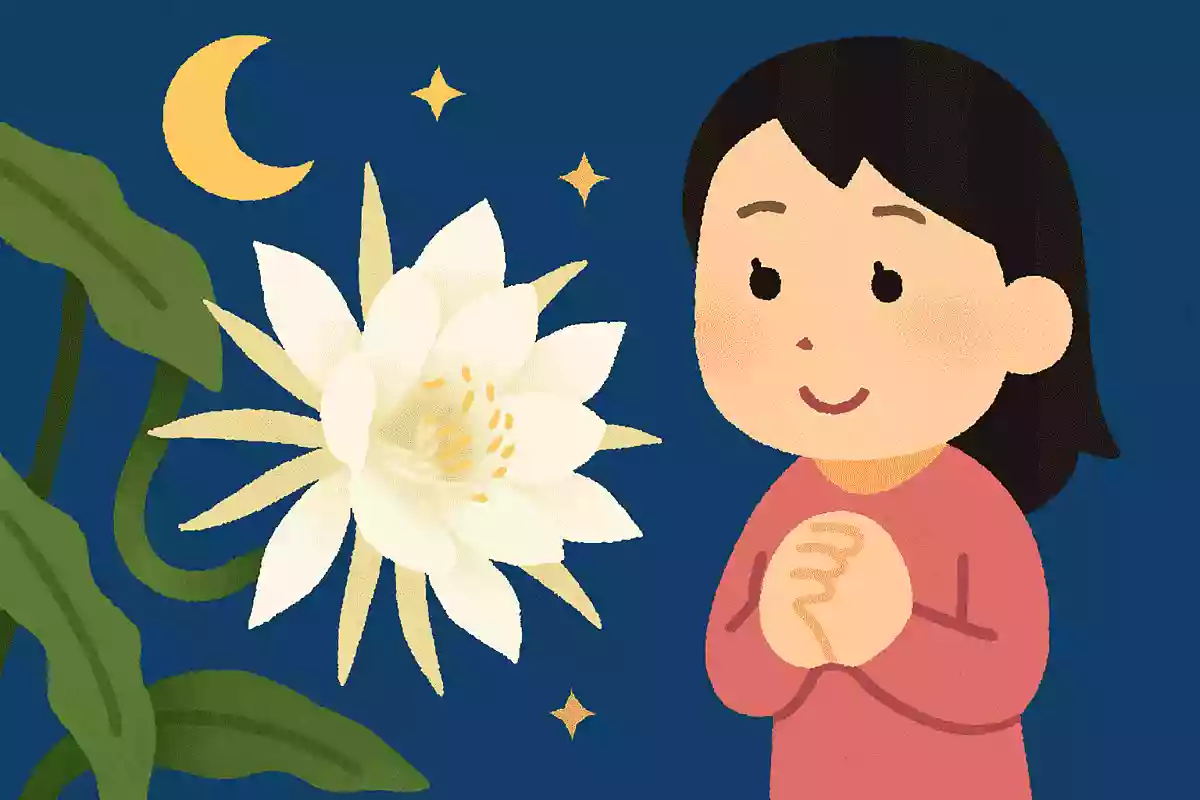
Gekka-bijin is the name of a flower, also affectionately known by the alternative name “Night Queen,” a type famed for blooming only at night.
The way it quietly displays its beauty while people are fast asleep makes it seem as if it deliberately conceals its own charm.
Another point is that its beauty has spawned various folk tales, suggesting that it has long been cherished as a special flower.
Strictly speaking, it’s not a four-character idiom but simply a name; still, as a cool four-character word, it comes highly recommended.

Say what you mean, do what you say.

It’s a four-character idiom meaning “to firmly carry out what you say.” For example, if you say, “I’ll study every day starting tomorrow!” then actually continuing to study every day is yūgen-jikkō (literally, ‘spoken words, carried out’).
Instead of stopping at just talk, seeing things through once you decide to do them builds your confidence.
For instance, if you tell everyone before a soccer match, “I’m going to score a goal!” and you really do score, that’s super cool and feels great, right? Even with small things, if you start with what you can do and act responsibly according to your words, people around you will trust you more.
Starting today, try aiming for ‘yūgen-jikkō’!
Future-oriented
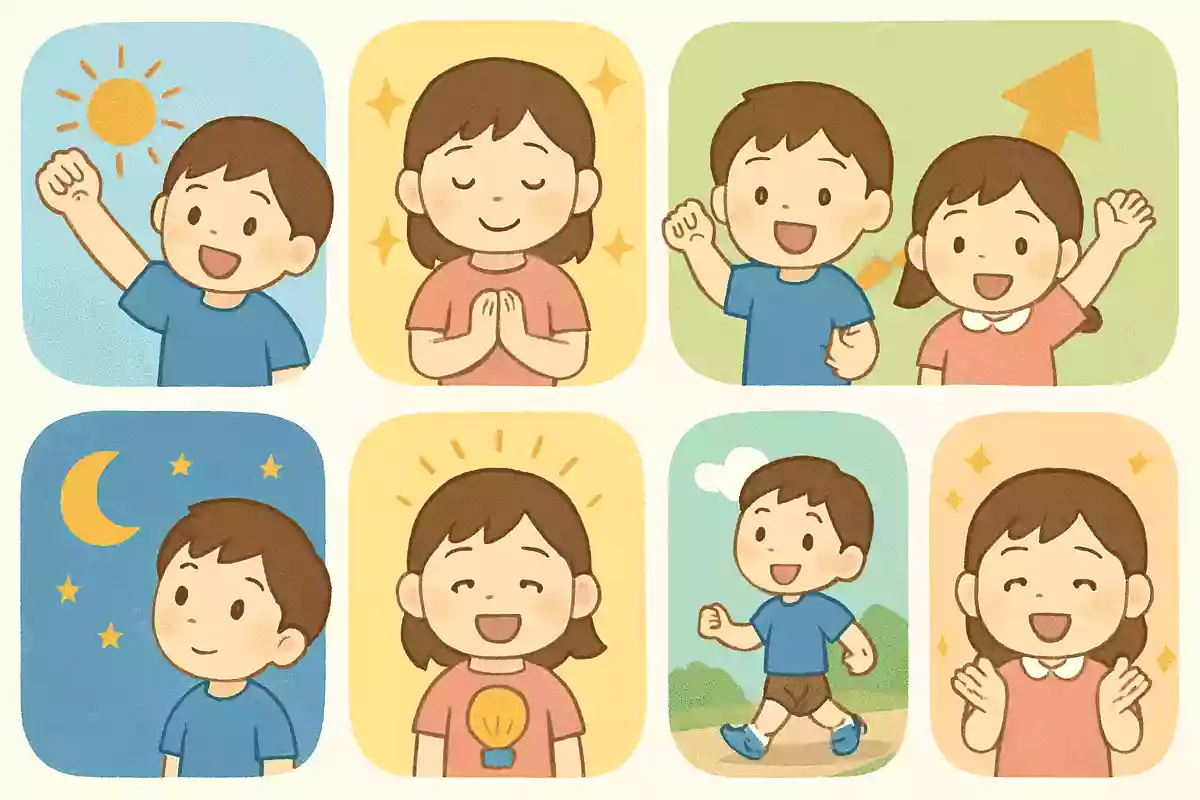
It means “thinking positively about what lies ahead and aiming for a better future.” For example, even if you make mistakes on a test, thinking “I’ll do my best next time!” is future-oriented thinking.
Instead of dwelling on past failures or unpleasant experiences, it’s important to ask yourself, “How can I make things better?” The feeling of “I can’t swim yet, but if I practice every day, I’ll be able to someday!” is also future-oriented.
When both adults and children adopt a future-oriented mindset, their spirits lift and their actions become more positive.
The future is something we create from now on.
That’s why it’s important to focus on what you can do and what you want to do, and enjoy each and every day!
flowery rhetoric

They’re “beautiful words” and “lovely turns of phrase.” For example, things like “You look super cool!” or “That picture is like a dream!”—words that feel nice to hear.
Using flowery expressions makes your speech and writing more enjoyable and really resonates with the listener.
“Your smile shines like the sun!” is another example.
When you use words with care, you can make others happy and lift their spirits.
Try using lots of kind, beautiful words at school and at home that will make others smile!
sincerity

It means “to work with all your heart, sincerely and earnestly.” For example, when a friend is in trouble, helping them honestly and wholeheartedly is an act of ‘seishin seii.’ Remembering this phrase can brighten your mood, because when you are sincere, the people around you smile and trust grows.
If you study for a test with ‘seishin seii,’ you’ll gain confidence and feel happy.
Both children and adults should cherish this phrase and spend each day energetically and joyfully!