

Intellectual beauty that shines! Stylish four-character idioms you can use in everyday situations

Yojijukugo are a linguistic art form that distills the beauty and depth of the Japanese language.
They’re popular as stylish calligraphy pieces and interior decor, and using them casually in everyday conversation can create an intellectual impression.
However, if you don’t know their correct meanings or usage, you might end up embarrassed.
So this time, we’ll introduce a world of chic yojijukugo that you can easily incorporate.
Why not enjoy discovering lovely expressions that add richer color to your daily life?
- Enrich your heart with beautiful four-character idioms! A collection of expressions you'll want to use in everyday life.
- Become positive with four-character idioms that resonate with the heart! Common yet deeply meaningful words.
- [Four-Character Idioms] Impressive and Cool Sound! A Collection of Famous Quotes Worth Knowing as General Knowledge
- Amusing four-character idioms you’ll want to use right away! A collection of expressions to remember as general knowledge.
- Popular even among elementary school students! Stylish and easy-to-remember four-character idioms
- [For Elementary Students] A Collection of Beautiful Four-Character Idioms to Know
- Learn the meanings too! Cool four-character idioms that elementary school students will want to remember
- Interesting four-character idioms for elementary schoolers! Words you'll want to use once you understand their meanings
- General: Four-character idioms that encourage determination—powerful, heart-stirring words
- Four-character idioms that help you achieve goals! Phrases you can use in everyday situations
- Surprisingly tricky! Check your general knowledge with a four-character idiom quiz
- [Kakizome] Four-character idioms fit for the New Year: Introducing words that resonate with the heart and their meanings
- Easy-to-remember, positive four-character idioms for elementary school kids! Words that brighten the heart
Intellectual beauty shines! Stylish four-character idioms you can use generally (21–30)
a match for a thousand

Ikki refers to a single mounted warrior, and tōsen literally means “equivalent to a thousand people.” Combined, the four-character idiom ikkitosen describes a person so strong—or so exceptionally skilled and experienced—that they could fight a thousand enemies alone.
While it was originally used mainly in the context of martial arts and combat prowess, today it refers to someone with outstanding ability in a particular field.
It appears the phrase was once read as ikkitozen, but in modern usage ikkitosen has become standard.

telepathy; tacit understanding (literally: ‘heart-to-heart communication’)

Communicating solely through the heart is called “ishin-denshin.” Normally, when we convey something to someone, we use spoken or written words.
But there are times when it’s hard to express things in words.
In such moments, it’s nice to have someone who can pick up on how you feel.
With a close friend, you may sometimes understand each other without putting your feelings into words.
Someone you can share ishin-denshin with is likely a person who always pays close attention to you and understands you deeply.

Harmony and united cooperation
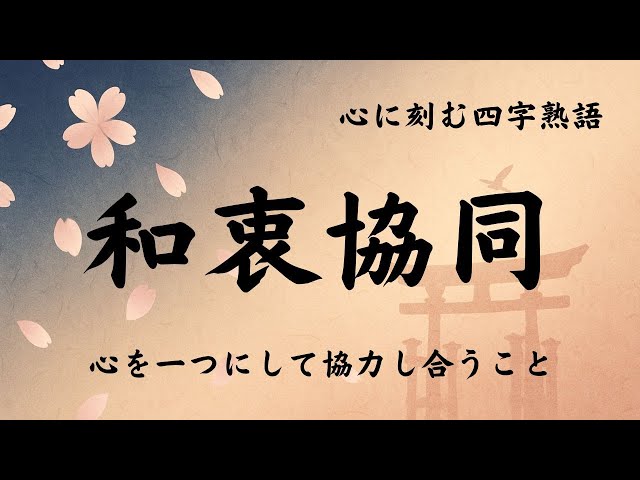
This four-character idiom expresses joining hearts as one, cooperating, and tackling things together.
Setting it as a class goal makes it easier for students to be mindful of kindness and a cooperative attitude toward their friends.
When everyone faces the same direction and acts together during group activities or choir practice, better results follow.
It isn’t enough for just one person to work hard; when everyone contributes their strength, a sense of unity grows throughout the class.
The experience of respecting and helping one another becomes an important ability that remains useful even as students move up a grade.
It’s a warm expression that helps students feel the joy of cooperation.

Dripping water wears through stone
@az0202za Dripping water wears through stone. #Tenteki Senseki #Four-character idiom #Learning
♬ Original Song – 0202civo – az0202za
Perfect as a personal motto, “ten-teki-sen-seki” (literally, “dripping water pierces stone”) expresses the idea that even tiny drops of water, if they fall continuously on one spot, can bore a hole through hard rock.
In the same way, small efforts, steadily accumulated, can lead to great achievements and results.
Continuing to strive until you reach your goals is difficult, but with the mindset that daily, modest efforts will one day bear fruit and blossom, we can keep at it.
This four-character idiom teaches the importance of perseverance.
A swift wind reveals sturdy grass.

Shippū Keisō (“gale and sturdy grass”) evokes grass that stands straight even when battered by strong winds.
From the idea that only when fierce winds blow can we tell which grasses will not break, this four-character idiom expresses that a person’s true strength and worth are revealed precisely in times of adversity or misfortune.
It can be used in sentences like, “It was a painful and difficult experience, but I’m glad I could learn, through shippū keisō, who my truly trustworthy friends are.” With its beautiful sound and thoughtful meaning, why not try using shippū keisō in conversation?
purple trunk, green leaves

The four-character idiom “shikan suiō” (紫幹翠葉), which conjures up purple trunks and emerald-green leaves, describes trees thriving in nature whose trunks gleam with a purplish hue in the sunlight and whose sunlit leaves appear vividly green and beautiful.
Even if “purple” trunks and “emerald” leaves don’t immediately resonate, these two colors symbolize nobility and freshness.
Shikan suiō expresses the untouched beauty of nature and conveys gratitude for its blessings, and it is often used in fields such as art.
Scattered blossoms, fallen leaves

The flowers that bloom in full glory in spring will eventually be scattered by the wind, and their leaves will wither and fall from the branches.
Life is like those flowers—ever fleeting and constantly changing.
The four-character idiom “hika rakuyō” (flying blossoms, falling leaves) expresses this impermanence of the world.
Everything we take for granted is transient; nothing lasts forever.
Because things are always changing, it seems to teach us to cherish each moment as it comes.
In this world of flying blossoms and falling leaves, we don’t know what tomorrow will bring.
All the more reason to treasure each day and live joyfully.