

Amusing four-character idioms you’ll want to use right away! A collection of expressions to remember as general knowledge.
Do you know any interesting four-character idioms? From common ones that are surprisingly useful in everyday conversation to rare expressions that might make someone ask, “What does that mean?”, there’s a truly fascinating world to explore.
We’ll introduce four-character idioms that will make you chuckle, make you think “I see!”, and make you want to start using them today.
Slip them into daily chats or on social media, and your cultural literacy is sure to get a boost! Please enjoy the profound world of four-character idioms.
Amusing four-character idioms you'll want to use right away! A collection of expressions to remember as basic common knowledge (1–10)
unprecedented and unrepeatable
https://www.tiktok.com/@mainiti4jizyukugo/video/7335784317840379156This four-character idiom expresses something extremely rare, the kind of thing that hardly ever happens.
Many people may recognize it from the phrase comedian Sunshine Ikezaki often uses when introducing himself.
The first half, “空前” (kūzen), means something that has never happened before, and the second half, “絶後” (zetsugo), suggests that it will likely never happen again.
Praising a world-stunning invention or a record-breaking achievement with this expression conveys just how extraordinary the feat is.

Three in the morning, four in the evening
https://www.tiktok.com/@rincoshorts1/video/7067478668871765249This expression describes a state where, even though the outcome is the same either way, one is so fixated on the conditions presented in front of them that they fail to notice the equivalence.
Its origin lies with a man named Ju Gong of Song, who kept monkeys.
When he said he would give them three nuts in the morning and four in the evening, the monkeys got angry, thinking it was too few.
Later, when he said he would give them four in the morning and three in the evening, the monkeys were delighted—even though the total for the day was the same.
From this comes the four-character idiom.
It shows how, although a little thought would reveal that both are the same, people can be easily deceived when the more favorable condition is presented first.
Beauty that shames fish and geese (an idiom describing an extraordinarily beautiful woman)
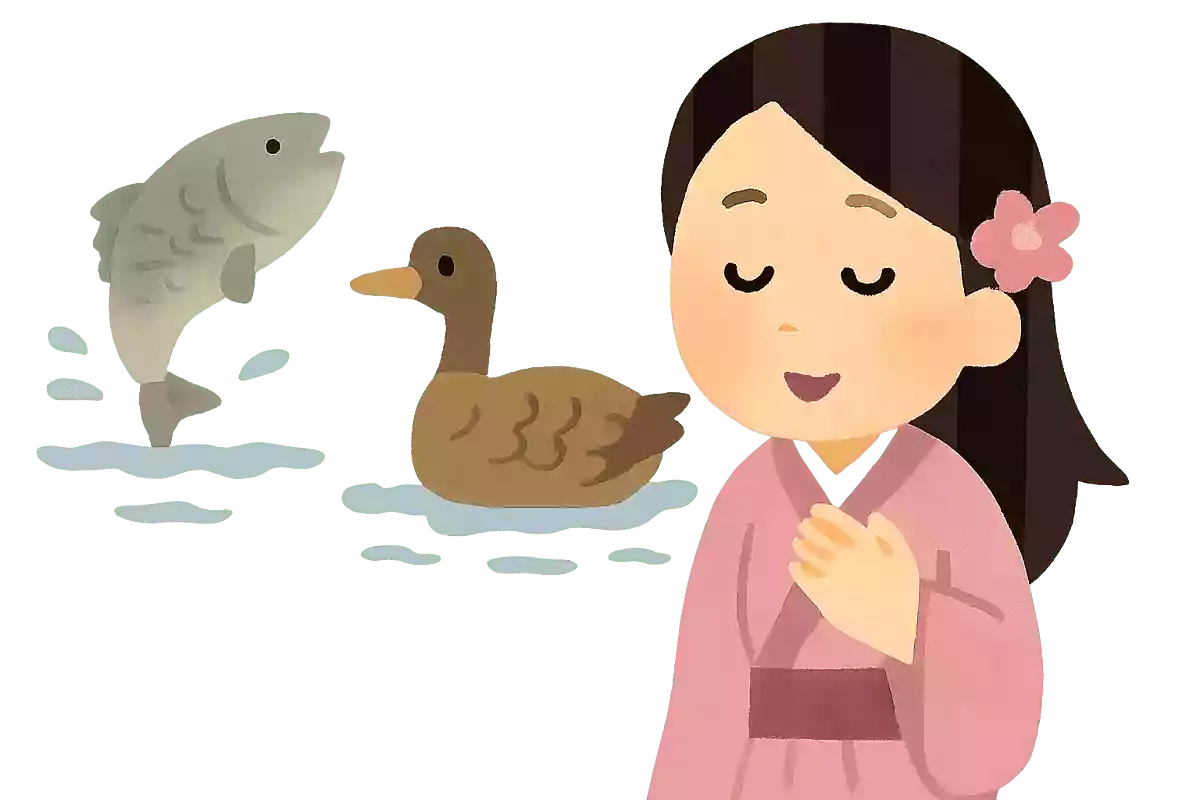
This expression has a curious arrangement of kanji and a distinctive feel that you don’t often encounter in everyday life.
It’s a four-character idiom that describes an exceptionally beautiful woman, and it’s striking that it doesn’t use direct characters like “beauty” (美).
As the kanji sequence suggests, it conveys that the woman is so beautiful that fish, embarrassed, sink to the bottom to hide, and wild geese are so captivated by her beauty that they fall from the sky.
Originally, the phrase meant that even if a woman appears very beautiful to humans, to animals humans are nothing but frightening beings.
Later, it came to describe a woman whose beauty captivates both people and animals.
like the east wind to a horse (an admonition goes unheeded; words fall on deaf ears)
https://www.tiktok.com/@kurukoba/video/7389007452898921736It’s read as “baji tōfū.” You can tell that the first part means “horse’s ear,” but you might wonder, “What is ‘east wind’?” In fact, “east wind” refers to the spring breeze.
Even when a pleasant spring wind brushes a horse’s ear, a horse that knows nothing of wabi-sabi feels nothing.
From this, the expression came to mean “to ignore other people’s opinions or advice and let them go in one ear and out the other.” It’s similar in meaning to phrases like “driving a nail into rice bran” and “Buddhist sutras to a horse’s ear” (i.e., “casting pearls before swine”).
Although it sounds lighthearted, it generally carries a negative connotation, so be careful when using it.
running around in confusion
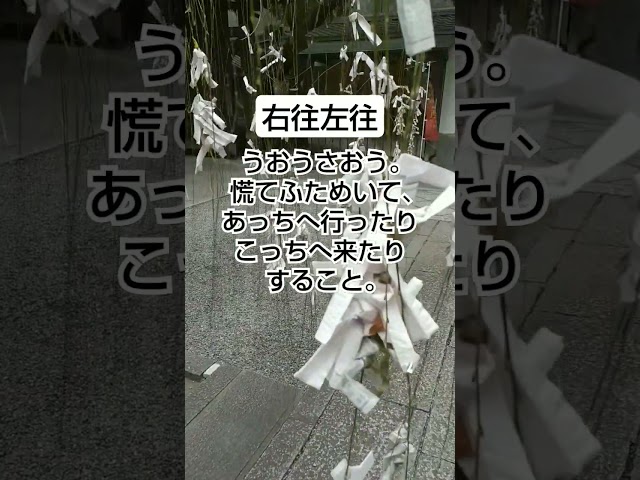
It’s a phrase often used when someone is lost or panicking.
普段は四字熟語を使わない人でも、これは取り入れやすいので、日常会話で使ってみてはいかがでしょうか。「右往左往」は「うおうさおう」と読み、字の「往」は「行く」という意味です。右へ左へと行き先も定まらずにうろたえる、つまり「混乱して右往左往する」という意味になります。例:『初めての場所だったので、着くまで右往左往してしまった』や『途中で予定が変更になったので、その後は右往左往だった』。
endless stream of eccentric ideas and innovations
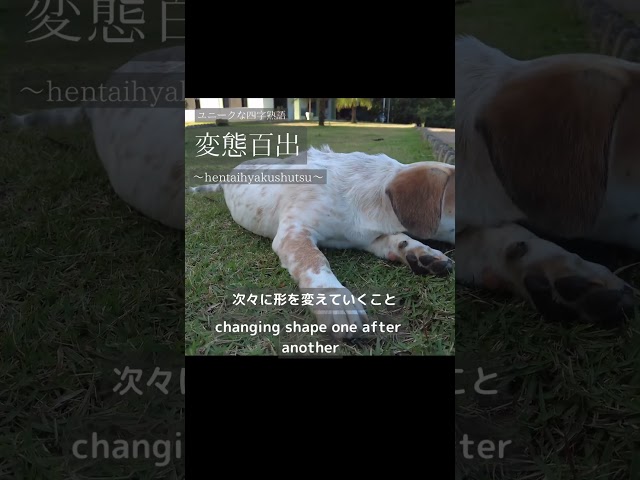
Introducing a slightly unusual four-character idiom that includes the word “hentai”: it’s read as hentaihyakushutsu and means “to take on many different forms or appearances.” Still, the characters for “hentai” can feel so intense that you might hesitate over how to use it.
For example, even with a slightly adapted sense, you can use it positively to reduce any awkwardness: “That actor effortlessly handles any role—he’s truly hentaih yakushutsu.” The image is similar to ‘ever-changing’ or ‘infinitely adaptable,’ so feel free to use it alongside hengenzizai (hengēn-jizai, ‘protean’) when in doubt!
bizarre and mysterious
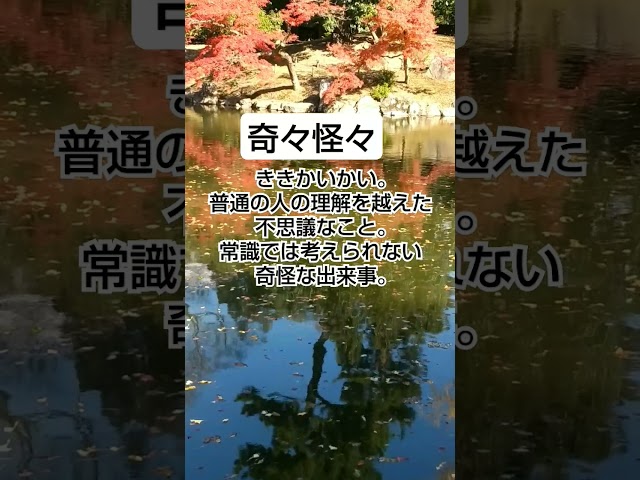
It can also be written using the repetition symbol as “奇々怪々.”
Of course, it’s read “kiki-kaikai.” Since it combines the characters for “strange” (奇) and “mysterious/monstrous” (怪), even the written form gives a scary impression.
It’s a four-character idiom used to refer to things beyond human understanding and mysterious phenomena that cannot be explained by common sense.
Many of the stories told as summer ghost tales are described as “kikikaikai,” aren’t they? Like how a human-shaped stain that was on the wall until yesterday suddenly disappeared… You probably have at least one or two kikikaikai happenings around you too!